
Waterbury Water Main Break: What Retail Investors and Financially Curious Readers Should Know


 Aime Summary
A major water main break in Waterbury, Connecticut, has left over 100,000 residents without reliable water access. The rupture, which occurred on December 13, 2025, caused road closures, school shutdowns, and a citywide boil water advisory. With the Connecticut National Guard mobilized to assist in water distribution and state officials coordinating emergency repairs, this event has sparked broader questions about aging infrastructure and local governance. For retail investors and financially curious readers, it’s a window into the hidden costs of neglecting critical public systems and the ripple effects of such failures on communities and economies.
The Core Event — What Happened and How Big Was the Impact?
A 36-inch transmission water main ruptured on Thomaston Avenue in Waterbury, CT, on Friday, December 13, 2025, triggering a chain reaction that left the city and surrounding towns of Wolcott, Watertown, and Prospect without pressurized water. The break caused a complete system-wide outage with water pressure dropping to near zero, leaving residents relying on stored water and emergency supplies. Schools were closed for the day and restaurants were forced to shut down due to the boil water advisory. 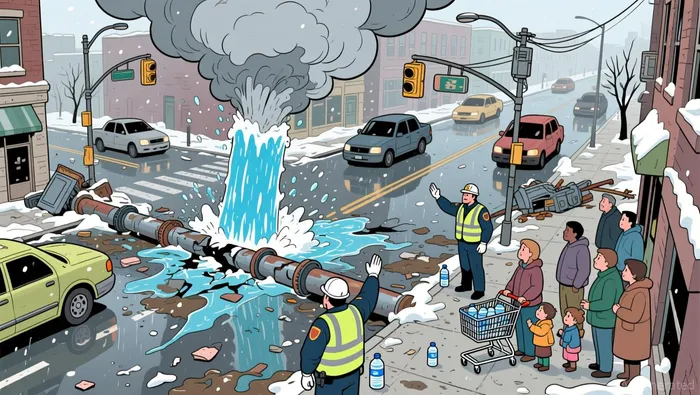 Local hospitals were among the hardest hit, with some having to rely on water tankers to maintain essential operations. The National Guard and municipal crews worked overnight to distribute bottled water and set up temporary supply lines, but full restoration of water service is expected to take several days. The incident also occurred near the site of a previous break in October, compounding concerns about structural integrity of Waterbury's water infrastructure.
Infrastructure and Governance — Why This Crisis Is More Than Just a Pipe Problem
At its core, the Waterbury water main break is a symptom of broader infrastructure challenges across the U.S. The 36-inch pipe, part of a critical transmission system, was already under stress from age and prior damage. Waterbury Fire Chief Javier Lopez and Mayor Paul K. Pernerewski noted that the prior 12-inch main break may have contributed to the collapse of the larger pipe. These failures highlight a pattern seen in many older cities—where water and sewer systems, built in the mid-20th century or earlier, are now reaching the end of their useful lifetimes.
The incident also raises questions about municipal budgeting and infrastructure spending. Waterbury, like many mid-sized cities, has long grappled with the cost of maintaining public utilities. In December 2018, the city even sued neighboring Watertown over $291,136.91 in unpaid water bills—revealing the financial strains often hidden behind water and sewer services. Meanwhile, state and local governments are increasingly stepping in with grant funding, such as the $500,000 grant given to Watertown for sanitary sewer improvements. But such funding is often reactive and piecemeal, rather than part of a comprehensive plan to modernize infrastructure.
What It Means for Local and Regional Markets
For investors, the Waterbury crisis underscores a growing risk in the U.S. economy: the financial burden of aging infrastructure. Cities and towns that rely on outdated water and sewer systems may face increased emergency costs, slower economic activity, and a loss of business appeal. For instance, Waterbury's road closures and business disruptions have already affected local commerce. While this may seem localized, similar events in other cities could trigger broader economic ripple effects, especially in states where infrastructure is already strained. From a governance perspective, the response to the water main break has highlighted the need for coordination between city, state, and federal agencies. Connecticut Governor Ned Lamont has been actively involved, showing the state's willingness to deploy resources in times of crisis. But as these events become more frequent—whether due to aging infrastructure or climate-related stressors—governments will face growing pressure to fund infrastructure upgrades in a more proactive manner.
Looking Ahead — Lessons for Investors and the Path to Recovery
Waterbury's water crisis, while dire, is a rare opportunity for the city to reassess its infrastructure strategy. Officials have already announced plans to replace the damaged pipe and invest in long-term upgrades, including new valves and improved monitoring systems. These steps, while necessary, will require significant capital—funds that may come from state grants, public-private partnerships, or even local tax increases.
For investors, the Waterbury situation is a reminder that infrastructure is not just a technical issue but a financial one. Municipal bonds, utility stocks, and infrastructure funds could see increased volatility in regions with aging systems. Similarly, investors in construction and engineering firms may benefit from the growing demand for infrastructure repairs and modernization.
In the short term, Waterbury residents and businesses will need to navigate a period of uncertainty. But for the rest of us, the event is a powerful example of how interconnected our systems are—and how fragile they can be when we neglect them.

Delivering real-time insights and analysis on emerging financial trends and market movements.
Latest Articles
Stay ahead of the market.
Get curated U.S. market news, insights and key dates delivered to your inbox.


AInvest
PRO
AInvest
PRO



Comments
No comments yet