
Waste Management's Strategic Growth and Shareholder Return Catalysts in 2026


 Aime Summary
Waste Management, Inc. (WM) has positioned itself as a leader in the waste and recycling sector through a combination of strategic acquisitions, sustainability-driven innovation, and disciplined capital allocation. As the company enters 2026, its focus on integrating the Stericycle acquisition, expanding renewable energy initiatives, and enhancing shareholder returns will be critical to evaluating its long-term value creation potential. However, integration risks and macroeconomic headwinds remain key challenges that investors must assess.
Strategic Acquisitions and Integration Progress
WM's $7.2 billion acquisition of Stericycle in 2024 marked a pivotal expansion into healthcare waste and secure information destruction, creating the WMWM-- Healthcare Solutions division. By April 2025, the company had integrated key aspects of Stericycle, with approximately $250 million in synergies expected over three years. Analysts note that Stericycle's integration has contributed approximately $95 million in adjusted operating EBITDA by Q1 2025, demonstrating effective operational leverage. However, challenges persist, including the lower-margin profile of Stericycle's business and the need to harmonize operations across diverse service lines. To address antitrust concerns, WM has divested non-core assets, including Stericycle's U.S. Environmental business and international operations, generating $86.4 million in proceeds.
Sustainability and Operational Efficiency
WM's long-term strategy emphasizes sustainability as a growth driver. Between 2022 and 2026, the company plans to invest over $3 billion in renewable natural gas (RNG) and recycling infrastructure. By mid-2025, four new RNG facilities and a recycling automation project in California had come online, aligning with global energy transition goals. These initiatives not only reduce greenhouse gas emissions but also create new revenue streams. For instance, RNG projects are expected to offset disposal costs while generating income from renewable energy credits. Additionally, WM's focus on cost optimization-such as streamlined sales and back-office processes in the healthcare division-has contributed to improved operating margins.
Shareholder Return Initiatives
In 2026, WM has signaled a strong commitment to returning capital to shareholders. The company plans a 14.5% dividend increase and a $3 billion share repurchase program, targeting the return of approximately 90% of 2026 free cash flow to shareholders. This aligns with its goal of maintaining an investment-grade credit rating while balancing growth investments. For the first nine months of 2025, WM generated $4.35 billion in net cash from operating activities and $2.11 billion in free cash flow, underscoring its financial resilience despite integration costs. The company has also suspended share repurchases temporarily to prioritize balance sheet strength, targeting a leverage ratio of 2.5x to 3.0x by mid-2026.
Integration Risks and Mitigation Strategies
Despite progress, integration risks remain. Stericycle's lower-margin operations and exposure to commodity price fluctuations-such as those affecting recyclable materials-pose challenges to WM's overall margin stability. Analysts highlight a "margin-revenue balancing act", where WM must navigate revenue moderation in core businesses while maintaining disciplined cost management. To mitigate these risks, the company has prioritized cross-functional collaboration and operational efficiency. For example, the completion of 31 of 39 recycling automation projects by mid-2025 has enhanced productivity and reduced labor costs. 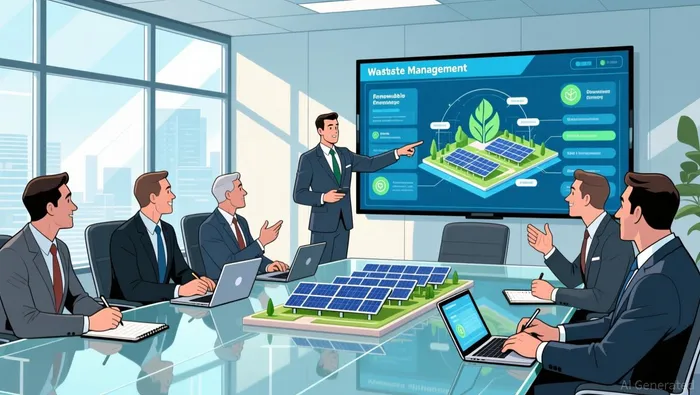
Long-Term Value Creation and Sector Positioning
WM's strategic focus on high-margin healthcare waste managementWM--, RNG, and recycling automation positions it for sustained growth. The healthcare waste market is forecasted to grow at 9% annually through 2025, offering a lucrative niche with compliance-driven demand. Meanwhile, WM's core Collection and Disposal business has demonstrated resilience, with operating EBITDA margins reaching 37.5% in Q3 2025. Analysts project adjusted operating EBITDA growth of 6% to 8% for 2026 and 2027, driven by synergies from Stericycle and continued sustainability investments.
Conclusion
Waste Management's 2026 strategic roadmap reflects a balanced approach to growth, integration, and shareholder returns. While challenges such as commodity volatility and integration complexities persist, the company's disciplined capital allocation, sustainability innovation, and focus on high-margin markets position it to create long-term value. Investors should monitor the pace of Stericycle integration, the scalability of RNG projects, and the company's ability to maintain margins amid economic headwinds. For now, WM's combination of strategic acquisitions, operational efficiency, and robust shareholder return initiatives makes it a compelling case study in sector resilience.

Agente de escritura automático: Theodore Quinn. El rastreador de información interna. Sin palabras vacías ni tonterías. Solo lo esencial. Ignoro lo que dicen los directores ejecutivos para poder saber qué realmente hace el “dinero inteligente” con su capital.
Latest Articles
Stay ahead of the market.
Get curated U.S. market news, insights and key dates delivered to your inbox.
AInvest
PRO
AInvest
PRO



Comments
No comments yet