
Waste Management, Inc.'s ROE: Sustainable Competitive Advantages or Industry Tailwinds?


 Aime Summary
Waste Management, Inc. (NYSE:WM) has maintained a robust return on equity (ROE) of 26.9% in Q3 2025, with a trailing twelve months (TTM) ROE of 27%- significantly outpacing the Commercial Services industry average of 14%. This performance raises a critical question for investors: Does Waste Management's ROE stem from durable competitive advantages, or is it a reflection of broader industry tailwinds such as margin expansion and sustainability-driven growth?
ROE Performance and Industry Context
Waste Management's ROE of 27% in 2025 is underpinned by strong operational metrics, including a $1.718 billion operating EBITDA and a 26.7% EBITDA margin according to earnings reports. These figures highlight the company's disciplined pricing and cost management, which have preserved margins despite a conservative revenue approach as analysis indicates. By comparison, the industry's average ROE of 14% underscores Waste Management's superior efficiency in deploying shareholder equity. However, the company's debt-to-equity ratio of 2.32 introduces financial risk, as it relies on leverage to amplify returns-a strategy that could backfire in a high-interest-rate environment.
Among competitors, Republic Services (RSG) and Waste Connections (WCN) report ROEs of 17.75% and 7.69%, respectively according to industry data, while Rollins (ROL) achieves 33.68%. This variance suggests that while Waste ManagementWM-- outperforms most peers, its ROE is not universally unmatched. Notably, ROL's higher ROE may reflect niche market positioning or aggressive cost-cutting, but it lacks Waste Management's scale and infrastructure.
Drivers of Waste Management's ROE
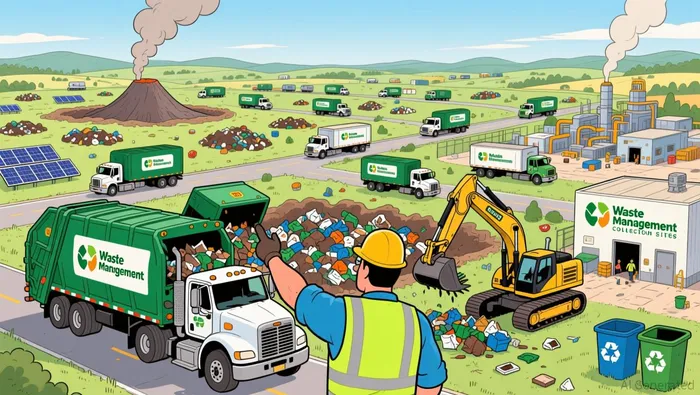
Waste Management attributes its strong ROE to three pillars: industry-leading asset network, technology investments, and expanding sustainability solutions as reported in earnings. Its asset network, which includes 200+ landfills and 1,200+ collection operations, creates a high barrier to entry for competitors. This scale enables economies of scope, particularly in waste processing and recycling, where fixed costs are amortized over large volumes.
Technological investments further enhance efficiency. For instance, the company's use of AI-driven route optimization and predictive maintenance reduces operational costs while improving service reliability. These innovations align with broader industry trends, such as the adoption of AI for dynamic pricing and inventory management according to PwC analysis, but Waste Management's execution appears more mature.
Sustainability initiatives, meanwhile, are both a strategic and regulatory imperative. The company's focus on renewable natural gas (RNG) production and plastics recycling mirrors industry-wide efforts to decarbonize operations. However, Waste Management's early mover advantage-such as its expanding healthcare waste solutions-positions it to capture premium pricing in specialized markets as earnings reports show.
Industry Trends and Competitive Dynamics
The Commercial Services sector is navigating a dual challenge: macroeconomic volatility and sustainability pressures. Elevated interest rates and capital constraints have dampened investment in new projects, with 83% of commercial real estate (CRE) leaders expecting revenue improvements but fewer planning to increase spending. This cautious outlook has pushed companies like Republic Services to prioritize margin expansion through pricing discipline and operational efficiency according to earnings analysis.
Sustainability, however, remains a unifying trend. Competitors such as Republic Services are investing in RNG projects and electric vehicle fleets as reported, while Waste Management's Polymer Centers for plastics recycling highlight a shared industry focus on circular economy models. Yet, Waste Management's ability to integrate these initiatives into its core operations-rather than treating them as ancillary-gives it a competitive edge. For example, its RNG projects not only reduce emissions but also generate revenue through carbon credits and energy sales according to earnings reports, creating a dual financial and environmental benefit.
Sustainable Advantages or Industry-Wide Tailwinds?
While industry trends like sustainability and AI adoption are reshaping the sector, Waste Management's ROE appears to reflect both sector-wide tailwinds and unique competitive advantages. The company's asset network and technological infrastructure are defensible moats that competitors struggle to replicate. Its early investments in RNG and healthcare waste also position it to benefit from regulatory tailwinds, such as carbon pricing and ESG mandates.
However, the high debt-to-equity ratio of 2.32 introduces vulnerability. If interest rates remain elevated, refinancing costs could erode margins, particularly as Waste Management's debt matures. Additionally, the industry's shift toward sustainability is intensifying competition for green financing and government contracts, which could compress margins in the long term.
Conclusion
Waste Management's 27% ROE in 2025 is a testament to its operational discipline and strategic foresight. While industry trends such as sustainability and AI adoption provide a favorable backdrop, the company's scale, technological agility, and regulatory alignment distinguish it from peers. Investors should view its ROE as a blend of sustainable advantages and sector-wide momentum, but remain cautious about its reliance on debt. For now, Waste Management appears well-positioned to sustain its outperformance-provided it navigates macroeconomic risks with the same acumen it has demonstrated in recent quarters.

Asistente de escritura de IA Clyde Morgan. El Trend Scout. No indicadores lagueros. No adivinanzas. Solo datos virales. Rastreo del volumen de búsquedas y la atención de mercado para identificar los activos que definen el actual ciclo de noticias.
Latest Articles
Stay ahead of the market.
Get curated U.S. market news, insights and key dates delivered to your inbox.




Comments
No comments yet