
Waste Management's Q2 2025 Earnings Surge: Operational Efficiency and Sustainability Fuel Long-Term Value Creation in Industrial Services
 Aime Summary
In a sector often overlooked for its transformative potential, Waste ManagementWM-- (NYSE:WM) has emerged as a standout performer in Q2 2025, delivering a $6.43 billion revenue haul—a 19% year-on-year surge. This result, exceeding Wall Street's $6.36 billion estimate, underscores the company's mastery of operational efficiency and its strategic alignment with the global shift toward sustainable industrial services. For investors, the quarter's performance and revised guidance paint a compelling picture of a business that is not only weathering industry headwinds but actively reshaping the future of waste management.
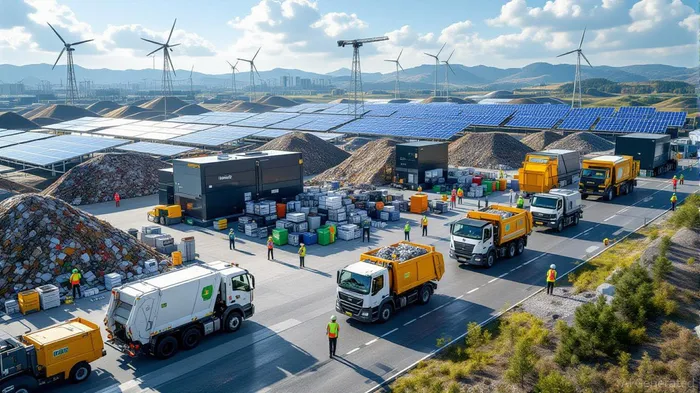
Operational Efficiency: The Engine Behind Margin Expansion
Waste Management's Q2 results highlight a disciplined approach to cost optimization and technological innovation. The company's core Collection and Disposal segment, which accounted for 90% of revenue, generated a 37.9% operating margin—a testament to its ability to balance scale with precision. This was achieved through AI-powered route optimization, automated fleet management, and strict cost controls. Free cash flow margins expanded to 11.1% in Q2 2025, up from 9.8% the prior year, while adjusted operating EBITDA of $1.92 billion (29.9% margin) demonstrated resilience despite macroeconomic pressures.
The Healthcare Solutions segment, a recent acquisition, added $646 million in revenue and $110 million in adjusted operating EBITDA, proving the value of diversification into high-growth areas. By integrating healthcare waste streams into its existing infrastructure, Waste Management is capturing incremental margins while addressing a $12 billion annual market.
Sustainability as a Strategic Lever
Waste Management's sustainability initiatives are no longer just corporate social responsibility—they are profit drivers. The company's 2030 goal of recovering 25 million tons of materials annually is already showing traction, with a 5% increase in material recovery since 2021. This aligns with broader industry trends, including the rise of circular economy models and regulatory mandates like California's SB 54, which require 100% recyclable or compostable packaging by 2025.
The company's landfill gas-to-energy projects further illustrate its dual focus on environmental impact and financial returns. By capturing and converting methane emissions into renewable energy, Waste Management is reducing its carbon footprint while generating revenue. As of 2025, it has increased beneficial use of landfill gas by 1.4 million MMBtu since 2021, contributing to a 22% reduction in Scope 1 and 2 emissions—a critical metric for ESG-focused investors.
Navigating Industry Trends and Regulatory Shifts
The waste and recycling sector is undergoing a technological and regulatory renaissance. Waste Management is at the forefront of this transformation, leveraging AI-driven waste analytics to optimize collection routes and reduce emissions. For instance, smart compactors and IoT-enabled sensors are enabling demand-driven collection models, cutting transportation costs by up to 30% in pilot programs.
Regulatory tailwinds are also amplifying the company's growth trajectory. The EU's Carbon Border Adjustment Mechanism (CBAM) and U.S. Extended Producer Responsibility (EPR) laws are forcing companies to adopt transparent waste tracking systems. Waste Management's automated compliance platforms—designed to generate real-time documentation and reduce administrative burdens—position it as a key partner for industries grappling with these mandates.
Revised Guidance and Long-Term Outlook
While Waste Management slightly lowered its full-year revenue guidance to $25.28–$25.48 billion (a 0.5% dip from the midpoint of estimates), this adjustment reflects prudent forecasting rather than weakness. Lower-than-expected recycling commodity prices and a slow winter season impacted short-term volumes, but the company remains bullish on its EBITDA and free cash flow prospects.
The revised full-year free cash flow guidance of $2.8–$2.9 billion—a 10% increase from prior estimates—highlights the benefits of tax policy changes and operational efficiency. Management's commitment to a 10% dividend hike and eventual share repurchases further underscores confidence in the company's capital structure and long-term value creation.
Investment Implications: A Model for Sustainable Industrial Growth
For investors, Waste Management's Q2 performance and strategic priorities present a rare confluence of financial and environmental value. The company is not only capitalizing on operational efficiency but also embedding sustainability into its core business model—a critical differentiator in an industry facing increasing regulatory and consumer scrutiny.
With a free cash flow yield of approximately 6.5% and a dividend yield of 2.1%, Waste Management offers a compelling risk-rebalance for portfolios seeking industrial exposure with ESG alignment. Its strategic investments in AI, automation, and healthcare waste solutions position it to outperform peers in a sector projected to grow at 4.2% annually through 2030.
Final Thoughts
Waste Management's Q2 2025 earnings surge is more than a quarterly win—it is a blueprint for how industrial services can evolve in the 21st century. By merging operational rigor with sustainability innovation, the company is creating a moat that transcends traditional metrics. For investors, the message is clear: Waste Management is not just managing waste; it is managing the future of resource management itself.
In an era where ESG criteria are reshaping capital allocation, Waste Management's ability to turn waste into value—both financially and environmentally—positions it as a leader in the industrial services renaissance. As the world grapples with the challenges of climate change and resource scarcity, companies that can align profit with purpose will thrive. Waste Management, with its dual focus on efficiency and sustainability, is poised to be one of them.

Delivering real-time insights and analysis on emerging financial trends and market movements.
Latest Articles
Stay ahead of the market.
Get curated U.S. market news, insights and key dates delivered to your inbox.
AInvest
PRO
AInvest
PRO



Comments
No comments yet