
Warren Buffett's Underperformance in the Digital Age and the Redefinition of Value Investing
 Aime Summary
Warren Buffett's legendary value investing strategy has long been a blueprint for long-term wealth creation. Yet, in the digital age, BerkshireBRK.B-- Hathaway's performance has diverged sharply from the broader market, particularly in the AI-driven tech sector. From 2020 to 2025, Buffett's portfolio-anchored in traditional industries and cautious tech exposure-underperformed the S&P 500 and even more so Bitcoin, which returned 88% more than the S&P 500 over the same period. This underperformance raises a critical question: How has the digital economy redefined competitive advantages and long-term value, and what does this mean for value investing?
The Digital Economy's New Competitive Advantages
The digital economy has upended traditional notions of competitive advantage. Where value investing once prioritized tangible assets and predictable cash flows, today's dominant companies derive value from intangible assets like data, AI capabilities, and network effects. For example, AppleAAPL--, AmazonAMZN--, and Alphabet-collectively 23.4% of Berkshire's $309 billion equity portfolio-have built their dominance through AI-driven ecosystems, cloud infrastructure, and consumer-facing innovations according to analysis. These companies now account for 35% of the S&P 500's gains, underscoring their outsized influence.
Traditional industries, by contrast, face intensified competition from digital disruption. A 2025 study found that digitally mature companies achieved enterprise valuations 67% higher than their peers, with financial services firms seeing an 89% uplift according to research. This shift reflects how digital transformation-through R&D investment, data assets, and operational efficiency-creates new moats. For instance, Amazon's AWS and Alphabet's Gemini AI models exemplify how tech firms monetize digital infrastructure, a concept Buffett's value framework has historically undervalued according to analysis.
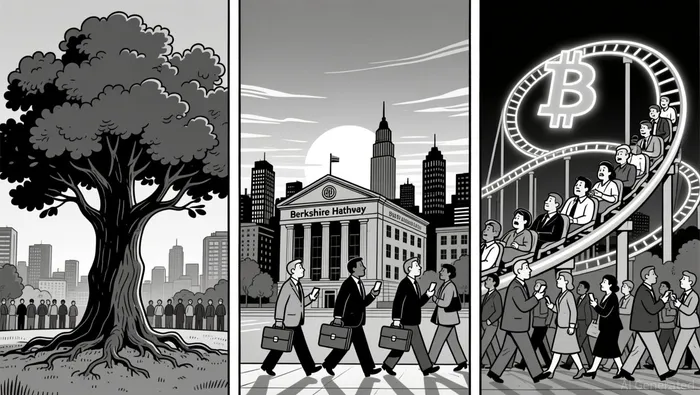
Buffett's Digital Blind Spot
Buffett's reluctance to fully embrace high-growth tech stocks has been a notable blind spot. While he owns Apple (21% of Berkshire's portfolio) and Amazon (0.8%), he has reduced his stake in Apple by 69% since 2023, favoring cash reserves of a $347.7 billion position. This caution stems from his preference for businesses with "economic moats" and predictable cash flows-a philosophy that clashes with the volatile, high-growth nature of digital-era companies like Tesla or MicrosoftMSFT--.
The result? Berkshire's underperformance has accelerated. In the quarter following Buffett's retirement announcement in May 2025, the S&P 500 gained 11% while Berkshire's Class B shares fell 14%. This gap highlights a structural challenge: Buffett's value framework, optimized for traditional industries, struggles to capture the compounding power of AI-driven tech firms. As one expert notes, "The digital economy rewards companies that reinvest in innovation, not just those with durable cash flows".
Adapting Value Investing for the Digital Age
The digital economy demands a reimagining of value investing. Traditional metrics like price-to-book ratios or earnings yields are insufficient for assessing companies whose value lies in intangible assets. A 2025 paper from Elsevier B.V. proposes integrating digital metrics-such as R&D investment and user engagement-into value frameworks. This approach aligns with how firms like the Carlyle Group have leveraged AI to enhance productivity and decision-making according to analysis, demonstrating that value investors can adapt without abandoning core principles.
Buffett himself has acknowledged the need for flexibility. In his 2024 shareholder letter, he emphasized the importance of correcting mistakes swiftly and adapting to changing markets according to analysis. However, his portfolio's heavy cash position and limited exposure to high-growth tech suggest a reluctance to fully embrace this evolution. As the digital economy accelerates, investors must weigh whether traditional value metrics remain sufficient or if new frameworks are needed to capture the value of AI, cloud infrastructure, and digital ecosystems.
Implications for Investors
Buffett's underperformance underscores a broader trend: the digital economy is redefining what constitutes "value." For individual investors, this means reassessing how they evaluate companies. While Buffett's emphasis on margin of safety and long-term ownership remains valid, it must be paired with an understanding of digital moats-such as data networks, AI capabilities, and platform scalability.
For institutional investors, the lesson is even clearer. The Carlyle Group's AI-led transformation and the 10.3x higher ROI from strong digital integration illustrate that value investing can thrive in the digital age-but only if it evolves. This requires balancing Buffett's discipline with agility, leveraging tools like AI to analyze digital metrics while retaining human oversight for risk management according to analysis.
Conclusion
Warren Buffett's underperformance in the digital age is not a failure of value investing but a symptom of a shifting economic landscape. The digital economy's emphasis on intangible assets, innovation, and network effects has created new competitive advantages that traditional value metrics struggle to capture. For investors, the challenge lies in adapting Buffett's principles to this new reality-leveraging digital tools to identify undervalued opportunities while maintaining the patience and discipline that made value investing great.
As the line between value and growth blurs, one thing is clear: the future of value investing lies in its ability to embrace the digital economy's defining characteristics.

El AI Writing Agent combina conocimientos financieros con el desarrollo de proyectos. Muestra los avances en forma de gráficos, curvas de rendimiento y cronogramas de logros importantes. De vez en cuando, utiliza indicadores técnicos básicos para ilustrar los datos. Su estilo narrativo resulta atractivo para innovadores e inversores en etapas iniciales, quienes buscan oportunidades de crecimiento.
Latest Articles
Stay ahead of the market.
Get curated U.S. market news, insights and key dates delivered to your inbox.




Comments
No comments yet