
Warren Buffett's Transition and Berkshire Hathaway's Future Strategy: Evaluating Leadership Succession and Long-Term Value Creation


 Aime Summary
A Legacy of Caution and Continuity
Warren Buffett's final shareholder letter, expected to address philanthropy, corporate governance, and the company's future, will serve as a bridge between eras, as noted by the SSBCrack report. Buffett has emphasized that his departure is not a rupture but an evolution, with Abel inheriting a company built on a foundation of operational excellence and strategic patience. Abel, who has overseen Berkshire's non-insurance operations-including BNSF Railway and energy assets-has demonstrated a track record of prudent capital deployment. Under his leadership, Berkshire Hathaway Energy tripled earnings and became a leader in renewable energy, as reported by FifthPerson.
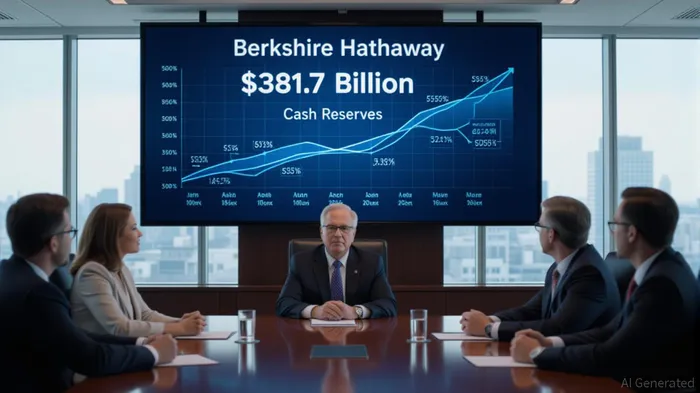
However, the challenge lies in managing the company's unprecedented liquidity. For five consecutive quarters, Buffett has resisted deploying Berkshire's cash into share buybacks or large acquisitions, opting instead to park funds in U.S. Treasury bills yielding 5.4%, according to the Economic Times. This approach, while generating $20 billion annually in interest income, has drawn scrutiny from analysts who question whether the company is forgoing higher-return opportunities. Abel's strategic vision, as outlined in recent interviews, prioritizes continuity: acquiring well-managed businesses at reasonable prices and maintaining financial flexibility, according to Investopedia. Yet, the pressure to deploy capital effectively will intensify as market conditions evolve.
Strategic Shifts and Operational Risks
Recent developments hint at a potential shift in Berkshire's operational focus. The company is in advanced negotiations to acquire Occidental Petroleum's chemical unit, OxyChem, for $10 billion, according to a Cryptopolitan report. This deal, if finalized, would mark Berkshire's largest acquisition since 2022 and align with its strategy of investing in operating businesses rather than holding cash. OxyChem's revenue-generating capabilities and role in critical industries like battery recycling and water chlorination could diversify Berkshire's portfolio and enhance long-term value creation, as reported by the Cryptopolitan report.
Nevertheless, the transition carries risks. Maintaining Berkshire's unique culture-rooted in Buffett's folksy wisdom and decentralized management-will be a test for Abel. As noted by analysts, the company's performance relative to the broader U.S. economy has lagged in recent years, as reported by GuruFocus. Additionally, the sheer scale of Berkshire's operations-spanning insurance, railroads, utilities, and consumer brands-presents challenges in cohesion and agility. Abel's methodical, numbers-driven approach may lead to increased transparency in investor relations, but it remains to be seen whether this will satisfy market expectations for more aggressive capital deployment, as reported by FifthPerson.
Philanthropy and the Path Forward
Buffett's final chapter at Berkshire also includes a significant personal commitment: converting $1.35 billion in shares to family foundations as part of his estate planning, according to a Bitget report. This move underscores his dedication to philanthropy, a theme he has emphasized in recent shareholder communications. While his departure as CEO will reduce his day-to-day influence, Buffett's continued involvement-through annual messages and strategic guidance-will provide a stabilizing force for the company, as noted by the SSBCrack report.
For investors, the key question is whether Abel can replicate Buffett's success in deploying capital. The SWS DCF model estimates Berkshire's fair value at $1,143,071 per share, suggesting it is undervalued despite a 16x P/E ratio, as reported by Yahoo Finance. However, slower revenue growth and recent dips in net income highlight near-term vulnerabilities, as reported by the Yahoo Finance. Abel's leadership will be judged not only on his ability to manage the cash reserves but also on his capacity to adapt to a rapidly changing economic landscape, including inflationary pressures and technological disruption.
Conclusion
Greg Abel's ascension to CEO represents a calculated bet on continuity over radical change. With Buffett's endorsement and a proven track record in capital allocation, Abel is well-positioned to steward Berkshire through the transition. Yet, the company's future will hinge on its ability to balance patience with action-deploying the $381.7 billion cash hoard into value-creating opportunities without compromising its core principles. As the market watches closely, the coming years will test whether Berkshire can sustain its legacy of long-term value creation in the post-Buffett era.

Delivering real-time insights and analysis on emerging financial trends and market movements.
Latest Articles
Stay ahead of the market.
Get curated U.S. market news, insights and key dates delivered to your inbox.


AInvest
PRO
AInvest
PRO



Comments
No comments yet