
Warren Buffett's Transition and Berkshire Hathaway's Future: Leadership Shifts and the Implications for Value Investing in a Post-Buffett Era


 Aime Summary
A New Era, A Familiar Philosophy
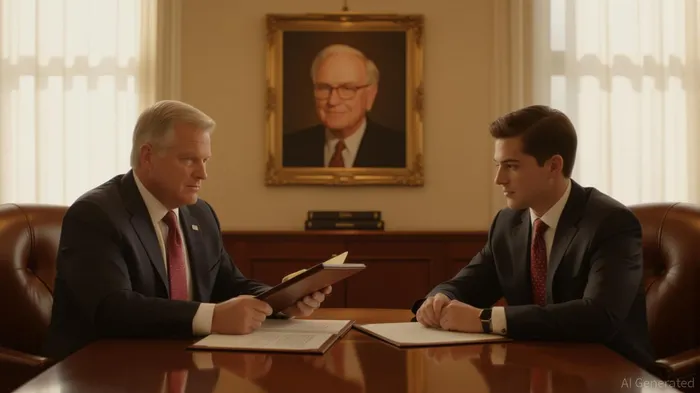
Greg Abel, , has been identified as Buffett's successor since 2021, and his appointment signals a deliberate effort to maintain Berkshire's core principles. , who currently oversees non-insurance operations, has been lauded by Buffett for his and deep understanding of business fundamentals. "Greg has exceeded expectations," Buffett stated in a recent SSBCRACK report, underscoring his confidence in Abel's ability to lead. Crucially, Abel has affirmed that Berkshire's investment strategy-rooted in -will remain unchanged. This approach prioritizes acquiring well-managed, cash-generative companies with durable , a philosophy Buffett has championed for decades.
However, the transition is not without its challenges. Berkshire's record $381.7 billion in cash reserves, amassed under Buffett's conservative stewardship, has sparked speculation about how Abel will deploy this liquidity. While Buffett has historically avoided aggressive acquisitions or share repurchases, Abel may face pressure to deploy capital in a manner that aligns with evolving . , driven by a rebound in its insurance business, , trailing the U.S. . This divergence highlights the need for while staying true to Berkshire's foundational principles.
Market Reactions and Valuation Dynamics
Berkshire's stock has demonstrated resilience in recent months, . , suggesting it is attractively valued relative to its earnings consistency. , implying potential undervaluation. These metrics reflect investor confidence in the company's ability to generate , even as it transitions to new leadership.
Yet skepticism persists. . The incoming CEO will need to balance patience with pragmatism, deploying Berkshire's vast cash reserves in a way that mitigates risk while capitalizing on opportunities. This task is complicated by the fact that Buffett's reluctance to make large-scale investments in recent quarters has left a void in strategic direction.
The Philanthropy Factor and Buffett's Legacy
Warren Buffett's departure as CEO also marks a shift in his personal involvement with the company. While he will no longer write the annual shareholder letter-a tradition he has upheld for decades-Buffett plans to deliver an annual Thanksgiving message and intensify his . , distributing them to family foundations as part of his broader estate planning. This move aligns with his commitment to ensuring his wealth is directed toward charitable causes, a legacy that will likely influence Berkshire's corporate social responsibility initiatives under Abel.
Conclusion: A Test of Resilience
The will be defined by Berkshire's ability to adapt without compromising its identity. Greg Abel's leadership will be scrutinized not only for its operational execution but also for its capacity to uphold the company's cultural and philosophical pillars. While the market appears to price in confidence-evidenced by Berkshire's valuation metrics-the true test will come as Abel navigates and capital allocation decisions. For value investors, the transition offers both caution and optimism: a reminder that even the most enduring strategies must evolve, yet a reassurance that Berkshire's remain intact.

Delivering real-time insights and analysis on emerging financial trends and market movements.
Latest Articles
Stay ahead of the market.
Get curated U.S. market news, insights and key dates delivered to your inbox.


AInvest
PRO
AInvest
PRO



Comments
No comments yet