
Warren Buffett's Strategic Shift Toward Tech and Consumer Discretionary Sectors: Evaluating Berkshire Hathaway's Evolving Portfolio as a Model for Long-Term Value Investors in the AI and E-Commerce Era
 Aime Summary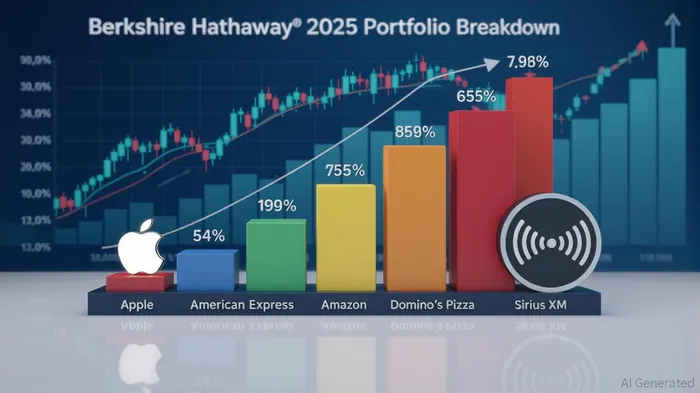
The world of value investing has long been anchored by Warren Buffett's disciplined approach to capital allocation. Yet, in 2025, Berkshire Hathaway's portfolio reveals a subtle but significant evolution: a strategic pivot toward tech and consumer discretionary sectors amid the AI and e-commerce revolution. For long-term investors, this shift offers a blueprint for balancing traditional moats with the disruptive forces reshaping global markets.
The Tech Conundrum: Apple's Dominance and the AI Dilemma
Apple (AAPL) remains Berkshire's crown jewel, accounting for 25.76% of its $259 billion portfolio. However, the company's performance has raised red flags. Despite Buffett's admiration for its durable moat and recurring revenue, Apple's stock has declined 19.57% year-to-date as of May 2025, largely due to its lag in AI integration. The iPhone maker's reluctance to embrace generative AI has left it trailing competitors like Google and Microsoft, which are racing to monetize AI tools.
Buffett's solution? A gradual reduction in Apple's stake to offset capital gains taxes and hedge against AI-related risks. Yet, the stock's future hinges on its $100 billion AI investment roadmap by 2026. If Apple accelerates its AI bets, it could retain its position in Berkshire's portfolio. Otherwise, Greg Abel—Buffett's successor—may prioritize capital reallocation toward sectors with clearer growth trajectories.
Consumer Discretionary: Amazon's AI-Driven Edge and Sirius XM's Subscription Moat
While Apple dominates the headlines, Berkshire's consumer discretionary holdings tell a more nuanced story. Amazon (AMZN), at 0.74% of the portfolio, represents a calculated bet on AI and cloud computing. Amazon Web Services (AWS) is the backbone of the AI revolution, powering infrastructure for generative AI models and offering customizable tools to businesses. AWS's 17% revenue growth in Q1 2025 underscores its role as a cash-cow, contributing nearly two-thirds of Amazon's operating income.
Amazon's e-commerce operations are also undergoing a quiet transformation. AI-driven supply chain automation and robotics are slashing costs, with potential to boost margins from historically low levels. For value investors, this represents a rare hybrid: a high-growth tech play wrapped in a stable, cash-generative business model.
Meanwhile, Sirius XM (SIRI) exemplifies Berkshire's preference for durable subscription models. At 1.04% of the portfolio, Sirius XM's 35% ownership by Berkshire highlights its strategic value. With 77% of revenue from recurring subscriptions and a legal monopoly in satellite radio, Sirius XM offers predictable cash flows—critical in an era of economic uncertainty. Under Greg Abel's leadership, Sirius XM could leverage AI to enhance user personalization and expand digital content offerings, aligning with Berkshire's evolving tech strategy.
The Abel Effect: From Tech to Renewables and Infrastructure
Greg Abel's leadership is reshaping Berkshire's DNA. Unlike Buffett's aversion to tech, Abel has shown a willingness to embrace AI and high-growth sectors while prioritizing capital preservation. His emphasis on infrastructure and renewables—evidenced by Berkshire's $348 billion cash reserves—is a hedge against market volatility.
Abel's strategic pivot is already underway:
- Trimming high-risk tech bets (e.g., Apple, Citigroup).
- Boosting cash-generative sectors (e.g., American Express, Constellation Brands).
- Investing in AI infrastructure via energy partnerships (e.g., MidAmerican Energy's AI/data center energy plans).
This approach mirrors Buffett's philosophy but adapts it for a post-pandemic world where AI and e-commerce are table stakes. For investors, the takeaway is clear: diversify across sectors with both durable moats and growth potential.
Investment Lessons for the AI Era
Berkshire's 2025 portfolio offers three key insights for long-term investors:
1. Balance Growth and Stability: Pair high-growth tech (e.g., AWS) with cash-generative consumer discretionary (e.g., Sirius XM) to mitigate risk.
2. Monitor AI Readiness: Companies like Apple must prove their ability to adapt to AI-driven markets. Investors should track their R&D spend and strategic partnerships.
3. Prioritize Capital Efficiency: Abel's focus on infrastructure and renewables signals a preference for sectors with stable returns and regulatory tailwinds.
In conclusion, Berkshire's evolving portfolio reflects a pragmatic approach to the AI and e-commerce era. By blending Buffett's value principles with Abel's growth-oriented vision, the conglomerate is positioning itself to thrive in a world where disruption and stability coexist. For investors, the lesson is simple: adapt, diversify, and let time compound your gains.

Stay ahead of the market.
Get curated U.S. market news, insights and key dates delivered to your inbox.
AInvest
PRO
AInvest
PRO



Comments
No comments yet