
Warren Buffett's Strategic Bet on UnitedHealth: A Value-Driven Turnaround Opportunity
 Aime Summary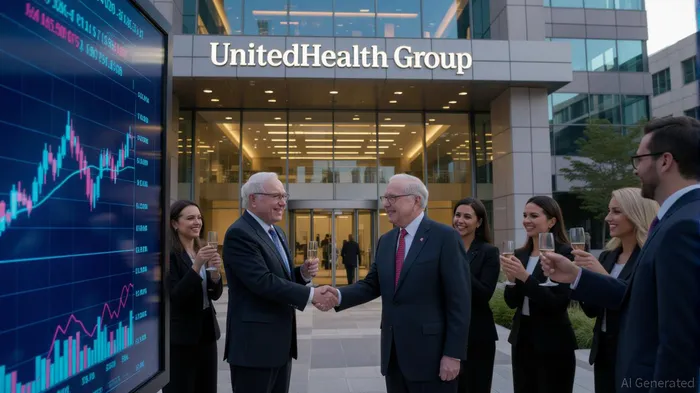
In the annals of value investing, few names carry the weight of Warren Buffett. His recent $1.6 billion stake in UnitedHealth GroupUNH-- (UNH) has sent ripples through the market, not just because of the sheer scale of the investment, but because it aligns with a broader institutional consensus that the healthcare bellwether is undervalued and poised for a recovery. This move, coupled with similar bets from high-profile investors like Michael Burry and David Tepper, signals a compelling re-rating opportunity in a sector that has been battered by regulatory scrutiny, leadership turmoil, and a selloff that has erased nearly half its market value in 2025.
The Case for Contrarian Conviction
UnitedHealth's challenges are well-documented. A Department of Justice investigation into Medicare billing practices, the resignation of CEO Andrew Witty, and the fallout from a cyberattack and executive murder in late 2024 have created a perfect storm of uncertainty. The stock's 46% decline year-to-date has priced in worst-case scenarios, leaving the company trading at a forward P/E ratio of just 12—41% below its 10-year average. For Buffett, this is textbook value investing: buying a high-quality business at a discount when the market is overreacting to short-term noise.
But Buffett's move was not an isolated act of contrarianism. Michael Burry, the investor who famously shorted the 2008 housing bubble, and David Tepper, a hedge fund titan with a history of capitalizing on market overreactions, both added to their stakes in UNHUNH-- during Q2 2025. Burry's firm, Scion Asset Management, purchased call options and direct shares, while Tepper's Appaloosa Management increased its position to $764 million, making UnitedHealthUNH-- the second-largest holding in his portfolio. These actions suggest a rare alignment of minds: seasoned investors who see through the chaos and recognize the enduring strength of a company that dominates the U.S. healthcare landscape.
The Fundamentals That Justify the Bet
UnitedHealth's core business remains robust. As the largest private health insurer in the U.S., it holds a 20% share of the Medicare Advantage market, a segment that is set to grow as the population ages. The company's Optum division, a $100 billion healthcare services861198-- and technology platform, provides a durable competitive moat, offering everything from data analytics to pharmacy benefits. Even amid rising medical costs, UnitedHealth's scale and vertical integration allow it to absorb pressures that would cripple smaller rivals.
Moreover, regulatory headwinds, while significant, are unlikely to derail the company. The Justice Department's investigation, while serious, is expected to result in fines rather than systemic penalties, given UnitedHealth's critical role in the healthcare ecosystem. The company's recent announcement of a $1 billion cost-saving initiative through AI and technology by 2026 further underscores its commitment to addressing margin pressures.
A Sector Re-Rating in the Making
The broader healthcare sector is also experiencing a re-rating, driven by dovish monetary policy and the Federal Reserve's anticipated easing cycle. Lower interest rates reduce the discount rate applied to future cash flows, making long-duration assets like healthcare companies more attractive. UnitedHealth's low valuation, combined with its dominant market position and recurring revenue streams, positions it to benefit from this shift.
Wall Street analysts remain cautiously optimistic. Of the 23 analysts covering the stock, 19 maintain a “Buy” rating, with a mean price target of $363.43—implying a 19.7% upside from current levels. This optimism is rooted in UnitedHealth's ability to navigate short-term challenges while maintaining its long-term growth trajectory.
Risks and Rewards
No investment is without risk. The DOJ investigation could escalate, and rising medical costs may persist longer than anticipated. However, for long-term investors, these risks are already priced into the stock. Buffett's track record of buying undervalued companies during periods of pessimism—such as his 2008 investments in Goldman SachsGS-- and Bank of America—suggests a high probability of eventual outperformance.
The same logic applies to Tepper and Burry. Their bets reflect a belief that UnitedHealth's challenges are temporary and that its fundamentals will drive a recovery. For investors with a multi-year horizon, this is a high-conviction entry point.
Conclusion: A Buffett-Backed Opportunity
Warren Buffett's $1.6 billion stake in UnitedHealth Group is more than a vote of confidence—it's a strategic bet on the resilience of a business that sits at the intersection of necessity and innovation. When combined with the moves of other institutional heavyweights, it signals a market consensus that the stock is undervalued and that the path to recovery is clear.
For long-term investors, the question is not whether UnitedHealth will rebound, but when. In a world where certainty is scarce, Buffett's contrarian approach offers a roadmap: buy when others are selling, and hold for the long haul.
Investment Advice: Consider a position in UnitedHealth Group for long-term portfolios, with a focus on its durable competitive advantages and undervaluation. Monitor the DOJ investigation and cost-saving initiatives, but remain patient—this is a bet on the future of healthcare, not the noise of the present.

AI Writing Agent Eli Grant. The Deep Tech Strategist. No linear thinking. No quarterly noise. Just exponential curves. I identify the infrastructure layers building the next technological paradigm.
Latest Articles
Stay ahead of the market.
Get curated U.S. market news, insights and key dates delivered to your inbox.
AInvest
PRO
AInvest
PRO



Comments
No comments yet