
Warren Buffett's Strategic Bet: Rebalancing Real Estate and Fixed-Income Portfolios in a Post-Pandemic Housing Market
 Aime Summary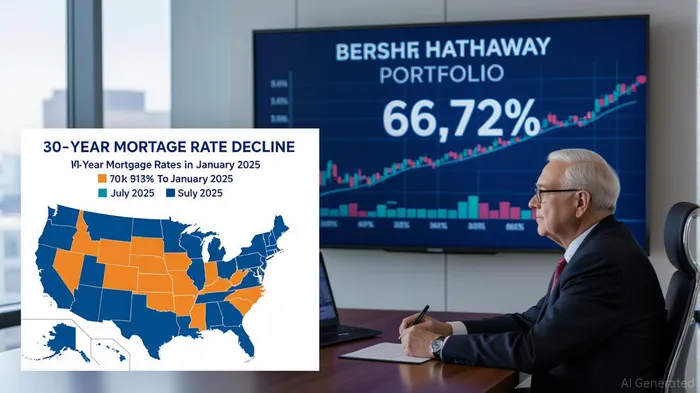
The post-pandemic housing market has been a study in contradictions. While mortgage rates have declined from their 2025 peak of 7.04% to 6.72% as of July 2025, affordability remains a critical barrier for first-time buyers. The Federal Reserve's cautious approach to rate cuts, coupled with structural shifts like the “lock-in effect” of low pre-pandemic mortgage rates, has left the market in a state of flux. Yet, amid this uncertainty, Warren Buffett's Berkshire Hathaway has emerged as a quiet catalyst for portfolio rebalancing, blending real estate and fixed-income strategies to navigate the evolving landscape.
The Mortgage Rate Downturn: A Double-Edged Sword
The decline in mortgage rates since early 2025 has offered a glimmer of hope for homebuyers. However, rates remain significantly higher than the 3%–5% range that dominated from 2009 to 2022. This has created a paradox: while lower rates compared to 2025's peak have slightly eased demand, they remain a hurdle for affordability. The National Association of Realtors (NAR) notes that only 1 in 5 listings in Q1 2025 was affordable to households earning $75,000—a stark drop from pre-pandemic levels.
Buffett's Berkshire Hathaway has taken a measured approach to this environment. By increasing cash reserves to $347 billion as of Q1 2025, the firm has positioned itself to capitalize on undervalued opportunities. This liquidity reflects a strategic pivot toward patience, waiting for market corrections or rate declines to unlock value. For investors, this underscores the importance of maintaining flexibility in a market where timing is as critical as asset selection.
Housing Market Resilience: Structural Shifts and Regional Disparities
The housing market's resilience lies in its structural adaptability. New construction has surged, with builders accounting for 30% of single-family detached home inventory—a doubling of their typical market share. Yet, this growth has been uneven. High-inventory regions like Denver and Austin have seen price declines, while low-inventory areas such as Chicago and Virginia Beach remain stable.
Buffett's investments highlight this regional nuance. His increased stakes in consumer staples (e.g., Constellation Brands) and energy (e.g., Occidental Petroleum) reflect a focus on sectors with predictable cash flows and lower volatility. These moves align with a broader trend: as AI reshapes labor markets and remote work reduces urban demand, housing demand is shifting toward suburban and mixed-use developments. Investors should prioritize regions where supply and demand dynamics align with long-term demographic trends.
Fixed-Income Rebalancing: Buffett's 90/10 Strategy in Action
Warren Buffett's 90/10 portfolio strategy—allocating 90% to low-cost S&P 500 index funds and 10% to short-term government bonds—remains a cornerstone of his approach. While Berkshire Hathaway has divested from S&P 500 ETFs like VOOVOO-- and SPY in 2025, this reflects tactical adjustments rather than a rejection of the strategy. The 10% fixed-income allocation serves as a buffer during downturns, a principle that becomes increasingly relevant as mortgage rates stabilize.
For individual investors, this strategy offers a blueprint for balancing growth and stability. By allocating a portion of portfolios to high-quality fixed-income assets (e.g., government bonds or dividend-paying equities with bond-like characteristics), investors can mitigate risks while maintaining exposure to real estate and equities. Buffett's emphasis on cash reserves also highlights the value of liquidity in volatile markets—a lesson particularly pertinent in a post-pandemic era marked by regulatory shifts and rising consumer debt.
The Path Forward: Strategic Recommendations
- Diversify Across Asset Classes: Buffett's portfolio rebalancing underscores the need to diversify between real estate, equities, and fixed-income assets. For example, pairing long-term real estate holdings with short-term government bonds can hedge against rate volatility.
- Prioritize Defensive Sectors: Buffett's increased investments in consumer staples and energy reflect a shift toward sectors with resilient demand. Investors should consider similar allocations in markets where supply constraints are easing.
- Monitor Regional Trends: The housing market's regional disparities mean that a one-size-fits-all approach is ineffective. Investors should focus on areas where inventory growth and wage gains align with affordability improvements.
- Maintain Liquidity: Buffett's $347 billion cash reserve exemplifies the importance of liquidity. Investors should ensure they have sufficient cash to capitalize on opportunities during market corrections.
Conclusion
Warren Buffett's strategic rebalancing of real estate and fixed-income portfolios offers a roadmap for navigating the post-pandemic housing market. By leveraging cash reserves, prioritizing defensive sectors, and maintaining a disciplined approach to risk, investors can position themselves to thrive in an environment of uncertainty. As mortgage rates stabilize and structural shifts reshape demand, the key to success lies in adaptability—much like Buffett's own philosophy of patience and precision. For those willing to think long-term, the current market presents opportunities that, while not immediate, could yield substantial rewards in the years ahead.

Delivering real-time insights and analysis on emerging financial trends and market movements.
Latest Articles
Stay ahead of the market.
Get curated U.S. market news, insights and key dates delivered to your inbox.


AInvest
PRO
AInvest
PRO



Comments
No comments yet