
Warren Buffett's Legacy Shift: From Philanthropy to Family Governance


 Aime Summary
Governance Evolution: From Buffett to Abel
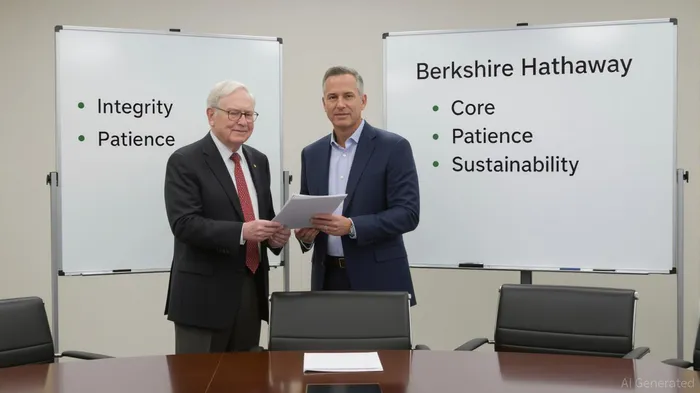
Buffett's farewell letter to shareholders, released in 2025, outlined a deliberate shift in leadership while reaffirming the company's core values, as noted by a BitGet analysis. By naming Abel as his successor, Buffett has ensured continuity in a leadership style that prioritizes operational discipline and decentralized decision-making. Abel, who has overseen Berkshire Hathaway Energy (BHE) for years, has demonstrated a hands-on approach to management, contrasting with Buffett's more delegative style, according to a CNBC report. This transition reflects a strategic balance: preserving Berkshire's culture of frugality and patience while adapting to a complex, evolving market landscape.
The governance framework post-Abel is designed to uphold Buffett's ethos of ethical leadership. In his letter, Buffett explicitly warned against the recruitment of "look-at-me-rich" executives who prioritize short-term gains over long-term integrity, as noted in the BitGet analysis. This caution aligns with Berkshire's historical resistance to speculative trends, favoring instead a patient, fundamentals-driven approach. Abel's leadership, rooted in operational excellence and sustainability-evidenced by his investments in renewable energy-positions Berkshire to navigate global economic shifts while maintaining its identity, according to a Invezz report.
Philanthropy as a Legacy Tool
Buffett's farewell letter also marked a significant pivot in his personal legacy planning. By converting 1,800 Class A shares of Berkshire into 2.7 million Class B shares-valued at $1.3 billion-and donating them to family foundations, Buffett has operationalized his philosophy of "enough but not too much," as detailed in the BitGet analysis. This move ensures his children inherit sufficient capital to pursue their ambitions without the disincentives of excessive wealth.
According to a ScanX Trade report, Buffett's philanthropy now totals over $50 billion, with major contributions to the Bill and Melinda Gates Foundation and family charitable trusts. This strategy mirrors the principles of generational wealth management, where controlled wealth transfer fosters financial independence while mitigating the risks of dynastic complacency. By aligning his estate with family foundations, Buffett has created a blueprint for sustainable legacy planning that prioritizes societal impact over mere asset preservation, as noted in the SSBCrack article.
Financial Resilience and Long-Term Stewardship
Berkshire's third-quarter 2025 financial performance underscores its readiness for this transition. The company's underwriting profit tripled to $3.16 billion, driven by robust performance in its insurance and reinsurance divisions, according to a Beinsure report. Meanwhile, cash reserves surged to $72.2 billion, reinforcing its capacity to weather market volatility, as reported by an InsiderMonkey analysis. These metrics highlight the strength of Berkshire's diversified business model, which has long served as a compounder of value for shareholders.
Greg Abel's leadership is expected to amplify this resilience. As noted by the Invezz report, Abel's tenure has already seen strategic bets on sectors like renewable energy and internet infrastructure, positioning Berkshire to capitalize on long-term trends. For family offices and institutional investors, this signals a governance model that balances continuity with innovation-a hallmark of effective long-term value stewardship.
Expert Perspectives on Legacy and Governance
Analysts have praised Berkshire's transition as a masterclass in succession planning. Hudson Financial Planning notes that Abel's deep operational expertise and cultural alignment with Buffett's principles make him an ideal successor, as detailed in a Hudson Financial Planning report. Meanwhile, BitGet highlights the company's governance framework as a case study in ethical leadership, emphasizing Buffett's warnings against greed and short-termism, as noted in the BitGet analysis.
The shift also resonates with broader trends in generational wealth management. By embedding philanthropy into his estate plan, Buffett has demonstrated how family foundations can serve as both legacy tools and vehicles for societal impact. This approach, as ScanX Trade observes, offers a replicable model for ultra-high-net-worth individuals seeking to balance wealth preservation with purpose-driven giving, as noted in the ScanX Trade report.
Conclusion: A New Era of Stewardship
Warren Buffett's legacy shift-from philanthropy to family governance-epitomizes the intersection of long-term value creation and ethical leadership. By entrusting Greg Abel with Berkshire's future and structuring his estate through family foundations, Buffett has ensured that the company's values endure beyond his tenure. For investors, this transition reaffirms Berkshire's commitment to disciplined governance and sustainable growth, offering a blueprint for navigating the complexities of generational wealth management in the 21st century.

Delivering real-time insights and analysis on emerging financial trends and market movements.
Latest Articles
Stay ahead of the market.
Get curated U.S. market news, insights and key dates delivered to your inbox.


AInvest
PRO
AInvest
PRO



Comments
No comments yet