
Warren Buffett's Final Shareholder Letter and Its Implications for Long-Term Value Investing


 Aime Summary
Buffett's Final Letter: A Blueprint for Value Investing
Buffett's 2025 letter was a masterclass in distilling complex financial concepts into actionable wisdom. He critiqued the "race" for excessive CEO compensation, citing Tesla's $1 trillion pay package for Elon Musk and Rivian's similar offer for RJ Scaringe as examples of misplaced priorities driven by envy rather than merit, as reported by The Times of India. This critique underscored a core tenet of value investing: aligning incentives with long-term performance rather than short-term spectacle.
The letter also emphasized the importance of patience and compounding. Buffett reiterated that "our favorite holding period is forever," a mantra that reflects his belief in the power of time and reinvestment. He highlighted how Berkshire's success stemmed from a few exceptional investments-such as GEICO and Japanese trading companies-that far outweighed its missteps, like the early purchase of Berkshire Hathaway as a struggling textile firm, according to Dorset Wealth's summary. This narrative reinforced the idea that value investing thrives on selective, patient ownership of high-quality businesses.
Succession Planning: Greg Abel and the Continuity of Principles
Buffett's choice of Greg Abel as his successor signals a commitment to preserving Berkshire's culture and investment philosophy. Abel, 63, has spent decades at Berkshire, leading non-insurance operations with a focus on operational discipline and cost efficiency. Buffett praised Abel as a "great manager, a tireless worker, and an honest communicator," expressing confidence that he would uphold the company's principles, as noted in Reuters' coverage.
Abel's approach appears aligned with Buffett's ethos. At the 2025 shareholders meeting, he emphasized the importance of hard work and long-term thinking, stating, "Hard work takes all of us a long way in life," as reported by Investopedia. This sentiment mirrors Buffett's own philosophy, which prioritizes operational rigor and ethical leadership. Moreover, Berkshire's record cash reserves of $381.7 billion in Q3 2025, according to Bitget's update, suggest that Abel will inherit a company well-positioned to capitalize on future opportunities, provided he adheres to the same disciplined capital allocation standards.
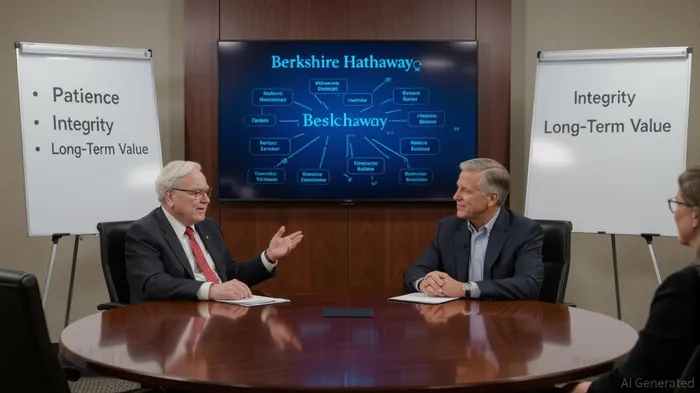
Behavioral Lessons for Today's Investors
Buffett's final letter and Abel's succession plan offer timeless behavioral lessons for investors:
Patience Over Activity: Buffett's adage that the stock market is a "relocation center" where money moves from the active to the patient, as reported by Forbes, remains relevant in an era of algorithmic trading and short-termism. Investors must resist the urge to overtrade and instead focus on compounding returns through long-term ownership.
Integrity as a Foundation: Buffett stressed that integrity is the most critical quality in leadership, noting that reputations take decades to build but moments to destroy, as reported by Economic Times. For investors, this means prioritizing companies with ethical governance and transparent practices.
Humility and Luck: Buffett acknowledged that his success was partly due to "Lady Luck," as reported by Economic Times, a reminder that external factors often influence outcomes. Investors should remain humble, avoid overconfidence, and diversify to mitigate unforeseen risks.
Simplicity in Complexity: Buffett's ability to simplify complex financial decisions-such as his focus on "businesses we understand"-highlights the value of clarity in an age of information overload. Investors should prioritize simplicity, avoiding overcomplicated strategies that obscure risk.
Implications for Long-Term Value Investing
The transition to Abel raises questions about Berkshire's future, but the company's strategic positioning remains robust. With a P/E ratio of 16x-well below its peer group average of 27x, as reported by Yahoo Finance-Berkshire is trading at an attractive valuation, reflecting investor confidence in its long-term compounder status. Abel's leadership will be tested by the need to deploy the company's massive cash reserves effectively, a task that demands the same rigor and selectivity that defined Buffett's tenure.
For value investors, the key takeaway is that Berkshire's success hinges not on its CEO but on its enduring principles. As Buffett noted, "It takes 20 years to build a reputation but five minutes to ruin it," as reported by Economic Times. Abel's challenge will be to maintain this reputation while navigating a rapidly evolving economic landscape.
Conclusion
Warren Buffett's final shareholder letter and the succession of Greg Abel represent more than a leadership change-they embody the continuity of a philosophy that has reshaped global investing. For today's investors, the lessons are clear: prioritize patience, integrity, and simplicity; recognize the role of luck; and remain committed to long-term value creation. As Berkshire enters this new chapter, the principles that guided Buffett will serve as a compass for Abel-and for investors seeking to emulate his success.

Delivering real-time insights and analysis on emerging financial trends and market movements.
Latest Articles
Stay ahead of the market.
Get curated U.S. market news, insights and key dates delivered to your inbox.




Comments
No comments yet