
Warren Buffett's Final Shareholder Letter and Its Implications for Long-Term Value Investing


 Aime Summary
Buffett's Legacy: Humility, , and a Critique of
Buffett's final letter was as much a reflection on personal values as it was a roadmap for Berkshire's future. He humorously declared, "As the British would say, I'm going quiet," signaling his departure from annual shareholder meetings and reports, according to a India Today report. Yet, his departure was not a retreat from influence. Buffett pledged to continue writing brief Thanksgiving messages to shareholders and accelerate his philanthropy, , as noted by an NDTV report.
The letter also took a pointed stance on CEO compensation, criticizing the "race" for executive pay driven by envy and greed. Buffett highlighted Tesla's $1 trillion package for Elon Musk and Rivian's similar offer for RJ Scaringe, arguing that such compensation packages often lack alignment with performance, as reported by a Times of India article. This critique underscores Buffett's belief in moderation and long-term value creation over short-term ego-driven incentives-a principle that has defined Berkshire's culture.
Greg Abel: The Successor and the Challenge of Continuity
Greg Abel, , is poised to assume the CEO role in early 2026, a transition Buffett described as a "handoff to a great manager, a tireless worker, and an honest communicator," according to the India Today report. Abel's leadership will be tested by Berkshire's record $381.7 billion in cash reserves as of Q3 2025-a figure that has drawn scrutiny for its underutilization, as noted in a article. While Buffett has been a net seller of stocks for 12 consecutive quarters, Abel must decide whether to deploy this liquidity through share repurchases, acquisitions, or strategic investments in a market characterized by high valuations and economic uncertainty, as noted in an Investopedia article.
Experts note that Abel's success will hinge on his ability to uphold Berkshire's core principles while adapting to new realities. As stated by a Yahoo Finance report, "Berkshire's ability to compound capital and maintain profitability across its diverse industries remains central to its value proposition, but the success of this strategy under Abel will depend on how well he navigates slower revenue growth and market skepticism." Abel's emphasis on disciplined capital allocation-echoing Buffett's mantra that "the value relative to the risks has to be right"-suggests continuity in approach, as noted in the Investopedia article.
The Cash Conundrum: Liquidity, Deployment, and Market Valuation
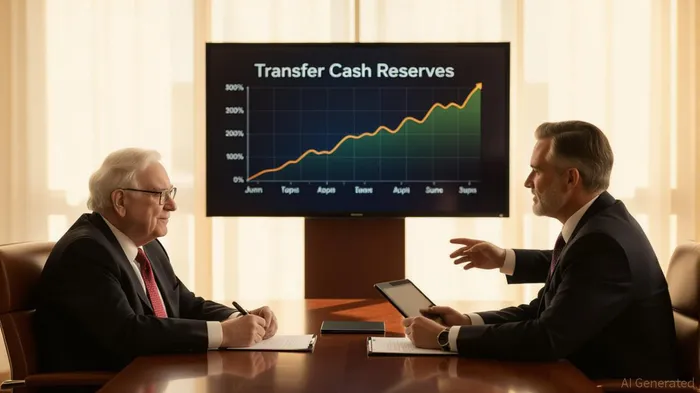
Berkshire's cash reserves have become both a strength and a liability. While the company's P/E ratio of 16x suggests it is undervalued relative to its peers (who average 27x), the market's discount reflects concerns about post-Buffett cohesion, as noted in a Yahoo Finance analysis. Analysts argue that the $381.7 billion liquidity provides a strategic edge, particularly in capital-intensive sectors like AI, where Big Tech companies are taking on debt, as reported by an Axios article. However, deploying such a vast sum without compromising Berkshire's conservative ethos will be a delicate balancing act.
Buffett's reluctance to deploy cash has already sparked debate. As noted in the Bitget article, "The challenge for Abel will be to uphold the principles of value investing while adapting to a shifting economic landscape and ensuring that the company's massive cash reserves contribute meaningfully to shareholder value." Abel's track record in managing non-insurance operations since 2018 suggests he is prepared for this task, but the market remains cautious. Berkshire's shares have fallen 4.5% year-to-date, reflecting the "Buffett premium" discount, as noted in the Bitget article.
The Future of Value Investing: Principles vs. Pragmatism
Buffett's investment philosophy-rooted in patience, , and staying within one's "circle of competence"-has been a cornerstone of Berkshire's success. His famous quote, "The first rule of an investment is don't lose money. And the second rule of an investment is don't forget the first rule," remains as relevant as ever, as noted in a U.S. News article. Under Abel, the challenge will be to apply these principles in a world where traditional industries face disruption and tech-driven valuations defy historical metrics.
Experts like those at Nasdaq argue that Berkshire's diverse operations-spanning insurance, rail, utilities, and equities-provide a buffer against volatility. However, the company's ability to compound capital at Buffett's legendary rate remains uncertain, as noted in a Nasdaq article. Abel's focus on "wonderful companies at a fair price" rather than "fair companies at a wonderful price" aligns with Buffett's strategy but may require recalibration in a market where "fair" valuations are increasingly rare, as noted in a article.
Conclusion: A New Era, A Timeless Philosophy
. While his departure as CEO marks the end of an era, the appointment of Greg Abel signals confidence in the company's ability to adapt without abandoning its core principles. The coming years will test whether Berkshire can maintain its identity as a value investor in a world increasingly dominated by speculative growth strategies. For now, the market watches closely, aware that the true measure of a successor lies not in the size of the cash reserves but in the wisdom to deploy them.

Delivering real-time insights and analysis on emerging financial trends and market movements.
Latest Articles
Stay ahead of the market.
Get curated U.S. market news, insights and key dates delivered to your inbox.




Comments
No comments yet