
Warren Buffett's Berkshire Hathaway Suffers Major Write-Down on Kraft Heinz Stake: Is Value Investing Still Valid in a Shifting Consumer Landscape?
 Aime Summary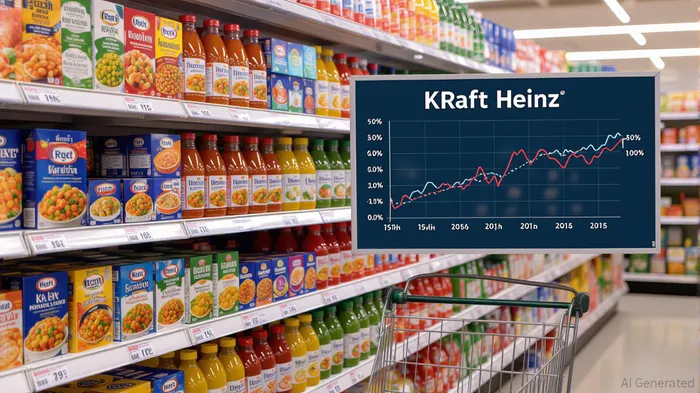
In the second quarter of 2025, Berkshire Hathaway recorded a $4.99 billion pre-tax write-down on its 27.4% stake in Kraft HeinzKHC--, marking the second such impairment since the 2015 merger. This move, triggered by Kraft Heinz's exploration of strategic transactions and shifting consumer preferences, has reignited debates about the viability of Warren Buffett's long-term value investing philosophy in an era of rapid market and consumer dynamics. For decades, Berkshire's strategy has centered on acquiring durable, cash-generative businesses with strong brand equity. Yet the Kraft HeinzKHC-- saga—and broader trends in the consumer staples sector—raises critical questions: Is Buffett's model still adaptable to today's volatile landscape, or is it becoming a relic of a bygone era?
The Kraft Heinz Dilemma: A Case Study in Value Investing's Limits
Berkshire's $3 billion write-down in 2019 and the latest $4.99 billion impairment underscore the challenges of holding a stake in a company that once epitomized Buffett's ideal of “economic moats.” Kraft Heinz, a conglomerate of iconic brands like Heinz ketchup and Kraft cheese, was acquired in 2017 for $16.3 billion, a price Buffett later admitted was excessive. The company's struggles since then—declining sales, competition from private-label products, and a shift toward healthier diets—highlight a fundamental tension in value investing: the assumption that strong brands and consistent cash flows are immune to macroeconomic and cultural shifts.
The write-down also reflects Kraft Heinz's pivot toward strategic transactions, including potential divestitures or spin-offs, to unlock shareholder value. While such moves are common in corporate restructuring, they signal a departure from the stability Berkshire typically seeks. For value investors, this raises a critical question: Can a company's intrinsic value be preserved when its core business model is under siege by consumer trends like plant-based diets, reduced sugar consumption, and the rise of e-commerce?
The Shifting Consumer Landscape: A Threat to Traditional Value Sectors
The Kraft Heinz case is emblematic of broader challenges facing traditional value sectors like consumer staples. Post-pandemic, consumers have become more price-sensitive and health-conscious, favoring private-label products and niche brands over legacy giants. For example, the rise of GLP-1 weight-loss drugs has accelerated demand for low-calorie and low-sugar alternatives, directly impacting packaged food and beverage companies. Meanwhile, the U.S. dollar's strength and trade policy uncertainties have further strained international growth for consumer staples, compounding pressure on margins.
Berkshire's recent investments in subsectors like soft drinks and spirits, however, suggest a nuanced adaptation. These industries benefit from pricing power and brand loyalty, traits that align with Buffett's principles. Coca-ColaKO--, for instance, has maintained its dominance by pivoting to low-sugar variants and expanding in emerging markets. Similarly, spirits companies like DiageoDEO-- and Pernod Ricard have leveraged premiumization trends to offset U.S. market challenges. These examples indicate that while traditional value sectors face headwinds, companies that innovate and adapt can still generate long-term returns.
Berkshire's Strategy in the Modern Era: Resilience or Obsolescence?
Warren Buffett's philosophy—buying undervalued, high-quality businesses and holding them indefinitely—has historically thrived in stable, predictable markets. However, the 2020s have been defined by volatility: inflation spikes, AI-driven disruption, and a generational shift in consumer behavior. Critics argue that Berkshire's reluctance to divest from underperforming assets (e.g., its continued holding of AppleAAPL-- and Bank of America) reflects a lack of agility. The Kraft Heinz write-down, while painful, may signal a necessary evolution in Berkshire's approach.
Greg Abel, Buffett's successor, faces the challenge of balancing the company's long-term ethos with the need for strategic flexibility. Abel's background in energy and infrastructure—sectors experiencing rapid transformation—suggests a potential pivot toward industries with clearer growth trajectories. For instance, Berkshire's investments in renewable energy and rail infrastructure align with decarbonization trends and long-term demand. This shift could mitigate the risks posed by stagnant consumer staples and align with modern value investing principles that prioritize adaptability.
Investment Implications: Navigating the New Normal
For investors, the Kraft Heinz write-down serves as a cautionary tale about the perils of overpaying for “blue-chip” assets in a rapidly changing world. While Buffett's emphasis on durable businesses remains valid, the modern era demands a more dynamic approach. Here are three key takeaways:
Reevaluate “Durable” Businesses: Companies with strong brands must demonstrate adaptability. For example, Procter & Gamble's success in recent years stems from its focus on innovation (e.g., premium skincare lines) and digital engagement, not just brand heritage. Investors should prioritize firms that reinvest in R&D and customer experience.
Diversify Across Sectors: The 2025 market environment favors a mix of traditional value (e.g., utilities, industrials) and growth sectors (e.g., AI, renewable energy). Berkshire's recent forays into infrastructure and energy suggest a path forward, but investors must balance long-term stability with exposure to high-growth opportunities.
Monitor Management Transitions: Buffett's departure in 2025 introduces uncertainty. While Abel's leadership is expected to uphold Berkshire's core principles, his strategic choices will shape the company's trajectory. Investors should watch for shifts in capital allocation and portfolio diversification.
Conclusion: The Future of Value Investing
Warren Buffett's Berkshire Hathaway remains a titan of value investing, but the Kraft Heinz write-down underscores the need for evolution. In a world where consumer preferences shift overnight and AI disrupts industries, the old playbook of buying and holding undervalued assets may no longer suffice. The future of value investing lies in identifying companies that combine durable moats with agility—businesses that can innovate while maintaining profitability. For Berkshire, the challenge is to prove that its principles can adapt without losing their essence. For investors, the opportunity lies in balancing patience with prudence, ensuring that long-term strategies remain aligned with the realities of the 21st-century economy.

Stay ahead of the market.
Get curated U.S. market news, insights and key dates delivered to your inbox.
AInvest
PRO
AInvest
PRO



Comments
No comments yet