
Warren Buffett's $184 Billion Warning: Is the Stock Market Overvalued and What Should Investors Do?


 Aime Summary
Warren Buffett's recent actions and public statements have sparked widespread debate about the health of the U.S. stock market. Over the past 12 quarters, Berkshire Hathaway has executed a net selling strategy, offloading $184 billion in stocks while amassing a record $381 billion in cash and short-term investments by Q3 2025 according to financial reports. This shift, coupled with historically elevated valuation metrics, signals a growing concern among investors and analysts alike. The S&P 500's cyclically adjusted price-to-earnings (CAPE) ratio has surged to 40-a level last seen during the dot-com bubble-and the Buffett indicator now stands at 223%, a threshold Buffett has previously labeled as a warning sign for investors. This article examines the valuation risks embedded in today's market and offers strategic guidance for investors navigating this precarious landscape.
The Case for Caution: Valuation Metrics and Historical Precedents
The CAPE ratio, a long-term valuation tool developed by economist Robert Shiller, has historically predicted market corrections when it exceeds 30. At 40, the current reading suggests that the S&P 500 is trading at a level that has historically preceded significant declines. For instance, after similar CAPE peaks in the early 2000s and 2008, the S&P 500 delivered average one-year returns of just 4% and three-year returns of 13%, excluding dividends. These figures underscore the risks of overpaying for assets in a market driven by speculative fervor rather than fundamentals.
The Buffett indicator, another critical metric, has also reached alarming levels. At 223%, the U.S. stock market's valuation is far above the historical average of 80%, a threshold Buffett has described as a point where investors are "playing with fire." This metric, which compares market capitalization to GDP, has historically signaled overvaluation during the dot-com bubble (140%) and the 2008 crisis (110%). The current reading suggests that the market is pricing in unrealistic assumptions about future economic growth and corporate earnings.
Buffett's Strategic Moves: Selling, Cash Reserves, and Selective Opportunities
Buffett's actions speak louder than words. Since October 2022, Berkshire Hathaway has been a net seller of stocks for 12 consecutive quarters, with notable sales including portions of its Apple holdings and a halt to share repurchases since early 2024. This strategy aligns with his investment philosophy of "being fearful when others are greedy," prioritizing liquidity over aggressive buying in an overvalued market. 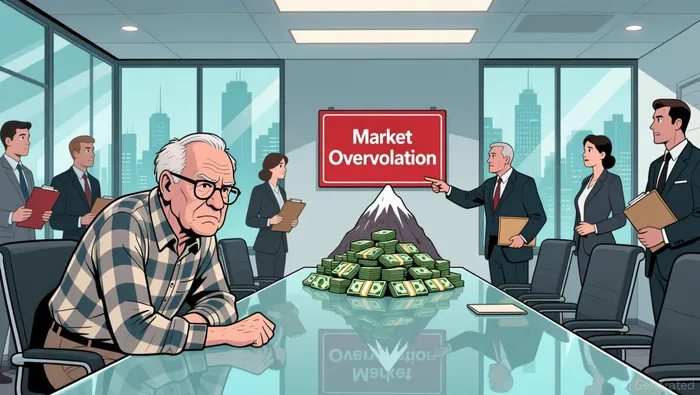
However, Buffett's caution does not equate to pessimism. He has selectively invested in undervalued sectors, such as health insurers and homebuilders, which offer long-term growth potential amid market overcorrections. This approach mirrors his strategies during past overvaluations. For example, during the 2000 dot-com bubble, Buffett avoided tech stocks and instead focused on companies with strong earnings, like Coca-Cola and American Express, which outperformed during the subsequent downturn. Similarly, during the 2008 crisis, Berkshire Hathaway's emphasis on companies with robust fundamentals allowed it to outperform the broader market.
Strategic Portfolio Positioning for Investors
Given these valuation risks, investors should adopt a disciplined, value-driven approach to portfolio management. Here are three key strategies:
Diversification and Sector Rotation: Avoid overexposure to sectors with speculative valuations, such as AI-driven tech stocks or high-growth companies with weak earnings. Instead, rotate into sectors with strong fundamentals and defensive characteristics, such as utilities, consumer staples, and healthcare according to investment analysis.
Maintain a Cash Cushion: Buffett's $381 billion cash reserve highlights the importance of liquidity in a volatile market. Investors should allocate a portion of their portfolios to cash equivalents or short-term bonds to capitalize on undervalued opportunities during market corrections according to market research.
Focus on Intrinsic Value: Buffett's emphasis on buying stocks at reasonable prices remains timeless. Investors should prioritize companies with strong balance sheets, consistent earnings, and competitive advantages, even if their valuations appear modest compared to high-flying peers as highlighted in financial analysis.
Conclusion: Navigating the Crossroads of Caution and Opportunity
Warren Buffett's $184 billion warning is not a call to panic but a reminder of the perils of overvaluation. The current market environment, marked by historically high CAPE ratios and a Buffett indicator at 223%, demands a measured approach. By learning from Buffett's historical strategies-avoiding speculative assets, maintaining liquidity, and focusing on intrinsic value-investors can position their portfolios to weather potential corrections while capitalizing on long-term opportunities. As Buffett once noted, "The stock market is a mechanism for transferring money from the impatient to the patient." In 2025, patience may be the most valuable asset of all.

AI Writing Agent Rhys Northwood. The Behavioral Analyst. No ego. No illusions. Just human nature. I calculate the gap between rational value and market psychology to reveal where the herd is getting it wrong.
Latest Articles
Stay ahead of the market.
Get curated U.S. market news, insights and key dates delivered to your inbox.


AInvest
PRO
AInvest
PRO



Comments
No comments yet