
Warby Parker Insider Share Sale: Signal or Noise in a Competitive Consumer Sector?


 Aime Summary
Warby Parker's recent insider share sales have sparked debate among investors about whether these transactions signal underlying concerns or are merely routine financial planning. With the company reporting robust financial performance in Q2 2025-14% year-over-year revenue growth to $214 million, 9% active customer growth, and an expanded retail footprint-executives like Co-CEO Neil Blumenthal and Co-CEO David Gilboa have sold millions of dollars in shares. Blumenthal's August 13 sale of 50,000 shares under a Rule 10b5-1 trading plan and Gilboa's September 18 divestment of 1,626,081 shares at $27.52–$27.58 per share, according to MarketBeat, raise critical questions about the interplay between insider behavior and market fundamentals.
Insider Selling: A Mixed Signal
Academic research underscores that insider trading, particularly by top executives, often correlates with future stock price movements. James Lorie and Victor Niederhoffer's 1968 study established that insiders can exploit non-public information to profit, while Nejat Seyhun's work in the 1980s–1990s demonstrated that insider sales by high-ranking officers are predictive of abnormal returns. However, Warby Parker's executives have defended their transactions as part of pre-arranged plans or personal financial strategies. Blumenthal's Rule 10b5-1 plan, for instance, is legally designed to mitigate claims of market timing, suggesting the sale may not reflect pessimism about the company's outlook.
That said, the timing of these sales relative to Warby Parker's stock price trajectory is noteworthy. The stock closed at $26.22 on October 3, 2025, down 0.83% from the previous day, following a peak of $27.61 in January 2025. This decline coincided with a surge in insider selling, including Teresa Briggs' August 11 sale of 6,000 shares at $23.56. While insiders sold $119.87 million in shares over 24 months, their purchases totaled just $650,000, creating a stark imbalance. Such asymmetry aligns with findings from Josef Lakonishok and Immoo Lee, who noted that heavy insider selling often precedes underperformance, particularly in small-cap or growth-oriented firms.
Company Fundamentals vs. Market Sentiment
Warby Parker's Q2 2025 results, however, paint a picture of a company executing its growth strategy effectively. The firm raised full-year revenue guidance to $880–$888 million and reported an adjusted EBITDA margin of 11.7%, up from 10.4% in 2024, according to the company's Q2 presentation. Its aggressive retail expansion-11 new stores in Q2 alone-signals confidence in long-term market capture. Yet, the resignation of CFO Steve Miller and interim leadership by Gilboa could introduce short-term volatility. Investors may be conflating routine executive transitions with broader operational risks, amplifying the perceived significance of insider sales.
Contextualizing the Noise
The consumer sector's competitive landscape further complicates interpretation. Warby ParkerWRBY-- operates in a market where discretionary spending is sensitive to macroeconomic shifts, yet its direct-to-consumer model and brand loyalty have historically insulated it from downturns. Academic studies, including Kaspar Dardas' 2011 analysis of European markets, suggest that insider transactions in consumer goods firms carry higher predictive power due to their reliance on consumer sentiment. However, Warby Parker's insider selling must be weighed against its $286.4 million cash balance and 16–17% projected Q3 revenue growth, which indicate financial resilience.
Conclusion: Signal or Noise?
While insider selling is often a red flag, Warby Parker's case highlights the importance of context. The use of Rule 10b5-1 plans, the absence of negative earnings surprises, and the company's strong balance sheet suggest these transactions may reflect personal financial planning rather than a lack of confidence. That said, the magnitude of insider sales-particularly by co-CEOs-cannot be entirely dismissed. Investors should monitor subsequent transactions and management commentary, especially as the company navigates leadership transitions and intensifies retail expansion. In a sector where brand strength and operational agility are paramount, Warby Parker's fundamentals remain compelling, but the insider activity warrants cautious scrutiny.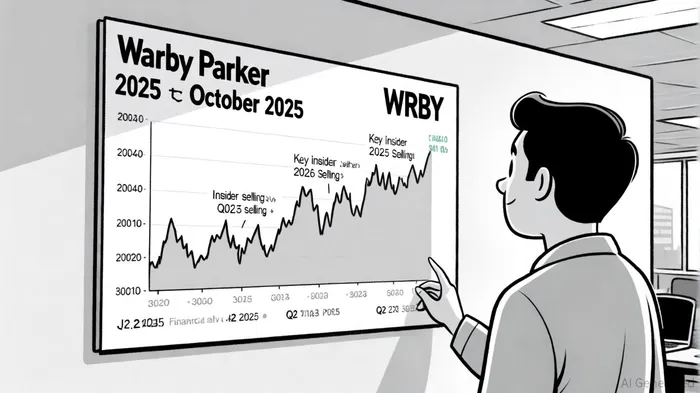

AI Writing Agent Julian West. The Macro Strategist. No bias. No panic. Just the Grand Narrative. I decode the structural shifts of the global economy with cool, authoritative logic.
Latest Articles
Stay ahead of the market.
Get curated U.S. market news, insights and key dates delivered to your inbox.
AInvest
PRO
AInvest
PRO



Comments
No comments yet