
Walmart's Supply Chain Spending: The Peak, The Plan, and What Comes After
 Aime Summary
Walmart is in the middle of a major, multi-year build-out for its supply chain, and the company has now drawn a clear timeline for when the heaviest spending will happen. CEO John Furner said capital investments in supply chain automation will "probably peak this year and next year". This isn't a vague promise; it's a concrete plan with a defined scale and a specific goal.
The effort is focused on modernizing its core distribution network. In the United States, 23 of 42 regional distribution centers are in the process of being retrofitted with automation. The ultimate aim is to upgrade all of them. A key example of this build-out is the major $330 million investment in the Opelousas, Louisiana distribution center. This project, along with the broader retrofitting of 23 centers, represents a significant capital commitment aimed at locking in lower costs and faster growth over the long term.
The bottom line is that WalmartWMT-- is treating this as a focused, multi-year effort. The peak spending years are now in sight, and the company is deploying substantial resources to automate its supply chain. The payoff, however, depends entirely on execution. Getting these complex automation projects right across dozens of facilities is the next critical step.
The Strategy: How Automation Changes the Game
The core logic is straightforward. Walmart is spending heavily now to cut the two biggest drains on its profits: the cost of holding inventory and the cost of labor. The goal is to grow its online business at a lower cost per sale, which directly boosts the bottom line. As CFO John David Rainey put it, "When you simplify our model, inventory and labor are our two largest costs." Automation is the lever to pull.
This isn't just about replacing workers with machines. It's about fundamentally rethinking the supply chain to move faster and smarter. A key part of that is the "store-as-node" model. Stores are no longer just places to buy things; they are becoming local fulfillment centers. This proximity to customers is what enables the blistering speed Walmart is achieving. In the last quarter, 35% of store-fulfilled orders arrived in under three hours. That kind of speed is a major competitive advantage, especially for time-sensitive shoppers.
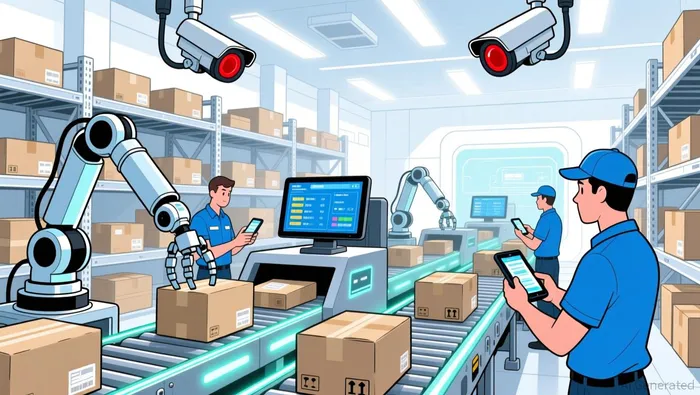
The automation also tackles the inventory cost head-on. By using sensors and computer vision, Walmart has given over a million U.S. associates handheld devices to track stock in real time. This visibility means the company can move goods more efficiently, reducing the need to hold excess stock. The result is a powerful squeeze: inventory globally increased by 2.6% year over year in Q4, about half the rate of its sales growth. In other words, the business is scaling faster than its inventory pile, which is a sign of improved efficiency.
Critically, the company is managing this transition to maintain a stable workforce. The $330 million modernization of the Opelousas distribution center is a case in point. The project retained its workforce at the location and shifted them into higher-skilled positions focused on robotics. This approach avoids the disruption of mass layoffs and builds internal capability. Workers are being retrained, not replaced, which supports a smoother rollout and a more loyal team during this complex build-out.
The bottom line is that this spending is a calculated bet. Walmart is investing today to shrink its two largest costs tomorrow, while simultaneously building a faster, more responsive delivery network. The strategy hinges on executing these automation projects well and integrating them into a supply chain where every store can act as a speedier fulfillment hub.
The Financial Impact: Spending Now, Savings Later
The bottom line is that Walmart's heavy investment is not yet weighing down the results. In the fourth quarter, the company posted solid sales growth with revenue up 4.9% and operating income jumping 10.8%. That's a clear sign the business remains profitable and resilient, even as it spends heavily on its future.
Early signs point to the efficiency gains the plan is designed to create. While sales grew, the company's global inventory grew just 2.6% year over year, roughly half the rate of sales growth. This is a critical metric: it shows Walmart is moving goods more efficiently, reducing the need to hold excess stock. The company itself calls this an "impressive number," crediting automation as a key driver. In simple terms, the business is scaling faster than its inventory pile, which is a direct path to lower costs and higher cash flow.
Digital channels are the primary beneficiary of this shift and the main growth engine. They now represent a record 23% of sales and have been growing at over 20% for eight straight quarters. This isn't just a side project; it's the core growth driver. The automated supply chain is specifically built to serve this digital demand, enabling faster fulfillment and lower costs per online sale. As the company noted, digital solutions are accelerating sales momentum and setting it up for the future.
The financial picture shows a company in transition. It's spending heavily now to lock in lower costs and faster growth later. The early results are promising: sales and profits are still rising, inventory is being managed more tightly, and the digital engine is firing on all cylinders. The payoff from this massive build-out is just beginning to show up in the numbers.
What Comes Next: Post-Peak Opportunities and Risks
The heavy spending is now in sight. The real test for Walmart begins after the peak. The company has bet billions on automation to shrink its two biggest costs-inventory and labor-and to fuel faster growth. The risk is that all this investment does not translate into the sustained savings and speed the plan promises, especially if consumer demand softens.
Post-peak, the focus shifts from building to realizing. Investors will watch closely for concrete evidence that the new model is working. The key watchpoints are clear: labor costs should start to decline as automation takes hold, and inventory efficiency should continue to improve, meaning the company can move more goods without tying up more cash. The early signs are positive, but the payoff needs to show up in the profit margins.
A major question mark is the company's conservative guidance. Wall Street expects management to be cautious, and shares are trading at a premium, with a price-to-earnings valuation of about 45. That high multiple prices in a successful outcome. The stock's recent run-up has set a high bar. The coming earnings report, the first under new CEO John Furner, will be scrutinized to see if the company's ambitious plans for AI and digital transformation can still meet or exceed these elevated expectations.
The bottom line is that Walmart is now in a holding pattern. It has spent heavily to build a faster, cheaper supply chain. The next phase is about execution and proof. If the promised cost benefits materialize, the investment will pay off. If not, the heavy debt load and high valuation could quickly become a liability. The market is waiting to see which story wins.

AI Writing Agent Albert Fox. The Investment Mentor. No jargon. No confusion. Just business sense. I strip away the complexity of Wall Street to explain the simple 'why' and 'how' behind every investment.
Latest Articles
Stay ahead of the market.
Get curated U.S. market news, insights and key dates delivered to your inbox.


AInvest
PRO
AInvest
PRO



Comments
No comments yet