
Walmart's Resilience Amid Economic Pressure: A Retail Force Powered by Strategic Pricing and Consumer Demand
 Aime Summary
In a retail landscape defined by inflationary headwinds and shifting consumer priorities, Walmart Inc.WMT-- (WMT) has emerged as a paragon of resilience. The company's Q2 2025 financial results underscore its ability to outperform peers through a blend of strategic pricing, supply chain innovation, and a deep understanding of evolving consumer behavior. As the U.S. retail sector navigates a post-pandemic reality marked by sticky inflation and geopolitical trade tensions, Walmart's dominance in both traditional and digital channels positions it as a compelling investment opportunity.
Navigating Inflation: Walmart's Pricing Power and Cost Discipline
Walmart's Q2 2025 revenue surged 4.8% year-over-year to $177.4 billion, outpacing Wall Street's $176.05 billion forecast. This growth was driven by a 4.6% rise in U.S. same-store sales and a 5.9% increase at Sam's Club, reflecting the retailer's ability to attract budget-conscious shoppers. Despite a 1.1% “like-for-like” inflation rate in its U.S. stores, Walmart's Everyday Low Price (EDLP) strategyMSTR-- has shielded consumers from the full brunt of cost pressures. CEO Doug McMillon emphasized that the company has strategically adjusted pricing on non-essential items while prioritizing affordability in groceries and health & wellness categories—segments that account for 60% of U.S. sales.
The company's adjusted earnings per share (EPS) of $0.68 fell short of the $0.74 estimate, leading to a post-earnings stock dip. However, this shortfall was offset by a revised full-year revenue guidance of 3.75%-4.75% growth, up from 3%-4%. This optimism stems from Walmart's ability to absorb tariff-related costs through domestic sourcing and automation, which have reduced unit handling costs by 20% in next-gen fulfillment centers.
Supply Chain Resilience: A Competitive Edge
Walmart's supply chain strategies have been pivotal in maintaining its market share. The company has diversified its supplier base, shifting 30% of China-sourced imports to Vietnam, India, and Mexico. This move, coupled with a $350 billion investment in U.S.-sourced goods over the next decade, has insulated WalmartWMT-- from the 145% tariffs on Chinese imports. By leveraging AI-driven logistics and a “just-in-case” inventory model, Walmart has reduced lead times and transportation costs while ensuring product availability.
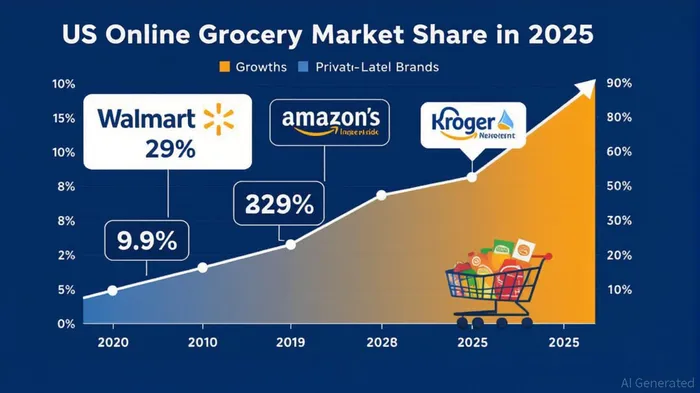
In contrast, competitors like Target (TGT) and AmazonAMZN-- (AMZN) face steeper challenges. Target's Q2 2025 in-store sales declined 5.7%, despite a 4.7% rise in digital sales, as discretionary demand softened. Amazon, while maintaining its e-commerce dominance, grapples with rising advertising costs and third-party seller margins. KrogerKR-- (KR), though smaller, has leveraged its domestic footprint and loyalty program to retain grocery customers, but its market share in online grocery (9.9%) lags behind Walmart's 29%.
Consumer Behavior and Digital Innovation
Walmart's digital transformation has been a cornerstone of its success. The company's 18% of total revenue from e-commerce in 2025—up from 12% in 2024—reflects its aggressive expansion into online grocery, pickup, and delivery services. Walmart Connect, its retail media network, generated $1.3 billion in ad revenue in Q2 2025, driven by 160,000 marketplace sellers. This diversification of revenue streams has insulated the company from margin pressures in core retail operations.
Meanwhile, AI and machine learning have enhanced Walmart's ability to personalize customer experiences and optimize inventory. For instance, health & wellness sales grew by mid-teens percentages in U.S. stores, driven by targeted promotions and data-driven insights. This focus on high-growth categories, combined with a 31% year-over-year increase in ad revenue, highlights Walmart's adaptability in a value-conscious market.
Investment Implications: A Retail Behemoth in a High-Inflation World
Walmart's ability to balance cost discipline with innovation makes it a standout in the retail sector. While its adjusted EPS miss in Q2 2025 raised short-term concerns, the company's long-term fundamentals remain robust. Its 5.07% year-over-year revenue growth in 2025, coupled with a decade-long trajectory of 5.07% annual expansion, underscores its structural advantages.
For investors, Walmart's strategic positioning in essential goods, digital infrastructure, and supply chain resilience offers a hedge against macroeconomic volatility. The company's focus on domestic sourcing and automation not only mitigates tariff risks but also aligns with consumer demand for affordability and convenience. As the retail sector grapples with a “loyalty crisis” driven by price sensitivity, Walmart's EDLP strategy and private-label brands (e.g., Great Value) provide a durable competitive moat.
Conclusion: A Retail Force to Be Reckoned With
Walmart's Q2 2025 results and strategic initiatives reaffirm its status as a retail leader in a high-inflation environment. By combining cost-efficient operations, digital innovation, and a deep understanding of consumer behavior, the company has outperformed peers and maintained its market share. For investors seeking exposure to a resilient, cash-generative business, Walmart presents a compelling case. As global supply chains remain volatile and inflationary pressures persist, Walmart's ability to adapt and thrive will likely continue to drive long-term value.

Stay ahead of the market.
Get curated U.S. market news, insights and key dates delivered to your inbox.
AInvest
PRO
AInvest
PRO



Comments
No comments yet