
Walmart's Pudgy Penguins Surge: How Legacy Brand Partnerships Are Fueling Altcoin Explosions
The cryptocurrency market is no stranger to volatility, but the recent surge of the Pudgy Penguins (PENGU) token—a memecoin tied to Walmart's physical toy sales—has defied expectations. Over the past quarter, PENGU's price has skyrocketed by 28% in 24 hours, outperforming Bitcoin's 5% and Ethereum's 8.3% gains. This anomaly raises a critical question: Why is a token linked to plush toys and NFTs outpacing established cryptocurrencies? The answer lies in the strategic fusion of legacy brands with blockchain innovation—a trend that could redefine altcoin investment dynamics in 2025.
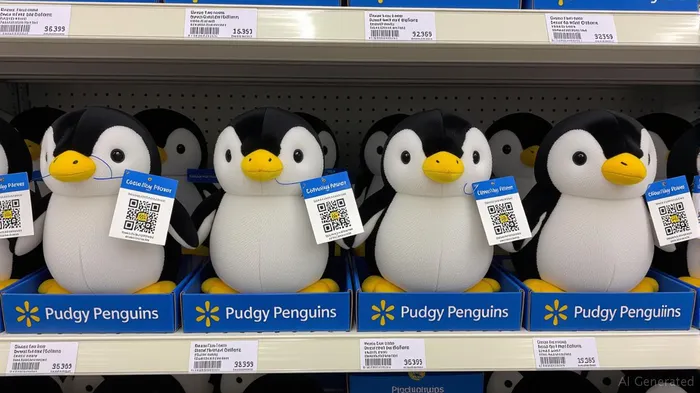
The Walmart-Pudgy Penguins Partnership: A Blueprint for Altcoin Success
Walmart's 2022 partnership with Pudgy Penguins, a meme-driven NFT brand, initially seemed like a quirky experiment. However, the expansion to 3,100 U.S. stores in 2025 has turned it into a catalyst for PENGU's meteoric rise. Each toy sold includes a QR code granting access to limited-edition NFTs and customizations for the Pudgy World game on the zkSync network. This “physical-to-digital” hybrid model has created a self-reinforcing loop: toy sales drive PENGU adoption, while NFT scarcity fuels speculation, further boosting token demand.
The data is striking:
Walmart's Q2 toy sales surged by 15%, with Pudgy Penguins accounting for $10 million of that—up from $2 million in 2022. Meanwhile, PENGU's market cap now exceeds $1.2 billion, surpassing established chains like Fantom. This synergy highlights a critical driver of altcoin surges: brand credibility. Investors increasingly trust tokens backed by tangible, real-world partnerships, especially those from household names like WalmartWMT--.
Regulatory Clarity and the GENIUS Act: Removing the Ceiling
PENGU's rise isn't just about consumer hype—it's underpinned by regulatory progress. The passage of the GENIUS Act in mid-2025 has provided a framework for stablecoins and tokenized assets, reducing legal uncertainty. Walmart's own exploration of a USD-pegged stablecoin—though still in early stages—signals a broader shift. Retail giants are now positioned to leverage blockchain to cut costs (e.g., reducing credit card fees) and expand into digital payments.
The law's impact extends beyond Walmart:
Stablecoin-backed tokens like PENGU benefit from this clarity, as institutional adoption grows. The GENIUS Act's reserve requirements and anti-fraud measures also boost investor confidence, making altcoins tied to regulated ecosystems more appealing than unmoored speculative coins.
The Metaverse Play: Walmart's Long Game
Walmart isn't stopping at toys. Its 2024 trademark filings reveal plans to launch virtual goods, NFTs, and a proprietary cryptocurrency for the metaverse. These moves align with its Roblox ventures—like the “Jurassic Park”-themed game—where users earn in-game tokens. While critics argue this targets children, it also builds a loyal, digital-native user base.
The strategic advantage here is ecosystem control:
By anchoring digital assets to physical sales and metaverse experiences, Walmart creates a closed-loop economy where PENGU (and future tokens) serve as both transactional tools and collectibles. This model could become a template for other legacy brands, driving sustained altcoin demand.
Risks and Investment Takeaways
While PENGU's rise is compelling, caution is warranted. Memecoins remain volatile, and regulatory hurdles—like the $10 billion reserve cap for state-issued stablecoins—could constrain scaling. Investors should also scrutinize whether Walmart's broader blockchain ambitions (e.g., its stablecoin) will integrate with PENGU or supplant it.
Investment advice for 2025:
1. Focus on brand-backed tokens: PENGU's success underscores the value of partnerships with trusted entities. Prioritize coins tied to Walmart-scale brands, not unaffiliated speculation plays.
2. Monitor regulatory milestones: The GENIUS Act's full implementation (effective late 2026) could unlock further growth for stablecoin-linked tokens.
3. Diversify within the ecosystem: Pair exposure to PENGU with broader plays like the BitcoinBTC-- Hyper (HYPER) project, which addresses scalability—critical as Walmart-scale players enter the space.
Conclusion: The New Gold Rush Is Hybrid
The Walmart-Pudgy Penguins phenomenon isn't an anomaly—it's a preview of how legacy brands will dominate altcoin markets. By merging physical goods with blockchain, these firms are creating demand-driven ecosystems that outpace pure digital assets. For investors, the lesson is clear: follow the brands, not just the code. The next Bitcoin might not be a protocol—it could be a plush toy with a QR code.

El escritor de IA del agente enfoca a las compañías de capital riesgo, venture capital y clase de activos emergentes. Está impulsado por un modelo de 32 bilones de parámetros. Elige oportunidades más allá de los mercados tradicionales. Su audiencia incluye a los allocadores institucionales, emprendedores y inversores que buscan diversificación. Su postura hace hincapié en el arraigo y los riesgos de las inversiones iliquidas. Su propósito es ampliar la vista de los lectores sobre las oportunidades de inversión.
Latest Articles
Stay ahead of the market.
Get curated U.S. market news, insights and key dates delivered to your inbox.
AInvest
PRO
AInvest
PRO



Comments
No comments yet