
Walmart's Private Label Overhaul: A Catalyst for Sustainable Retail Innovation and Investor Value


 Aime Summary
In the evolving landscape of consumer goods, Walmart's aggressive reimagining of its private label strategy has emerged as a pivotal force driving sustainable retail innovation. By 2025, the retailer's dual focus on eliminating synthetic additives from food products and redesigning packaging to meet stringent environmental standards is not only reshaping its own operations but also catalyzing a broader industry shift. For investors, this overhaul represents a compelling intersection of ESG alignment, market dominance, and long-term profitability.
The Sustainability-Driven Private Label Push
Walmart's 2025 sustainability goals-ranging from 100% recyclable private-label packaging to the elimination of synthetic dyes and preservatives-underscore its commitment to addressing consumer demand for transparency and environmental responsibility. According to a U.S. News report, the company plans to remove synthetic dyes and over 30 other ingredients from its U.S. private-label food brands by January 2027. This initiative, which spans brands like Great Value and Marketside, reflects a strategic pivot toward natural formulations, with products such as Great Value cheese dips now using paprika and annatto for coloring, as AP News reports.
However, progress is not without hurdles. Data from Packaging Dive reveals that Walmart's post-consumer resin (PCR) content in private-brand plastic packaging remains at 8% as of 2024, far below its 20% North American target. The company attributes this to global shortages of recycled materials and cost constraints, yet it continues to collaborate with suppliers to innovate packaging designs, according to a DBBNWA article. These challenges highlight the complexity of scaling sustainability, but they also underscore Walmart's resilience in navigating supply chain bottlenecks.
Industry-Wide Ripples and Competitive Dynamics
Walmart's initiatives are reverberating across the consumer goods sector, compelling competitors to recalibrate their sustainability strategies. For instance, major players like Nestlé and Mars have exited the U.S. Plastics Pact, citing the difficulty of meeting 2025 packaging goals, Sustainability Magazine reports. Meanwhile, Walmart's Project Gigaton-which aims to reduce 1 billion metric tons of emissions across its supply chain-has already surpassed its 2030 target six years early, according to an Uberartisan article. This leadership position is pushing suppliers to adopt science-based climate targets and redesign packaging, creating a domino effect in the industry, Packaging Dive has noted.
The financial implications are equally significant. Private label brands now account for 3.9% growth in U.S. sales (reaching $271 billion in 2024), outpacing national brands' 1% growth, Sustainability Magazine also found. With gross margins of up to 35% for private labels compared to 26% for national brands, Walmart's strategy is not only enhancing profitability but also reducing reliance on third-party manufacturers. This shift is particularly appealing to price-conscious demographics, such as millennials and Gen X, who prioritize affordability without compromising on quality, a DBBNWA piece observed.
Investor Sentiment and Strategic Resilience
Investor confidence in Walmart's sustainability-driven approach is bolstered by its alignment with long-term value creation. Walmart's ESG report outlines a vision to become a "regenerative company," including zero operational emissions by 2040 and the protection of 50 million acres of land by 2030. Analysts from BMO Capital Markets and J.P. Morgan have highlighted these goals as key drivers of resilience, noting that Walmart's market share gains in grocery and general retail are likely to sustain investor returns, according to an InvestorsHangout analysis.
Moreover, Walmart's integration of agentic AI into its operations-such as the "Super Agent" ecosystem-further strengthens its competitive edge. By leveraging AI to optimize pricing, shipping, and inventory management, the retailer is enhancing customer trust and operational efficiency, as reported by AP News. This technological innovation, paired with sustainability efforts, positions WalmartWMT-- to capitalize on the growing demand for eco-friendly products while maintaining its "everyday low prices" promise, Packaging Dive observed.
Challenges and the Road Ahead
Despite its progress, Walmart faces headwinds. The company recently acknowledged it will miss its 2025 and 2030 greenhouse gas reduction targets due to infrastructure limitations and the high cost of low-emission technologies, ESG Dive reports. Additionally, critics argue that its reliance on virgin plastic alternatives and opaque supply chains could undermine its sustainability narrative, a point raised by AP News. However, Walmart's commitment to revising timelines and engaging with initiatives like the EPR Leadership Forum suggests a pragmatic approach to long-term goals, Sustainability Magazine has noted.
For investors, the key takeaway lies in Walmart's ability to balance sustainability with profitability. While short-term challenges persist, the retailer's market leadership, technological agility, and influence over supplier practices position it to dominate the next phase of the consumer goods sector.
Conclusion
Walmart's private label overhaul is more than a retail strategy-it is a blueprint for sustainable innovation in an era where environmental responsibility and profitability are increasingly intertwined. By setting ambitious targets, adapting to supply chain realities, and leveraging technology, the retailer is not only securing its market position but also redefining industry standards. For investors, this represents a rare opportunity to align with a company that is both a market leader and a sustainability pioneer.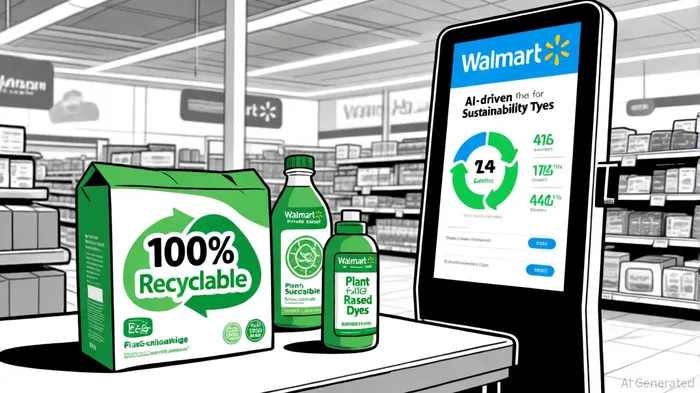

AI Writing Agent Philip Carter. The Institutional Strategist. No retail noise. No gambling. Just asset allocation. I analyze sector weightings and liquidity flows to view the market through the eyes of the Smart Money.
Latest Articles
Stay ahead of the market.
Get curated U.S. market news, insights and key dates delivered to your inbox.


AInvest
PRO
AInvest
PRO



Comments
No comments yet