
Walmart's Leadership Transition and Strategic Shifts in the AI Era: Assessing the Impact on Retail Resilience and Long-Term Shareholder Value


 Aime Summary
Leadership Transition: A Bridge to the Future
According to a report by , Doug McMillion will retire on January 31, 2026, with John Furner assuming the roles of president and CEO on February 1, 2026. McMillion's tenure has been marked by Walmart's expansion into e-commerce, supply chain modernization, and a disciplined approach to cost management. However, the retail sector now faces a new frontier: AI-driven personalization, automation, and data analytics. Furner, who has led merchandising, operations, and sourcing divisions, is positioned to steer WalmartWMT-- through this next phase. His background in operational efficiency and customer-centric strategies suggests a leadership style attuned to leveraging technology for resilience.
The transition reflects a calculated effort to align leadership with evolving market demands. As stated by , Walmart's board emphasized that Furner's experience "prepares him to lead the company through the next AI-driven transformation." This framing implies a strategic pivot toward innovation, though specifics on AI investments remain opaque.
Strategic Shifts: AI as a Catalyst for Resilience
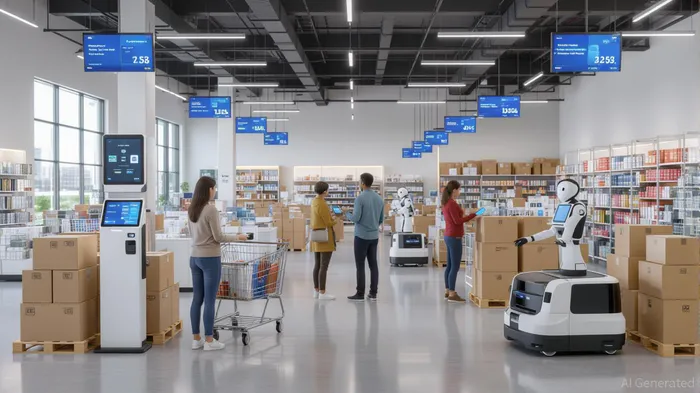
While the provided research lacks granular details on Walmart's AI initiatives, the company's public emphasis on "omnichannel growth" and "supply chain modernization" hints at areas of focus. AI's potential to optimize inventory management, enhance customer segmentation, and reduce operational costs is well-documented. For instance, AI-powered demand forecasting could mitigate supply chain disruptions, a persistent challenge for retailers. Similarly, personalized digital experiences could bolster Walmart's e-commerce platform, which competes with Amazon's AI-driven recommendations.
Retail resilience in the AI era hinges on two pillars: agility in adopting new technologies and the ability to scale innovations profitably. Walmart's $1.5 billion investment in its AI and automation division, announced in 2024, suggests a commitment to these goals. However, the absence of recent analyst reports on the efficacy of these investments introduces uncertainty. Investors must weigh the company's historical execution against the risks of overhyping AI's ROI.
Shareholder Value: Balancing Innovation and Profitability
For Walmart, the leadership transition and AI strategy must ultimately translate into sustainable shareholder returns. Under McMillion, the company maintained a disciplined approach to capital allocation, prioritizing dividends and share buybacks. Furner's challenge will be to balance innovation expenditures with profitability. AI initiatives, while transformative, often require upfront costs that may pressure short-term margins.
Data from Bloomberg indicates that Walmart's stock has underperformed the S&P 500 over the past 12 months, reflecting investor skepticism about its digital transformation. A visual analysis of WMT's price trend could provide insights into market sentiment around the leadership announcement.
Analysts remain divided. Some argue that Walmart's scale and data assets position it to outperform rivals in AI adoption, while others caution against the risks of fragmented implementation. The key will be Furner's ability to integrate AI into core operations without sacrificing Walmart's cost leadership model.
Conclusion: A Test of Strategic Vision
Walmart's leadership transition is more than a personnel change-it is a signal of intent. By appointing Furner, the board has signaled confidence in its ability to navigate the AI-driven retail revolution. However, the absence of concrete details on AI strategies and financial projections leaves room for caution. For investors, the critical question is whether Walmart can harmonize innovation with its operational DNA to sustain resilience and deliver value. The coming years will test Furner's vision and the company's adaptability in an era where AI is no longer a luxury but a necessity.

Delivering real-time insights and analysis on emerging financial trends and market movements.
Latest Articles
Stay ahead of the market.
Get curated U.S. market news, insights and key dates delivered to your inbox.
AInvest
PRO
AInvest
PRO



Comments
No comments yet