
Walmart's Leadership Transition and Its Implications for Retail Stock Valuations


 Aime Summary
Immediate Market Reaction: A 3% Stock Drop and Leadership Uncertainty
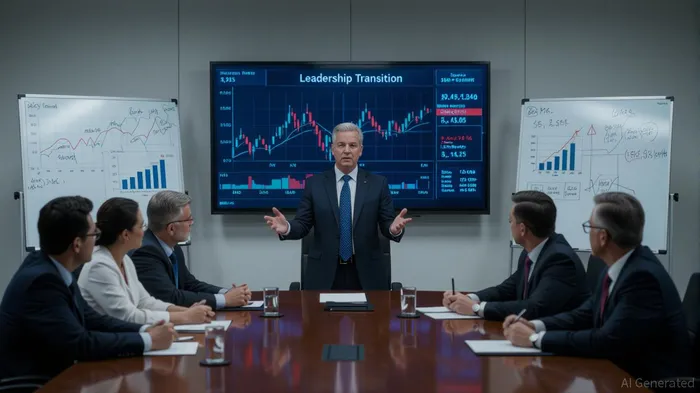
The announcement of McMillon's retirement, effective January 31, 2026, triggered an immediate 3% decline in Walmart's stock during premarket trading, closing at $102.28 on the day. This sharp drop underscores the market's sensitivity to leadership transitions, particularly in a sector where consumer spending trends and operational efficiency are paramount. While internal promotions often signal continuity, the shift to Furner-a U.S. operations chief with deep retail expertise but limited public exposure as a CEO-raised questions about strategic direction, especially for Walmart's e-commerce and omnichannel initiatives according to market analysis.
According to a report by , the stock's volatility reflects broader investor concerns about the retail sector's ability to navigate macroeconomic headwinds, including a hawkish Federal Reserve and soft economic data from China. These factors, combined with leadership uncertainty, created a perfect storm for short-term pessimism.
Strategic Continuity and Analyst Confidence: The Case for Stability
Despite the initial sell-off, analysts from firms like Telsey Advisory Group have reiterated positive ratings for Walmart, emphasizing Furner's 25-year tenure at the company and his track record in driving U.S. retail growth according to market analysis. This internal promotion is seen as a strategic move to preserve institutional knowledge and maintain focus on Walmart's core strengths, such as supply chain optimization and price competitiveness.
John Furner's appointment also aligns with a broader trend in the retail sector: the preference for internal candidates during periods of economic uncertainty. A 2025 study by the National Retail Federation found that 70% of investors view internal CEO transitions as less disruptive than external hires, particularly in industries with thin profit margins. This sentiment appears to be gradually stabilizing Walmart's stock, which has since recovered some of its pre-announcement losses.
Broader Retail Sector Context: A Challenging Macro Environment
Walmart's leadership transition must be viewed through the lens of a broader retail sector grappling with inflationary pressures, shifting consumer preferences, and geopolitical risks. The Federal Reserve's prolonged high-interest-rate environment has dampened consumer spending, while China's economic slowdown has disrupted global supply chains. These macro factors have amplified the sector's sensitivity to leadership changes, as investors seek reassurance about a company's ability to adapt.
For example, Target Corp. (TGT) and Costco Wholesale (COST) have seen mixed stock performances in 2025, with their valuations fluctuating based on both operational results and leadership stability. Walmart's internal succession, however, is perceived as a mitigating factor against sector-wide volatility, given Furner's familiarity with the company's operational challenges.
Conclusion: A Test of Resilience for Retail Stocks
Walmart's CEO transition highlights the delicate balance between leadership continuity and innovation in the retail sector. While the immediate 3% stock drop reflects investor caution, the long-term outlook hinges on Furner's ability to execute Walmart's digital transformation and maintain its cost leadership. For investors, this transition serves as a reminder that CEO succession is not just a corporate event but a catalyst for reevaluating a company's strategic resilience in a volatile market.
As the retail sector navigates these crosscurrents, Walmart's stock may serve as a bellwether for how well internal leadership changes can stabilize-or destabilize-investor confidence.

Delivering real-time insights and analysis on emerging financial trends and market movements.
Latest Articles
Stay ahead of the market.
Get curated U.S. market news, insights and key dates delivered to your inbox.




Comments
No comments yet