
Walmart's Leadership Transition and Its Implications for Retail Stock Valuation


 Aime Summary
A Smooth Succession? The Walmart Case
Walmart's leadership transition follows a relatively structured path. John Furner, who has led the U.S. division since 2019 and has over 30 years of company experience, will take over from McMillon, who will remain on the board and serve as an advisor until 2027 according to Seeking Alpha. This continuity is a deliberate move to mitigate disruption, as Furner's deep familiarity with Walmart's operations-spanning e-commerce, supply chain, and store-level execution-positions him to maintain the company's strategic trajectory according to Seeking Alpha.
However, the market's initial reaction was mixed. Following the announcement, , reflecting investor uncertainty about the transition's short-term risks according to Investing.com. Analysts at Telsey Advisory Group and others have since tempered concerns, , citing confidence in Furner's ability to sustain Walmart's competitive edge in pricing and product mix. , above its historical fair value, suggests that investors are cautiously optimistic but remain sensitive to execution risks citing analyst ratings.
Lessons from Past Retail Transitions
Walmart's case is not unique. The retail sector has seen a surge in leadership changes over the past decade, according to Modern Retail. These transitions often expose vulnerabilities in operational continuity. For instance, ImmuCell Corporation's 2025 leadership shift, which saw appointed as CEO, initially coincided with an 8% decline in product sales. Yet, the company stabilized through operational improvements, according to Seeking Alpha. This underscores the dual-edged nature of leadership changes: while short-term volatility is common, disciplined execution can restore confidence.
Conversely, poorly managed transitions can be catastrophic. The Solorz family's legal battle over media and telecoms empire control highlights how internal conflicts can destabilize operations and erode valuation. When 's succession plan unraveled, it triggered legal disputes, operational instability, and a loss of board control, illustrating the perils of inadequate succession frameworks. Retailers without clear transition plans risk similar fallout, particularly in an era where digital transformation and AI-driven strategies demand agile leadership according to Modern Retail.
Industry-Wide Trends and Retail's "Leadership Vacuum"
The retail sector's high CEO turnover rate-driven by unplanned exits, abrupt retirements, and strategic resets-has created a "leadership vacuum" according to Modern Retail. Boards are increasingly turning to external candidates with cross-industry experience, such as executives from technology or automotive sectors, to navigate complex challenges like e-commerce disruption and according to Spencer Stuart. While this trend may bring fresh perspectives, it also raises questions about cultural alignment and operational continuity.
Walmart's internal succession model, by contrast, offers a counterpoint. Furner's appointment reflects a preference for continuity over radical change, a strategy that has historically minimized disruption. However, the company's reliance on McMillon's advisory role until 2027 signals lingering concerns about the transition's complexity. This mirrors broader industry patterns: 64% of retail CEO exits in 2025 were unplanned, according to Modern Retail, forcing boards to prioritize stability over innovation.
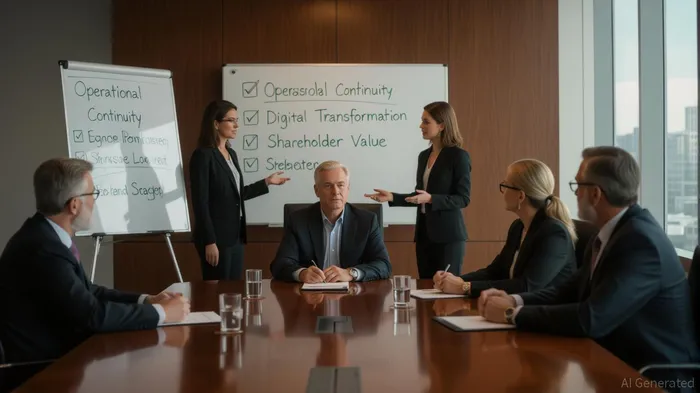
Implications for Retail Stock Valuation
For investors, the key question is whether Walmart's transition will reinforce or undermine its valuation. The company's current stock price, while volatile post-announcement, remains supported by strong fundamentals: a 12-year legacy under McMillon, , and a dominant position in U.S. retail according to Seeking Alpha. However, the broader sector's sensitivity to leadership changes cannot be ignored.
Historical data shows that retail stocks often experience short-term underperformance following transitions, with recovery hinging on operational execution. For example, according to Seeking Alpha. Similarly, Walmart's success will depend on Furner's ability to maintain its value-focused strategy while addressing emerging challenges like inflationary pressures and citing analyst ratings.
Conclusion
Walmart's leadership transition, while internally driven, occurs against a backdrop of heightened succession risk in the retail sector. The company's emphasis on continuity-through Furner's appointment and McMillon's advisory role-suggests a calculated effort to minimize disruption. Yet, the broader industry's trend of unplanned exits and external hires highlights the fragility of operational continuity in an era of rapid change. For investors, the lesson is clear: while Walmart's transition appears well-managed, the retail sector's valuation dynamics will remain closely tied to how effectively new leaders navigate both internal and external uncertainties.

Delivering real-time insights and analysis on emerging financial trends and market movements.
Latest Articles
Stay ahead of the market.
Get curated U.S. market news, insights and key dates delivered to your inbox.
AInvest
PRO
AInvest
PRO



Comments
No comments yet