
Walmart's Leadership Transition and Its Implications for Retail Stock Performance


 Aime Summary
A Smooth Transition, But Risks Linger
McMillon, who has led WalmartWMT-- since 2014, will remain on the board until June 2026 and serve as an advisor to Furner through 2027, a move designed to ease the transition. Furner, a 30-year Walmart veteran, has overseen the company's U.S. operations since 2019, managing 4,600 stores and driving digital initiatives like same-day delivery. His deep institutional knowledge is seen as a mitigant to succession risk, particularly compared to external hires, which often face integration challenges.
However, the stock's immediate reaction suggests lingering uncertainty. According to a report by MarketWatch, the 3% drop reflects investor skepticism about whether Furner can sustain Walmart's recent gains in e-commerce and supply chain efficiency. This contrasts with Amazon's more volatile leadership dynamics, where CEO Andy Jassy's focus on high-margin tech ventures has left physical retail segments like Amazon Fresh underperforming as reported by Darden Insights.
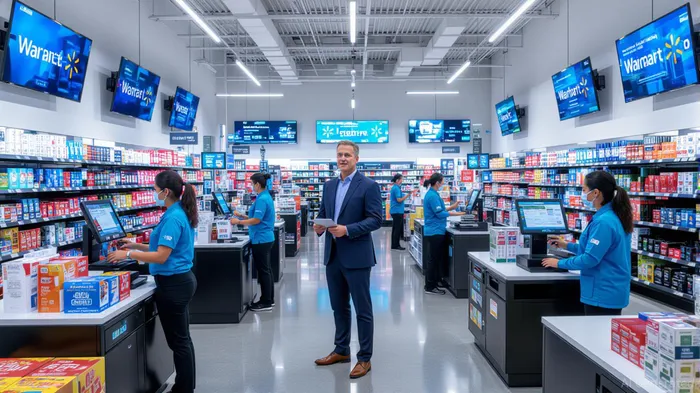
Operational Continuity: A Strategic Strength
Furner's appointment signals continuity in Walmart's strategic priorities. Analysts note that he will likely double down on digital transformation, associate engagement, and AI-driven operational efficiency-initiatives that have underpinned Walmart's recent outperformance. For instance, the company's investment in AI-powered employee training and IoT-based inventory management has improved productivity while reducing costs.
Moreover, Furner's track record in managing U.S. operations during periods of rapid digital acceleration-such as the expansion of Walmart+-positions him to navigate emerging challenges like global tariffs and AI integration as noted by Reuters. This contrasts with Target's recent leadership shift, where new CEO faces the challenge of in Q2 2025.
Sector-Wide Implications: Stability vs. Innovation
Walmart's transition reflects a broader retail sector trend: the balance between stability and innovation. While Amazon bets on moonshot tech ventures, Walmart's methodical approach-expanding delivery networks to 93% of U.S. households and acquiring VIZIO for digital advertising-has delivered consistent revenue growth. This stability is a key differentiator. As stated by Deloitte Insights, , areas where Walmart's omnichannel strategy excels.
Comparatively, Target's new leadership emphasizes AI-driven efficiency and merchandising over aggressive digital expansion, a strategy that may struggle to match Walmart's scale as reported by Constellation R. Amazon, meanwhile, remains a wildcard, . digital sales as noted in Darden research.
Investor Confidence: A Mixed Outlook
For long-term investors, the transition presents both opportunities and risks. On the positive side, Walmart's financial flexibility-$22 billion in annual capital expenditures and a robust balance sheet-positions it to weather macroeconomic headwinds as detailed in the company's 2025 report. Furner's focus on growing operating profits faster than sales also aligns with shareholder value creation.
Yet, the stock's post-announcement dip underscores concerns about short-term volatility. Analysts at Morningstar note that while Walmart's fair value estimate has been cautiously revised upward, the market remains wary of execution risks as reported by Yahoo Finance. This contrasts with Amazon's stock, which has seen more speculative momentum despite its physical retail struggles as observed in Darden analysis.
Conclusion: A Test of Resilience
Walmart's leadership transition is a case study in balancing continuity with innovation. While Furner's internal promotion reduces succession risk, the retail sector's rapid evolution-driven by AI, tariffs, and shifting consumer habits-will test his ability to sustain growth. For investors, the key takeaway is that Walmart's strategic focus on operational efficiency and digital expansion offers a more predictable path to long-term value compared to rivals like Amazon. However, the stock's immediate reaction serves as a reminder that even well-planned transitions can unsettle markets.
As the retail landscape continues to fragment, Walmart's ability to adapt without losing its operational DNA will be critical. For now, the company's deep bench of talent and proven strategies suggest it is well-positioned to navigate the next chapter.

Delivering real-time insights and analysis on emerging financial trends and market movements.
Latest Articles
Stay ahead of the market.
Get curated U.S. market news, insights and key dates delivered to your inbox.
AInvest
PRO
AInvest
PRO



Comments
No comments yet