
Walmart's Leadership Transition and Its Implications for Retail Investors


 Aime Summary
Succession Strategy: A Bet on Internal Expertise
Walmart's decision to promote John Furner-a 30-year veteran who began as an hourly associate and has led U.S. operations since 2019-underscores its commitment to continuity. Furner's deep institutional knowledge and track record of steering Walmart U.S. through economic volatility position him as a natural successor to McMillon, whose 12-year tenure saw the company's market cap quadruple [1]. The structured handover, with McMillon remaining on the board and as an advisor until 2027, further mitigates risks of abrupt strategic shifts.
This approach contrasts with peers like Target, which has faced leadership challenges amid declining traffic and revenue. Walmart's internal promotion strategy, as noted by analysts, signals "a vote of confidence in its retail playbook," particularly its ability to balance affordability with margin management [3]. By prioritizing operational continuity, Walmart aims to preserve its dominance in a sector where customer loyalty is increasingly tied to value and convenience.
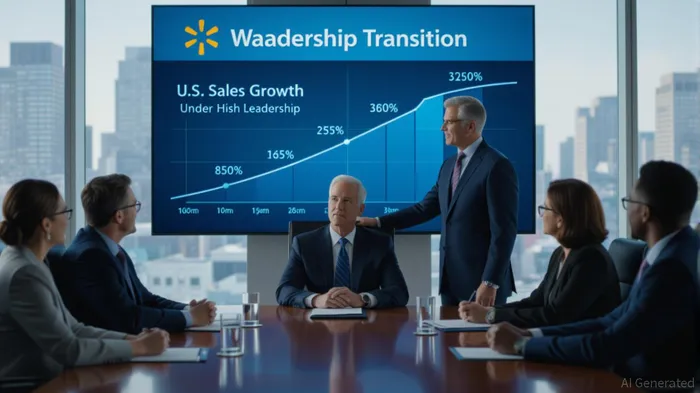
Operational Performance: Resilience in a Post-Pandemic Era
Under Furner's stewardship, Walmart U.S. accounted for 69% of the company's $340 billion in net sales during the first half of fiscal 2026 . Q3 2025 results reinforced this strength: revenue grew 6.1% in constant currency, e-commerce sales surged 27%, and gross margins expanded by 21 basis points [4]. These figures outpace competitors like Target, which reported a 0.9% revenue decline in the same period [3].
Walmart's "portfolio approach" to pricing-raising costs selectively while maintaining low prices on essentials-has proven effective in navigating inflation. This strategy, as highlighted by CNBC, allows the company to absorb tariff-driven costs without alienating price-sensitive shoppers [2]. In contrast, Amazon's reliance on third-party sellers has led to steeper price increases (12.8% year-to-date), potentially eroding its customer base [2].
Risks and Opportunities for Investors
While Walmart's financials are robust, the transition introduces short-term uncertainties. The market's initial skepticism-reflected in the 3% share drop-suggests concerns about whether Furner can replicate McMillon's success. However, analysts remain cautiously optimistic. BofA and Wolfe Research have upgraded their price targets to $125 and $129 per share, respectively, citing Walmart's AI-driven commerce initiatives and supply chain innovations [5].
Long-term risks include Amazon's aggressive expansion and Target's potential to recalibrate its value proposition. Yet, Walmart's first-mover advantage in omnichannel retail and its $2.5 billion monthly store-fulfilled delivery system provide a formidable moat [4]. For investors, the key will be monitoring how effectively Furner executes McMillon's legacy while adapting to evolving consumer demands.
Broader Implications for Retail Sector Investing
Walmart's leadership transition offers a blueprint for how established retailers can navigate macroeconomic headwinds. Its focus on operational efficiency and customer-centric pricing contrasts with the "disruptive" strategies of newer entrants like Amazon. In a post-pandemic world where inflation remains a concern, Walmart's ability to balance affordability with profitability may serve as a benchmark for the sector.
Investors should also consider the ripple effects of Walmart's strategies. For instance, its AI-driven inventory systems and AI-powered commerce initiatives could redefine industry standards, pressuring competitors to invest heavily in technology [5]. This dynamic may favor capital-efficient players like Walmart, which has consistently outperformed peers in cost control.
Conclusion
John Furner's ascension to CEO represents more than a leadership change-it is a strategic statement about Walmart's confidence in its retail model. While the market's initial reaction was mixed, the company's operational resilience and structured succession plan suggest a smooth transition. For retail investors, the broader takeaway is clear: in an era of economic uncertainty, companies that prioritize continuity, innovation, and customer value are best positioned to thrive.

Delivering real-time insights and analysis on emerging financial trends and market movements.
Latest Articles
Stay ahead of the market.
Get curated U.S. market news, insights and key dates delivered to your inbox.




Comments
No comments yet