
Walmart's Leadership Shift and Strategic Implications: Navigating Retail Volatility with Insider Succession


 Aime Summary
A Retail Sector on Edge: Volatility and the Need for Steady Leadership
The U.S. retail landscape in 2024-2025 is a patchwork of challenges and opportunities. Total industry revenue hit $7.4 trillion in 2025, but growth is tepid at just 0.2%. Discretionary spending is under pressure, operating costs are soaring, and tariffs have intensified price competition-particularly in the digital space. Yet, essential retailers like Walmart have shown resilience, with e-commerce sales growing 6.3% in 2024. This duality-between survival and innovation-has made leadership continuity a critical factor in investor calculus.
Walmart's decision to promote from within, rather than seek an external CEO, signals a commitment to preserving the operational discipline that has long defined the company. Furner's 30-year tenure, starting as an hourly associate, underscores his deep institutional knowledge. As Bloomberg noted, McMillion's endorsement of Furner as the "right person to lead the company through the next era of growth" has reassured markets that Walmart's DNA-low prices, operational efficiency, and customer focus-will remain intact.
Furner's Playbook: AI, Stores of the Future, and Investor Trust
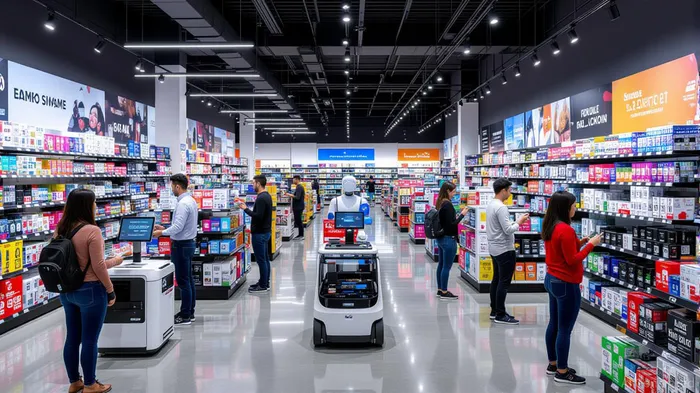
Furner's leadership has already proven its mettle. Under his stewardship, Walmart's U.S. division has driven a 18% contribution from e-commerce in FY2025, up from 15.4% the prior year. His strategic pillars-digital transformation, employee development, and sustainability-are now central to the company's roadmap. For instance, Walmart's "Store of the Future" initiative, which will modernize 650 locations in 2025, aims to create a seamless omnichannel experience. These investments are not just about growth; they're about future-proofing against the kind of volatility that has felled less agile competitors.
Analysts are taking note. Yahoo Finance reports that several firms have raised price targets for Walmart, citing Furner's track record in navigating economic uncertainty. His emphasis on AI and automation-such as optimizing supply chains and predicting buying trends-aligns with the sector's broader shift toward data-driven decision-making according to IbisWorld. Yet, as Deloitte's 2024 retail outlook highlights, only 50% of retail executives feel confident in their AI capabilities. Walmart's early adoption gives it a critical edge.
The Investor Angle: Why This Transition Matters
Leadership changes in retail have historically been a double-edged sword. While 2024 saw over 7,100 U.S. store closures and 170,000 job losses, Walmart's orderly succession plan has mitigated uncertainty. Furner's role as CEO of Walmart U.S. until 2026, coupled with McMillion's advisory role through 2027, ensures a smooth handover. This contrasts sharply with the abrupt exits at companies like Target and Best Buy, where leadership shifts have often coincided with stock volatility.
Moreover, Walmart's focus on loyalty programs and personalized experiences-exemplified by Ulta Beauty's 94% sales tied to its loyalty base-positions it to capitalize on consumer behavior trends. Furner's strategy to eliminate synthetic dyes and harmful ingredients from private-label products by 2027 according to DBBNWA also taps into the growing demand for ethical consumption, a key driver of brand loyalty.
Conclusion: A Retail Titan's Next Act
Walmart's leadership transition is more than a personnel change-it's a strategic masterstroke. By appointing an insider with a proven ability to balance innovation with operational rigor, the company is sending a clear message: it's prepared to dominate the AI-driven retail landscape while maintaining its core strengths. For investors, this means a stock that's not just resilient but forward-looking. As the retail sector grapples with volatility, Walmart's playbook-anchored by Furner's leadership-offers a blueprint for sustained growth.

Delivering real-time insights and analysis on emerging financial trends and market movements.
Latest Articles
Stay ahead of the market.
Get curated U.S. market news, insights and key dates delivered to your inbox.




Comments
No comments yet