
Walmart's Fashion Strategy: Outpacing Target in the Battle for Main Street Retail Supremacy
 Aime Summary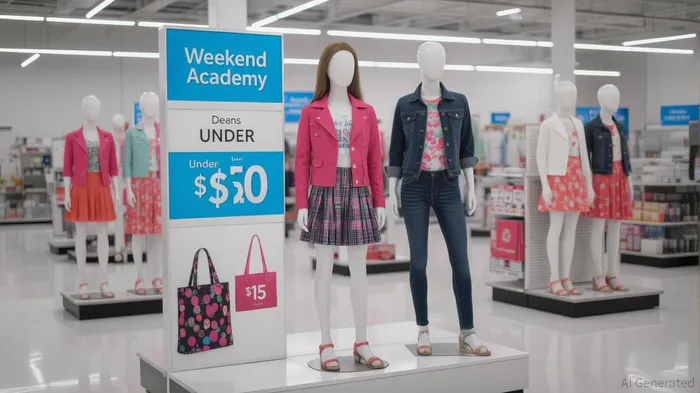
The retail sector is undergoing a seismic shift as consumer priorities evolve in the post-pandemic era. Walmart's aggressive pivot toward trendy, affordable fashion has not only redefined its brand identity but also positioned it to outpace rivals like TargetTGT-- in the battle for Main Street dominance. By leveraging private-label brands, digital innovation, and a relentless focus on value, WalmartWMT-- is reshaping consumer behavior and redefining the rules of retail competition. For investors, this strategy offers a compelling case study in sector disruption and value creation.
The Rise of Private Labels: A Strategic Reboot
Walmart's fashion strategy hinges on its private-label ecosystem, which now accounts for 20-25% of total sales. Brands like Weekend Academy (for tweens), Bettergoods (groceries), and Great Value (personal care) are designed to blend affordability with trendiness. For instance, Weekend Academy offers full outfits under $50, directly targeting budget-conscious families without sacrificing style. This approach has proven particularly effective in a climate where 47% of U.S. consumers wait for sales or promotions before purchasing apparel, as highlighted by the State of the Consumer 2025 report.
Walmart's private-label success is underpinned by its ability to optimize costs through automation and supplier relationships. The company's 2025 e-commerce revenue, at 18% of total sales, is bolstered by Walmart Connect, its retail media network, which drives private-label visibility. In contrast, Target's private-label brands, while innovative (e.g., Hearth & Hand with Magnolia), cater to a more affluent demographic and face challenges when economic pressures force consumers to prioritize essentials over discretionary spending.
Retail Sector Disruption: Value vs. Lifestyle
The clash between Walmart and Target reflects a broader tension in retail: value-driven pragmatism versus curated lifestyle branding. Walmart's “Everyday Low Prices” model has gained traction as inflation and economic uncertainty persist. For example, Indagari data shows that 30% of customers who left Target post-2023 shifted their next three purchases to Walmart, signaling a long-term realignment of consumer loyalty.
Target's strength lies in its design-forward approach, with private-label brands like Good & Gather (groceries) and All in Motion (activewear) commanding premium margins. However, its reliance on a “value plus” strategy—combining affordability with style—has exposed vulnerabilities during periods of economic stress. While Target's private labels contributed $30 billion in 2023 revenue, Walmart's scale and pricing discipline have allowed it to capture a larger share of price-sensitive shoppers, particularly in suburban and rural markets.
Investor Implications: Private Labels as a Growth Engine
For investors, the rise of private-label brands represents a key driver of retail stock performance. Walmart's private-label sales have grown steadily, with 2025 Q1 results showing 20-25% of total sales attributed to these lines. This compares favorably to Target's 30% private-label revenue share, though Target's higher-margin categories (e.g., home goods) offset some of Walmart's volume-driven gains.
The financial resilience of private-label strategies is evident in both companies' stock trajectories. Walmart's shares have outperformed Target's in 2025, reflecting investor confidence in its cost-optimization and digital integration. Meanwhile, Target's stock remains sensitive to macroeconomic shifts, as seen in its 2023 earnings surge (driven by private labels) followed by a 2024 correction amid inflationary pressures.
The Future of Value-Focused Retail
Looking ahead, Walmart's strategy is poised to benefit from several tailwinds. First, the normalization of e-commerce and digital shopping has amplified the reach of private-label brands. Walmart's 31% year-over-year ad revenue growth via Walmart Connect underscores its ability to monetize its platform while driving private-label sales. Second, the company's focus on automation and AI-driven personalization is likely to enhance customer retention and reduce operational costs.
Target, meanwhile, must balance its design-driven identity with the need to remain competitive on price. Its recent forays into wellness and fitness categories, such as the All in Motion line, could attract new demographics but may struggle to gain traction in a market increasingly prioritizing affordability.
Investment Advice: Positioning for the New Retail Landscape
For investors, the key takeaway is clear: private-label brands are no longer a niche strategy but a core component of retail resilience. Walmart's ability to combine scale, innovation, and value positioning makes it a compelling long-term bet, particularly in a macroeconomic environment where price sensitivity remains high. Target, while still a strong performer, faces greater volatility due to its reliance on discretionary spending.
Investors should also monitor Walmart's sustainability initiatives, as consumer demand for ethically produced goods grows. Though the company has not yet detailed specific sustainability efforts in its private-label lines, aligning with this trend could further differentiate its offerings.
In conclusion, Walmart's fashion strategy exemplifies how brand reinvention can drive sector disruption. By redefining value as a blend of affordability, quality, and trendiness, Walmart is not just outpacing Target—it is reshaping the future of retail for Main Street. For investors, the message is straightforward: the retailers that best navigate the tension between value and innovation will dominate the next era of consumer spending.

Stay ahead of the market.
Get curated U.S. market news, insights and key dates delivered to your inbox.
AInvest
PRO
AInvest
PRO



Comments
No comments yet