
Walmart's Competitive Resilience in 2025: Earnings Outperformance and Stock Volatility Amid Retail Evolution


 Aime Summary
In the ever-shifting landscape of global retail, Walmart Inc.WMT-- (NYSE: WMT) has demonstrated a unique ability to adapt to macroeconomic headwinds and competitive pressures. As of Q3 2025, the company
reported adjusted earnings per share of $0.62, exceeding analyst estimates of $0.60, while revenue surged to $179.5 billion-a 5.8% year-over-year increase. Despite these robust financial results, Walmart's stock price fell by 2.1% following the earnings announcement, raising questions about investor sentiment and the broader market's expectations for the retail giant. This article examines Walmart's competitive resilience in 2025, analyzing its earnings performance, strategic initiatives, and the factors driving its stock volatility in the context of evolving retail dynamics.
Earnings Outperformance and Strategic Strengths
Walmart's Q3 2025 results underscore its dominance in both physical and digital retail. The company's U.S. comparable sales rose 4.5%,
driven by aggressive pricing strategies and a focus on value-conscious consumers. Its e-commerce business, a critical battleground against Amazon,
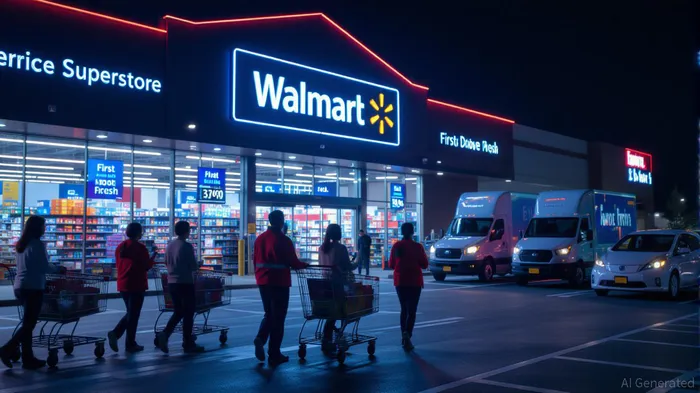
grew 27% globally, with the U.S. segment contributing significantly to this momentum. This growth is underpinned by Walmart's "First-Day Fresh" campaign, which has resonated with budget-conscious shoppers during inflationary periods,
capturing 49% of consumer sentiment as the best back-to-school deal provider.
However, the company's Q1 FY26 earnings report revealed a more nuanced picture. While U.S. same-store sales accelerated to 4.6%,
adjusted EPS of $0.68 fell short of the $0.74 forecast, prompting a 4.5% stock decline. The earnings miss was attributed to one-time charges related to legal and restructuring costs, as well as rising inventory replenishment expenses post-tariff adjustments. CEO Doug McMillon emphasized Walmart's commitment to maintaining low prices despite these pressures,
signaling a strategic focus on long-term consumer loyalty over short-term margin optimization.
Competitive Resilience: WalmartWMT-- vs. Amazon vs. Target
Walmart's ability to outperform rivals like Amazon and Target in 2025 hinges on its dual focus on pricing and operational efficiency. Amazon, with its diversified revenue streams (e.g., AWS, advertising),
reported $167.7 billion in Q2 revenue and a 13% year-over-year growth, leveraging its Prime Day event to dominate back-to-school shopping. However, Walmart's localized pricing strategies and physical footprint-4,600 superstores serving as same-day fulfillment hubs-have
allowed it to capture market share in a price-sensitive environment.
Target, meanwhile, faces a "no-man's land" challenge. Despite a 4.3% digital sales growth,
its Q2 2025 results showed a 0.9% revenue decline and a 3.2% drop in comparable store sales. This underperformance highlights the difficulty of balancing value and convenience, as budget shoppers gravitate toward Walmart and convenience-driven buyers favor Amazon's logistics network.
E-Commerce and Supply Chain Innovations
Walmart's e-commerce profitability, achieved in Q1 FY26, now accounts for 20% of U.S. sales.
This transformation is driven by automation in four next-generation fulfillment centers, which have reduced labor and unit costs by 20%, and a strategic loop of density-driven delivery, paid speed, and high-margin advertising. The introduction of 3-hour "Express" delivery windows has further boosted basket sizes and fee revenue, enhancing gross margins.
The company's supply chain efficiency is another cornerstone of its resilience. By leveraging superstores for same-day delivery, Walmart ensures 93% of U.S. households have access to rapid fulfillment, reducing last-mile costs and improving customer retention. These innovations position Walmart to compete effectively with Amazon's logistics prowess while maintaining a cost structure that supports long-term profitability.
Stock Volatility: Earnings vs. Expectations
The post-earnings stock decline reflects a disconnect between Walmart's operational performance and investor expectations. While the company
raised FY26 guidance-projecting 4.8% to 5.1% net sales growth and 4.8% to 5.5% adjusted operating income growth in constant currency- the market appears skeptical about its ability to sustain margin improvements. The Q1 FY26 earnings miss, coupled with anticipated cost pressures in H2 2025, has
led to a reevaluation of its growth trajectory.
Broader market dynamics, including sector-wide volatility and macroeconomic uncertainties, may also contribute to the stock's underperformance. However, Walmart's strong balance sheet and resilient consumer demand suggest that its fundamentals remain intact, even as short-term headwinds persist.
Conclusion: A Resilient Retailer in a Fragmented Market
Walmart's 2025 performance illustrates its capacity to navigate a fragmented retail landscape defined by e-commerce growth, inflationary pressures, and competitive rivalry. While its stock volatility reflects investor caution, the company's strategic focus on pricing, supply chain efficiency, and digital innovation positions it as a long-term winner in the retail sector. For investors, the key question is whether Walmart can maintain its margin resilience amid rising costs and evolving consumer preferences-a challenge it has historically met with adaptability and scale.

Stay ahead of the market.
Get curated U.S. market news, insights and key dates delivered to your inbox.




Comments
No comments yet