
Walmart's CEO Transition and Its Implications for Retail Stock Volatility


 Aime Summary
Leadership Continuity: A Bridge Between Stability and Innovation
Doug McMillon's 12-year tenure as CEO has been defined by a dual focus on operational efficiency and digital transformation. Under his leadership, Walmart's market capitalization quadrupled, , outperforming the S&P 500 by a significant margin according to Seeking Alpha. His successor, , brings deep institutional knowledge, having led WalmartWMT-- U.S. . This internal promotion signals continuity, as Furner has already demonstrated success in scaling e-commerce, optimizing supply chains, and integrating AI-driven inventory systems according to Seeking Alpha.
However, the transition is not without risks. While McMillon will remain on the board until June 2026 and serve as an advisor through 2027, the absence of a clear replacement for Furner in the U.S. segment introduces uncertainty. Historically, retail CEO transitions have led to short-term stock volatility, according to Finance Monthly. For Walmart, the key question is whether Furner's operational expertise will mitigate these risks or if the lack of a fully mapped-out succession plan could amplify investor anxiety.
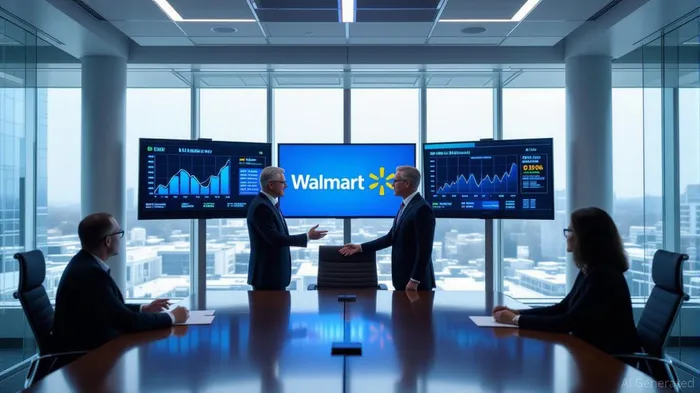
Investor Sentiment: A Mixed Bag of Optimism and Caution
The immediate market reaction to the announcement was telling: Walmart shares fell over 3% on the news, reflecting skepticism about the transition's short-term impact according to Seeking Alpha. This aligns with broader trends in the consumer discretionary sector, which has underperformed the S&P 500 in 2024, according to SP Global. Analysts attribute this to factors like depleted consumer savings, high inflation, and job market uncertainty, which have dampened spending on nonessential goods.
Yet, long-term optimism persists. of GlobalData has praised McMillon's tenure as a "masterclass in resilience," crediting his ability to transform Walmart into a digitally integrated retail powerhouse according to Finance Monthly. Analysts from BofA and Goldman Sachs echo this sentiment, highlighting Furner's potential to accelerate AI-driven initiatives and global expansion according to Finance Monthly. However, , citing mixed Q2 performance and macroeconomic risks according to Yahoo Finance. This duality-between strategic confidence and economic caution-underscores the sector's inherent volatility.
Historical Context: Retail Sector Volatility and CEO Transitions
The consumer discretionary sector has historically experienced higher CEO turnover than other industries. In 2024, , according to Spencer Stuart. Research from the New York Fed indicates that forced CEO turnovers and external appointments typically increase equity volatility, as markets grapple with uncertainty about the successor's ability to execute strategic priorities according to New York Fed.
For Walmart, the transition's internal nature may mitigate some of this volatility. Furner's deep familiarity with Walmart's operations reduces the risk of abrupt strategic pivots, a factor that could stabilize investor sentiment. However, the broader retail sector's sensitivity to macroeconomic shifts-such as inflationary pressures and potential trade policy changes under the 2025 U.S. presidential administration-means that external factors will likely play a larger role in shaping stock performance than the CEO transition itself according to SP Global.
Conclusion: Navigating the Crossroads of Continuity and Uncertainty
Walmart's CEO transition represents a pivotal moment for the retail sector. While Furner's appointment offers a clear path of continuity, the broader consumer discretionary landscape remains fraught with challenges. Investors must weigh the company's operational strengths against macroeconomic headwinds and sector-specific risks. For now, the market appears to be hedging its bets: short-term volatility is likely, but long-term confidence in Walmart's strategic resilience remains intact.
As the 2025 presidential inauguration looms, policy shifts-whether in tax cuts, infrastructure spending, or trade regulations-could further complicate the retail sector's trajectory. For Walmart, the coming months will test not only Furner's leadership but also the sector's ability to adapt in an era of perpetual disruption.

Delivering real-time insights and analysis on emerging financial trends and market movements.
Latest Articles
Stay ahead of the market.
Get curated U.S. market news, insights and key dates delivered to your inbox.




Comments
No comments yet