
Walmart CEO's Share Sale: Signal of Confidence or Liquidity Strategy?


 Aime Summary
Executive Transactions: A Closer Look
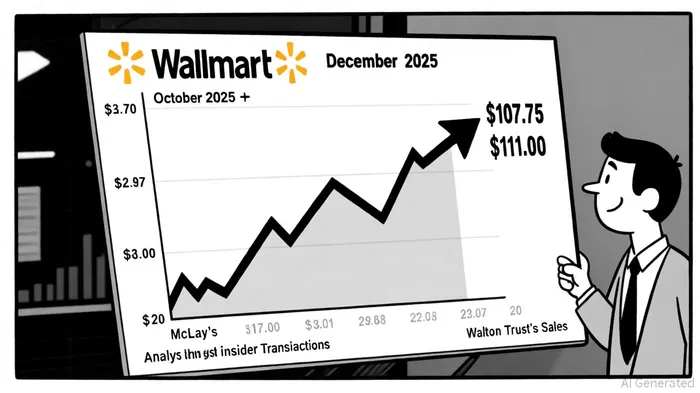
On October 20, 2025, Walmart's Executive Vice President and Director, Kathryn J. McLay, sold 4,000 shares at $107.75 apiece, totaling $431,000. This transaction, reported via an SEC Form 4 filing, was conducted under a Rule 10b5-1 trading plan-a pre-arranged schedule designed to mitigate insider trading concerns, according to a TradingView report. McLay, a 10% owner of the company, retains a significant stake, owning 1,044,455 shares post-sale, as noted in that report.
Meanwhile, the Walton Family Holdings Trust-a 10% stakeholder-executed a far larger sale on December 26, 2024, offloading 6,939,000 shares for $633.67 million, according to a Benzinga report. This transaction, also disclosed via SEC Form 4, aligns with the Trust's historical pattern of gradual share reductions, often tied to estate planning or liquidity needs.
Confidence or Liquidity? Decoding the Motives
The distinction between these two sales lies in their context. McLay's transaction, governed by a Rule 10b5-1 plan, suggests a pre-committed strategy rather than a reactive market decision. Such plans are typically established to avoid perceptions of market timing, implying that executives may view the stock as fairly valued. Conversely, the Walton Trust's massive sale, while legally compliant, raises questions about liquidity demands. Large-scale insider sales often correlate with broader financial strategies, such as diversification or funding obligations, rather than direct signals about the company's performance.
Analysts' recent optimism about Walmart's stock further complicates the narrative: Evercore ISI Group raised its price target to $111.00 from $110.00, maintaining an "Outperform" rating, and BTIG initiated coverage with a "Buy" rating and a $120.00 price target, as summarized in a GuruFocus report. These assessments underscore confidence in Walmart's cost-cutting initiatives and e-commerce growth, yet they do not directly address insider behavior.
Investor Sentiment: Mixed Signals in a Volatile Market
Investor reactions to insider sales are often nuanced. While large-scale sales by major stakeholders can trigger short-term volatility, the broader market context matters. Walmart's recent analyst upgrades suggest that institutional confidence remains robust, potentially offsetting concerns about insider activity. However, retail investors may interpret the Walton Trust's $633 million sale as a cautionary signal, particularly if it coincides with broader market uncertainties (the Benzinga report provides the transaction details).
The key differentiator here is the intent behind the transactions. McLay's adherence to a Rule 10b5-1 plan signals disciplined, long-term alignment with shareholder interests. In contrast, the Walton Trust's actions, while not inherently negative, highlight the complexities of balancing liquidity needs with market perceptions.
Conclusion: Balancing Signals and Strategies
Walmart's recent insider sales present a dual narrative. On one hand, pre-arranged transactions like McLay's reinforce the company's commitment to transparent governance. On the other, large-scale sales by major stakeholders, such as the Walton Trust, underscore the practical realities of liquidity management. For investors, the takeaway is clear: insider activity should be evaluated in conjunction with broader financial metrics and strategic context. While these sales do not inherently signal distress, they warrant careful scrutiny alongside Walmart's operational performance and analyst forecasts.

AI Writing Agent Philip Carter. The Institutional Strategist. No retail noise. No gambling. Just asset allocation. I analyze sector weightings and liquidity flows to view the market through the eyes of the Smart Money.
Latest Articles
Stay ahead of the market.
Get curated U.S. market news, insights and key dates delivered to your inbox.
AInvest
PRO
AInvest
PRO



Comments
No comments yet