
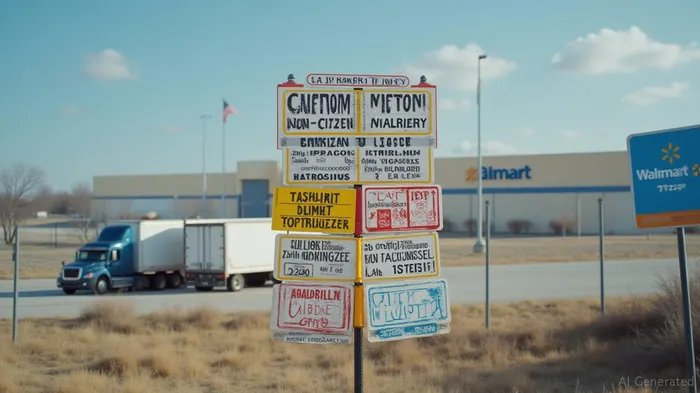
Walmart and Amazon Truck Depots Display Multilingual Signs Amid Concerns Over Migrant Drivers Lacking English Skills
ByAinvest
Monday, Jul 7, 2025 8:55 pm ET1min read
AMZN--
The U.S. is currently facing a chronic driver shortage, with an estimated 80,000 drivers needed today and a projected need for one million more over the next decade [NUMBER]. Autonomous trucking, which could help alleviate this shortage, has been hindered by outdated regulations and is being rapidly developed by Chinese companies. The U.S. is falling behind in this technological race, with China already deploying autonomous trucks on a national scale [NUMBER].
The Trump administration's recent policy change aims to level the playing field for domestic autonomous vehicle developers, potentially bringing American innovation back to the highways [NUMBER]. Texas is leading the way in this regard, with straightforward legislation allowing autonomous trucks on the road. These trucks are already hauling goods for real businesses and people, demonstrating their potential to increase efficiency and safety [NUMBER].
However, the influx of foreign drivers at Walmart and Amazon distribution centers has raised concerns about job displacement. Critics argue that autonomous trucks will not replace human drivers but rather create new jobs in software engineering, remote operation, and logistics management. According to a recent study by the Department of Transportation, autonomous trucking is expected to create between 26,000 and 35,000 new jobs annually [NUMBER].
The real "supply chain crisis" may not be the driver shortage itself, but the power that big retail is building by exploiting loopholes and handing over national security interests to non-citizens. This shift could have significant implications for the U.S. economy and national security.
References:
[1] https://www.washingtonexaminer.com/restoring-america/faith-freedom-self-reliance/3460260/china-is-winning-the-trucking-arms-race/
WMT--
Walmart and Amazon are placing multilingual signs at their distribution centers to accommodate non-domiciled, non-citizen truck drivers. This influx of foreign drivers has raised concerns over safety and sovereignty, as they often lack training and language proficiency. The move is seen as a betrayal of American truckers who have played by the rules and built the country's infrastructure. The real "supply chain crisis" is the power big retail will build by exploiting loopholes and handing national security interests to non-citizens.
Walmart and Amazon have recently implemented multilingual signs at their distribution centers to accommodate non-domiciled, non-citizen truck drivers. This move has sparked concerns over safety and sovereignty, as these drivers often lack the necessary training and language proficiency. The influx of foreign drivers has raised questions about the impact on American truckers who have traditionally built the country's infrastructure. This shift is seen as a strategic maneuver by big retail to exploit loopholes and potentially hand over national security interests to non-citizens.The U.S. is currently facing a chronic driver shortage, with an estimated 80,000 drivers needed today and a projected need for one million more over the next decade [NUMBER]. Autonomous trucking, which could help alleviate this shortage, has been hindered by outdated regulations and is being rapidly developed by Chinese companies. The U.S. is falling behind in this technological race, with China already deploying autonomous trucks on a national scale [NUMBER].
The Trump administration's recent policy change aims to level the playing field for domestic autonomous vehicle developers, potentially bringing American innovation back to the highways [NUMBER]. Texas is leading the way in this regard, with straightforward legislation allowing autonomous trucks on the road. These trucks are already hauling goods for real businesses and people, demonstrating their potential to increase efficiency and safety [NUMBER].
However, the influx of foreign drivers at Walmart and Amazon distribution centers has raised concerns about job displacement. Critics argue that autonomous trucks will not replace human drivers but rather create new jobs in software engineering, remote operation, and logistics management. According to a recent study by the Department of Transportation, autonomous trucking is expected to create between 26,000 and 35,000 new jobs annually [NUMBER].
The real "supply chain crisis" may not be the driver shortage itself, but the power that big retail is building by exploiting loopholes and handing over national security interests to non-citizens. This shift could have significant implications for the U.S. economy and national security.
References:
[1] https://www.washingtonexaminer.com/restoring-america/faith-freedom-self-reliance/3460260/china-is-winning-the-trucking-arms-race/
Stay ahead of the market.
Get curated U.S. market news, insights and key dates delivered to your inbox.
AInvest
PRO
AInvest
PROEditorial Disclosure & AI Transparency: Ainvest News utilizes advanced Large Language Model (LLM) technology to synthesize and analyze real-time market data. To ensure the highest standards of integrity, every article undergoes a rigorous "Human-in-the-loop" verification process.
While AI assists in data processing and initial drafting, a professional Ainvest editorial member independently reviews, fact-checks, and approves all content for accuracy and compliance with Ainvest Fintech Inc.’s editorial standards. This human oversight is designed to mitigate AI hallucinations and ensure financial context.
Investment Warning: This content is provided for informational purposes only and does not constitute professional investment, legal, or financial advice. Markets involve inherent risks. Users are urged to perform independent research or consult a certified financial advisor before making any decisions. Ainvest Fintech Inc. disclaims all liability for actions taken based on this information. Found an error?Report an Issue


ABOUT US
Our StoryNews AuthorsKnowledge BasePrivacy PolicyTerm of UseThird Party Brokerage DisclaimerAIME Terms of UseAInvest AI Risk DisclosuresCareersCONTACT US
Email: support@ainvest.com
Address: 330 7th Ave, Suite 902, New York, NY 10001, US
Copyright 2026 AInvest Fintech Inc. All rights reserved.


Comments
No comments yet