
Walmart's 2026 Transformation: A Strategic Edge in AI, Automation, and Consumer Trends


 Aime Summary
Walmart's 2026 leadership transition and strategic pivot toward AI-driven innovation mark a pivotal inflection point for the retail giant. As Doug McMillion steps down on January 31, 2026, and John Furner assumes the CEO role, the company is poised to leverage its decade-long digital transformation to cement its dominance in a retail landscape increasingly defined by technological agility and operational efficiency. This analysis examines how Walmart's integration of AI, automation, and consumer-centric strategies under Furner's leadership positions it to outperform competitors while delivering robust shareholder value.
Leadership Transition: A Continuity of Innovation
John Furner's appointment as CEO signals a strategic continuity rather than a radical shift. With a 30-year tenure at WalmartWMT--, including leadership of Walmart U.S. since 2019, Furner has been instrumental in scaling the company's digital capabilities and supply chain modernization. McMillon praised Furner's "deep understanding of all aspects of the business" and his readiness to lead Walmart's next phase of AI-driven transformation. This transition ensures institutional knowledge remains intact while accelerating investments in technologies that align with evolving consumer expectations.
AI and Automation: The Core of Walmart's 2026 Strategy
Walmart's AI initiatives are no longer experimental-they are operational bedrocks. The company has deployed tools like My Assistant (for employee productivity), Wallaby (for retail-specific operations), and Sparky (an AI-powered chatbot in the Walmart app) to streamline workflows and enhance customer interactions. These tools are part of a broader "agentic AI" ecosystem that includes AI agents for suppliers, employees, and developers, all designed to reduce costs and improve decision-making.
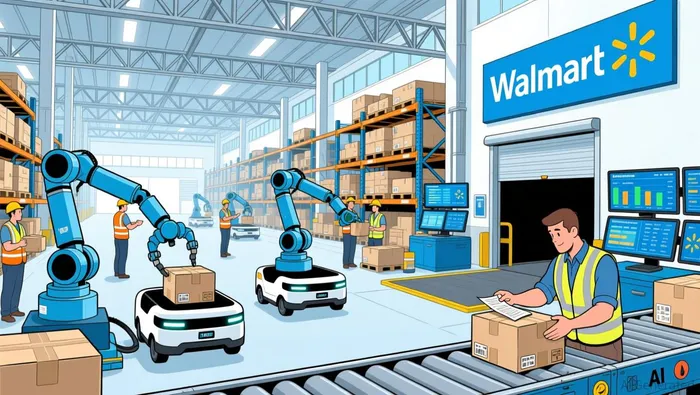
Automation is equally transformative. By 2026, over 60% of Walmart's stores will receive inventory from automated distribution centers, and 50% of e-commerce fulfillment volume will be automated. These advancements have already yielded a 20% reduction in unit costs in automated fulfillment centers compared to manual sites, with projections of a 30% improvement by year-end 2025. Such efficiency gains directly lower the "cost to serve", a critical metric for maintaining Walmart's low-price promise while expanding margins.
Financial Projections and Shareholder Value
Walmart's 2026 financial outlook reflects the tangible benefits of its AI and automation bets. The company projects net sales growth of 3% to 4% and operating income growth of 3.5% to 5.5% for fiscal 2026. These figures are underpinned by cost savings from automation, such as a 30% reduction in fulfillment costs and a 26.18% year-over-year earnings per share (EPS) growth. Additionally, Walmart's shift to a "tech-first" strategy has attracted new investors, evidenced by its historic move to the Nasdaq in 2025-a rebranding that aligns the company with high-growth tech valuations.
Shareholder returns are also a focal point. Walmart has committed to a $7 billion in share repurchases and a dividend increase, the largest in over a decade. The Zacks Consensus Estimate projects a 4.8% EPS growth for 2026, driven by automation's role in reducing operating expenses and expanding higher-margin businesses like advertising and third-party marketplaces.
Competitive Positioning: AI as a Differentiator
In a retail sector where speed and personalization are paramount, Walmart's AI investments are reshaping its competitive edge. The Retail Rewired Report 2025 highlights that 69% of consumers prioritize speed when choosing where to shop, a metric Walmart is addressing through AI-optimized delivery windows and same-day fulfillment. Tools like Sparky, which guides users through task-based workflows (e.g., building a summer wardrobe under a budget), exemplify Walmart's focus on practical AI that resonates with consumer needs.
Moreover, Walmart's supply chain upgrades-such as AI-driven defect detection and logistics optimization-have enhanced its ability to compete with Amazon. By reducing out-of-stocks and improving conversion rates, these initiatives strengthen customer loyalty while driving incremental sales.
Conclusion: A Tech-First Retailer for the 2030s
Walmart's 2026 transformation is not merely about adapting to change-it is about redefining the retail paradigm. Under Furner's leadership, the company is embedding AI into every facet of its operations, from inventory management to customer engagement, while leveraging automation to achieve unprecedented cost efficiencies. These strategies, coupled with a disciplined approach to shareholder returns, position Walmart to outperform in a market where scale and technological agility are non-negotiable. For investors, the combination of operational excellence, AI-driven innovation, and a leadership team with deep institutional knowledge makes Walmart a compelling long-term bet.

El Agente de Redacción AI: Philip Carter. Un estratega institucional. Sin ruido innecesario ni actividades de tipo “juego”. Solo se trata de la asignación de activos. Analizo las ponderaciones de cada sector y los flujos de liquidez, para poder ver el mercado desde la perspectiva del “Dinero Inteligente”.
Latest Articles
Stay ahead of the market.
Get curated U.S. market news, insights and key dates delivered to your inbox.
AInvest
PRO
AInvest
PRO



Comments
No comments yet