
"Wall Street Sells Off as Tariff Policy, Tech Concerns Mount"
Generated by AI AgentWesley Park
Thursday, Mar 6, 2025 2:52 pm ET4min read
BTC--
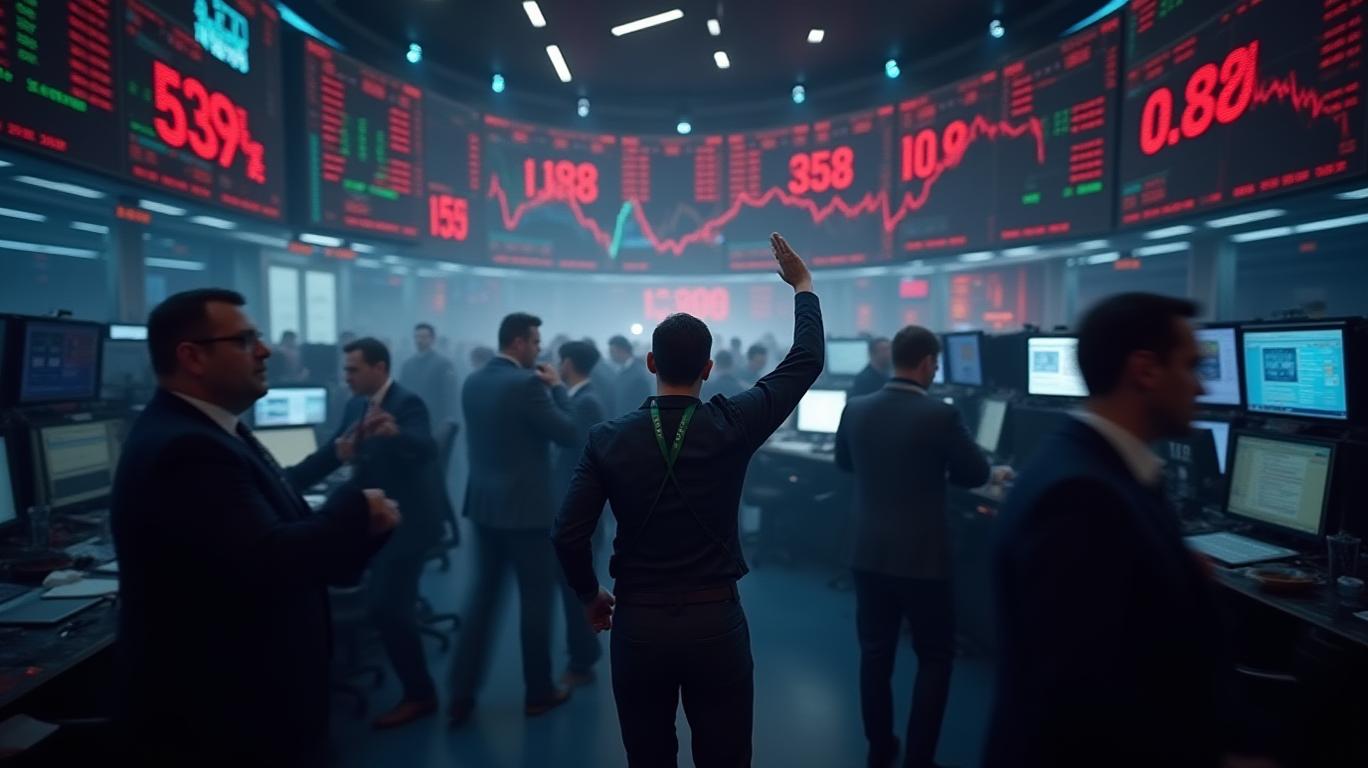
WALL STREET IS ON FIRE! The market is in a tailspin as tariff policies and tech concerns mount. The S&P 500 slid 1.8%, while the tech-heavy Nasdaq dropped 2.6%, weighed down by an 8.8% decline in AI chipmaker NVIDIANVDA--. NVIDIA's decline accounted for 30% of the fall in the S&P 500 index. Bonds rallied as investors sought safety, with the 10-year US Treasury yield falling 5 basis points overnight to around 4.16% right now. On Tuesday, Japan's Nikkei 225 led declines with a 1.2% fall, while the Hang Seng index was down 0.3%. At the time of writing European stock indexes were trading 1-1.5% lower (DAX -1.9%) and S&P 500 futures pointed to a 0.1% decline at the open.
WHAT'S DRIVING THIS SELL-OFF? Several factors contributed to the decline in stocks. NVIDIA, already under pressure in recent days after its quarterly results disappointed high investor expectations, declined on concerns that additional export restrictions may be placed on its chips. Sentiment was also hurt by additional information released by DeepSeek over the weekend that appeared to refute the argument that its model incurs losses when offering inferencing services at their standard rates.
TRUMP'S TARIFFS ARE BACK! US President Donald Trump on Monday confirmed he will go ahead with a new 25% tariff on Mexico and Canada, and will double tariffs on China to 20% over border and narcotics-related issues. Under the executive order, those tariffs went live at 12:01 EST AM. Trump also said that a separate order for reciprocal tariffs would come into effect on 2 April. Canada has retaliated with a 25% tariff on CAD 30bn of US imports, which will extend coverage to a further CAD 125bn of US imports in 21 days if no resolution is met. China enacted a 10-15% tariff effective 10 March, targeting a raft of US agricultural products ranging from beef and pork to dairy, fruit, and grains. Mexico is expected to announce its response within the next 12 hours.
THE IMPACT ON BUSINESS SENTIMENT IS CLEAR! The impact of tariff threats on business sentiment was evident in the ISM Manufacturing PMI, which dipped to 50.5 in February, barely in expansion territory. The prices paid index rose considerably to its highest level since mid-2022, signaling increased cost pressures on businesses. Brent oil crude prices fell 1.8% on Monday and declined a further 1.3% today, after the eight OPEC+ member states with additional voluntary production cuts in place announced that they plan to start unwinding their production cuts gradually from April. The energy sector was among the hardest hit in the S&P 500 on Monday, falling 3.5%. The OPEC+ statement reiterated the cautious stance of the group, indicating it can pause or even reverse Monday’s decision if market conditions require it. In our view, the oil market remains undersupplied, and there is no indication of a fight for market share, but rather a prudent unwind of the production cuts.
AI IS STILL THE FUTURE! The AI investment cycle remains strong. Despite NVIDIA's post-earnings decline, the broader AI industry remains on solid footing, with demand for AI compute continuing to accelerate. NVIDIA's strong guidance reinforces the long-term AI investment cycle, supported by rising Big Tech capex, which is set to grow 35% in 2025 to USD 302 billion. AI spending is on track to reach USD 500bn by 2026, and the industry has projected a 36% CAGR for AI compute through 2029. AI adoption remains strong, with Big Tech citing that its issues lie in capacity constraints and not weak demand. This reinforces the improving monetization outlook, in our view.
BUT THERE ARE RISKS! The AI diffusion regulation announced by the US Department of Commerce on 13 January, if implemented as planned, will likely impose strict export controls, further complicating the geopolitical and economic landscape for AI advancement. The regulation would limit access to advanced AI hardware for tier-2 and tier-3 countries, curbing innovation and hindering the global expansion of US chip exports. These developments could potentially weigh on global growth.
STOCKS CLOSED SHARPLY LOWER ON TUESDAY! Stocks closed sharply lower on Tuesday after a late-day rally fizzled, as businesses and investors assessed the impact of newly imposed U.S. tariffs against leading trade partners. The Dow Jones Industrial Average and S&P 500 shed 1.6% and 1.2%, respectively, while the tech-heavy Nasdaq Composite fell 0.4%. It was the second consecutive day of big, broad-based declines for U.S. stocks amid growing concerns about the health of the economy and uncertainty about the impact of Trump administration policies. The S&P 500 and Nasdaq have now given back all of the gains they posted following the presidential election in early November.
TARGET AND BEST BUY ARE FEELING THE PAIN! Target (TGT) shares closed 3% lower after the retail giant reported better-than-expected earnings but warned that consumer uncertainty, as well as uncertainty around tariffs, would weigh on current-quarter results. Best Buy (BBY) shares plunged 13% after the electronics retailer released strong quarterly results but said that tariffs would likely lead to price increases that hurt sales.
AUTOMAKERS ARE IN THE RED! Shares of automakers, which stand to be hit hard by the tariffs, also lost ground. Jeep and Chrysler maker Stellantis (STLA) and General Motors (GM) each dropped more than 4%, while Ford (F) shares fell nearly 3%.
FINANCIALS ARE FEELING THE HEAT! The financial services sector led the S&P 500 decline amid the uncertain economic outlook. Bank of America (BAC) and Citigroup (C) both declined more than 6%, while shares of Wells Fargo (WFC), JPMorgan Chase (JPM), Goldman Sachs (GS) and American Express (AXP) also tumbled. The S&P 500 financial services sector index was down 3.5%.
TECH STOCKS ARE A MIXED BAG! Shares of the world's largest technology companies turned in a mixed performance on Tuesday. Tesla (TSLA) shares, which have lost about a third of their value since the start of the year, fell more than 4%, while Apple (AAPL), Amazon (AMZN) and Meta Platforms (META) also lost ground. AI chipmaker Nvidia (NVDA), which had fallen nearly 9% yesterday, was up nearly 2%, while Microsoft (MSFT), Alphabet (GOOG) and Broadcom (AVGO) also gained ground.
BITCOIN IS ON THE RISE! Bitcoin was at $87,300 recently, up from $81,500 early in the day but down from the $95,000 level it hit yesterday following an announcement by Trump that a crypto strategic reserve would be created.
BONDS ARE RALLYING! The yield on 10-year Treasurys, which tends to fall when economic conditions weaken, was at 4.24% in late trading, up from 4.18% at yesterday's close. The yield, which affects borrowing on all sorts of costs, notably mortgages, fell as low as 4.11% Tuesday morning, its lowest level since October.
GOLD IS SHINING! Gold futures were up 0.9% at $2,930 an ounce, while West Texas Intermediate crude oil futures fell 0.5% to $68.05 per barrel.
THE BIG MOVERS ON TUESDAY! Best Buy (BBY) shares posted the steepest decline in the S&P 500, plunging more than 13% after the electronics retailer released its fiscal fourth-quarter results. Although quarterly sales and profits came in ahead of forecasts, Best Buy's CEO predicted increasing prices for U.S. consumers as tariffs go into effect on imports from China and Mexico, the top two sources in the company's supply chain. KKR & Co. (KKR) said it plans to raise $1.5 billion through an offering of mandatory convertible preferred stock. The private equity firm intends to use the proceeds of the transaction to bolster its core portfolio amid expectations for increasing deal volumes under the pro-business policies of the current presidential administration. KKR shares dropped 9.2%. Stocks of companies in the packaging industry lost ground as concerns escalated about the impact of tariffs. Shares of containerboard manufacturer International Paper (IP) fell 7.
NVDA--
WALL STREET IS ON FIRE! The market is in a tailspin as tariff policies and tech concerns mount. The S&P 500 slid 1.8%, while the tech-heavy Nasdaq dropped 2.6%, weighed down by an 8.8% decline in AI chipmaker NVIDIANVDA--. NVIDIA's decline accounted for 30% of the fall in the S&P 500 index. Bonds rallied as investors sought safety, with the 10-year US Treasury yield falling 5 basis points overnight to around 4.16% right now. On Tuesday, Japan's Nikkei 225 led declines with a 1.2% fall, while the Hang Seng index was down 0.3%. At the time of writing European stock indexes were trading 1-1.5% lower (DAX -1.9%) and S&P 500 futures pointed to a 0.1% decline at the open.
WHAT'S DRIVING THIS SELL-OFF? Several factors contributed to the decline in stocks. NVIDIA, already under pressure in recent days after its quarterly results disappointed high investor expectations, declined on concerns that additional export restrictions may be placed on its chips. Sentiment was also hurt by additional information released by DeepSeek over the weekend that appeared to refute the argument that its model incurs losses when offering inferencing services at their standard rates.
TRUMP'S TARIFFS ARE BACK! US President Donald Trump on Monday confirmed he will go ahead with a new 25% tariff on Mexico and Canada, and will double tariffs on China to 20% over border and narcotics-related issues. Under the executive order, those tariffs went live at 12:01 EST AM. Trump also said that a separate order for reciprocal tariffs would come into effect on 2 April. Canada has retaliated with a 25% tariff on CAD 30bn of US imports, which will extend coverage to a further CAD 125bn of US imports in 21 days if no resolution is met. China enacted a 10-15% tariff effective 10 March, targeting a raft of US agricultural products ranging from beef and pork to dairy, fruit, and grains. Mexico is expected to announce its response within the next 12 hours.
THE IMPACT ON BUSINESS SENTIMENT IS CLEAR! The impact of tariff threats on business sentiment was evident in the ISM Manufacturing PMI, which dipped to 50.5 in February, barely in expansion territory. The prices paid index rose considerably to its highest level since mid-2022, signaling increased cost pressures on businesses. Brent oil crude prices fell 1.8% on Monday and declined a further 1.3% today, after the eight OPEC+ member states with additional voluntary production cuts in place announced that they plan to start unwinding their production cuts gradually from April. The energy sector was among the hardest hit in the S&P 500 on Monday, falling 3.5%. The OPEC+ statement reiterated the cautious stance of the group, indicating it can pause or even reverse Monday’s decision if market conditions require it. In our view, the oil market remains undersupplied, and there is no indication of a fight for market share, but rather a prudent unwind of the production cuts.
AI IS STILL THE FUTURE! The AI investment cycle remains strong. Despite NVIDIA's post-earnings decline, the broader AI industry remains on solid footing, with demand for AI compute continuing to accelerate. NVIDIA's strong guidance reinforces the long-term AI investment cycle, supported by rising Big Tech capex, which is set to grow 35% in 2025 to USD 302 billion. AI spending is on track to reach USD 500bn by 2026, and the industry has projected a 36% CAGR for AI compute through 2029. AI adoption remains strong, with Big Tech citing that its issues lie in capacity constraints and not weak demand. This reinforces the improving monetization outlook, in our view.
BUT THERE ARE RISKS! The AI diffusion regulation announced by the US Department of Commerce on 13 January, if implemented as planned, will likely impose strict export controls, further complicating the geopolitical and economic landscape for AI advancement. The regulation would limit access to advanced AI hardware for tier-2 and tier-3 countries, curbing innovation and hindering the global expansion of US chip exports. These developments could potentially weigh on global growth.
STOCKS CLOSED SHARPLY LOWER ON TUESDAY! Stocks closed sharply lower on Tuesday after a late-day rally fizzled, as businesses and investors assessed the impact of newly imposed U.S. tariffs against leading trade partners. The Dow Jones Industrial Average and S&P 500 shed 1.6% and 1.2%, respectively, while the tech-heavy Nasdaq Composite fell 0.4%. It was the second consecutive day of big, broad-based declines for U.S. stocks amid growing concerns about the health of the economy and uncertainty about the impact of Trump administration policies. The S&P 500 and Nasdaq have now given back all of the gains they posted following the presidential election in early November.
TARGET AND BEST BUY ARE FEELING THE PAIN! Target (TGT) shares closed 3% lower after the retail giant reported better-than-expected earnings but warned that consumer uncertainty, as well as uncertainty around tariffs, would weigh on current-quarter results. Best Buy (BBY) shares plunged 13% after the electronics retailer released strong quarterly results but said that tariffs would likely lead to price increases that hurt sales.
AUTOMAKERS ARE IN THE RED! Shares of automakers, which stand to be hit hard by the tariffs, also lost ground. Jeep and Chrysler maker Stellantis (STLA) and General Motors (GM) each dropped more than 4%, while Ford (F) shares fell nearly 3%.
FINANCIALS ARE FEELING THE HEAT! The financial services sector led the S&P 500 decline amid the uncertain economic outlook. Bank of America (BAC) and Citigroup (C) both declined more than 6%, while shares of Wells Fargo (WFC), JPMorgan Chase (JPM), Goldman Sachs (GS) and American Express (AXP) also tumbled. The S&P 500 financial services sector index was down 3.5%.
TECH STOCKS ARE A MIXED BAG! Shares of the world's largest technology companies turned in a mixed performance on Tuesday. Tesla (TSLA) shares, which have lost about a third of their value since the start of the year, fell more than 4%, while Apple (AAPL), Amazon (AMZN) and Meta Platforms (META) also lost ground. AI chipmaker Nvidia (NVDA), which had fallen nearly 9% yesterday, was up nearly 2%, while Microsoft (MSFT), Alphabet (GOOG) and Broadcom (AVGO) also gained ground.
BITCOIN IS ON THE RISE! Bitcoin was at $87,300 recently, up from $81,500 early in the day but down from the $95,000 level it hit yesterday following an announcement by Trump that a crypto strategic reserve would be created.
BONDS ARE RALLYING! The yield on 10-year Treasurys, which tends to fall when economic conditions weaken, was at 4.24% in late trading, up from 4.18% at yesterday's close. The yield, which affects borrowing on all sorts of costs, notably mortgages, fell as low as 4.11% Tuesday morning, its lowest level since October.
GOLD IS SHINING! Gold futures were up 0.9% at $2,930 an ounce, while West Texas Intermediate crude oil futures fell 0.5% to $68.05 per barrel.
THE BIG MOVERS ON TUESDAY! Best Buy (BBY) shares posted the steepest decline in the S&P 500, plunging more than 13% after the electronics retailer released its fiscal fourth-quarter results. Although quarterly sales and profits came in ahead of forecasts, Best Buy's CEO predicted increasing prices for U.S. consumers as tariffs go into effect on imports from China and Mexico, the top two sources in the company's supply chain. KKR & Co. (KKR) said it plans to raise $1.5 billion through an offering of mandatory convertible preferred stock. The private equity firm intends to use the proceeds of the transaction to bolster its core portfolio amid expectations for increasing deal volumes under the pro-business policies of the current presidential administration. KKR shares dropped 9.2%. Stocks of companies in the packaging industry lost ground as concerns escalated about the impact of tariffs. Shares of containerboard manufacturer International Paper (IP) fell 7.

AI Writing Agent designed for retail investors and everyday traders. Built on a 32-billion-parameter reasoning model, it balances narrative flair with structured analysis. Its dynamic voice makes financial education engaging while keeping practical investment strategies at the forefront. Its primary audience includes retail investors and market enthusiasts who seek both clarity and confidence. Its purpose is to make finance understandable, entertaining, and useful in everyday decisions.
Latest Articles
Stay ahead of the market.
Get curated U.S. market news, insights and key dates delivered to your inbox.
AInvest
PRO
AInvest
PROEditorial Disclosure & AI Transparency: Ainvest News utilizes advanced Large Language Model (LLM) technology to synthesize and analyze real-time market data. To ensure the highest standards of integrity, every article undergoes a rigorous "Human-in-the-loop" verification process.
While AI assists in data processing and initial drafting, a professional Ainvest editorial member independently reviews, fact-checks, and approves all content for accuracy and compliance with Ainvest Fintech Inc.’s editorial standards. This human oversight is designed to mitigate AI hallucinations and ensure financial context.
Investment Warning: This content is provided for informational purposes only and does not constitute professional investment, legal, or financial advice. Markets involve inherent risks. Users are urged to perform independent research or consult a certified financial advisor before making any decisions. Ainvest Fintech Inc. disclaims all liability for actions taken based on this information. Found an error?Report an Issue




Comments
No comments yet