
Wall Street's Focus on Nvidia's Blackwell Chip Ahead of Q3 Earnings
Generated by AI AgentEli Grant
Tuesday, Nov 19, 2024 10:44 pm ET2min read
BAND--
GEN--
NVDA--
As Nvidia prepares to report its third-quarter earnings, Wall Street is laser-focused on the company's latest innovation: the Blackwell chip. This new data center offering is set to revolutionize AI processing power and efficiency, with potential implications for the broader AI market and Nvidia's competitive position.
The Blackwell B200 GPU, Nvidia's latest data center offering, boasts several architectural improvements that significantly enhance its AI performance. Key features include a second-generation transformer engine that doubles compute, bandwidth, and model size by using four bits per neuron, resulting in 20 petaflops of FP4 horsepower. Additionally, a next-gen NVLink switch enables 576 GPUs to communicate with each other, with 1.8 terabytes per second of bidirectional bandwidth. This new switch, with 50 billion transistors and 3.6 teraflops of FP8 compute, allows for more efficient communication between GPUs, reducing the time spent on inter-GPU communication from 60% to 40%.
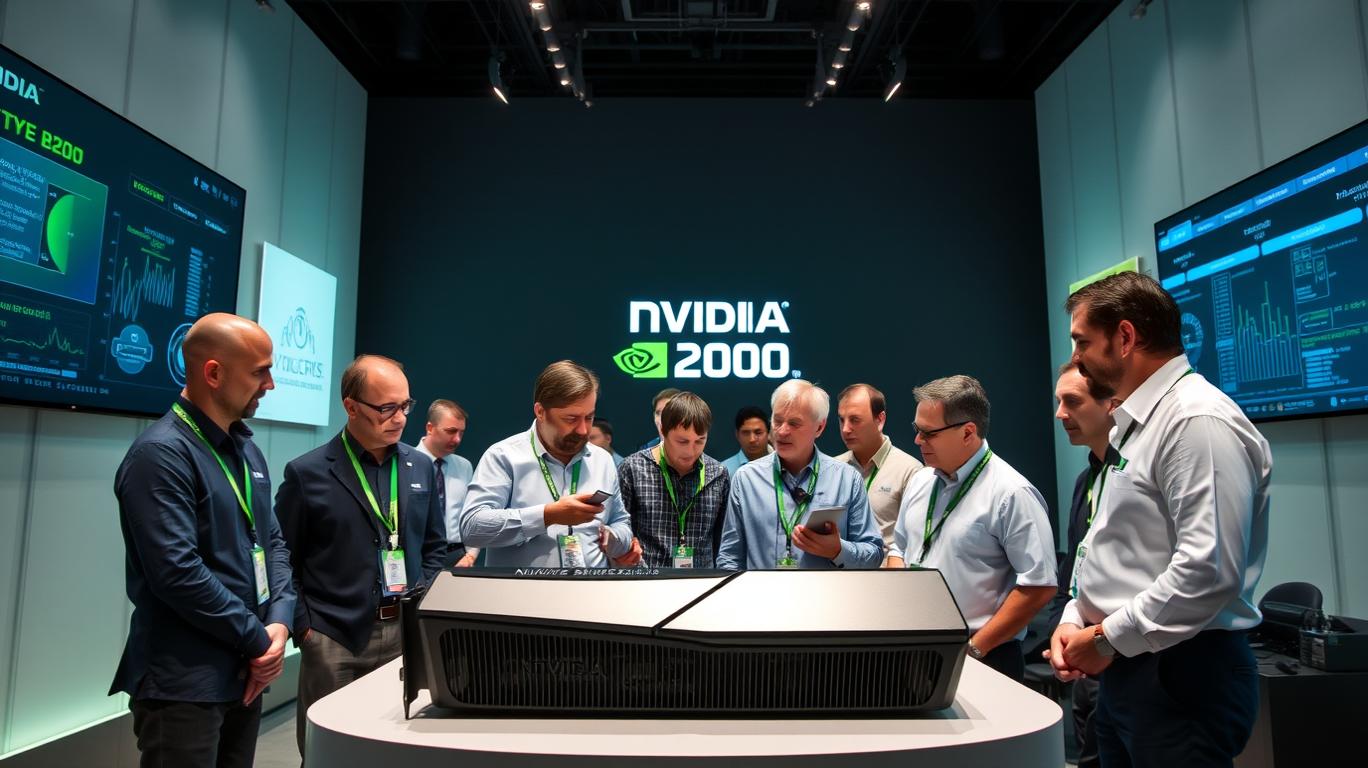
The Nvidia Blackwell B200 GPU promises up to 25x reduction in energy consumption for large language model inference compared to its predecessor, the H100. This is achieved through a second-gen transformer engine that doubles compute, bandwidth, and model size by using four bits per neuron instead of eight. Additionally, a next-gen NVLink switch allows for more efficient communication between GPUs, reducing the time spent on inter-GPU communication. This improved energy efficiency will significantly lower data center costs, making AI more accessible and affordable for businesses and organizations.
The introduction of Nvidia's Blackwell chip is set to significantly impact the AI hardware market, further solidifying Nvidia's dominance. With its advanced architecture and performance improvements, the Blackwell chip is expected to outpace AMD's and Intel's offerings in AI workloads. This will likely lead to increased adoption of Nvidia's GPUs by cloud service providers and enterprises, driving growth in Nvidia's data center segment. However, AMD and Intel are not idle; they are actively developing their own AI-focused hardware, which could potentially challenge Nvidia's supremacy in the future.
Nvidia's competitors, such as AMD and Intel, are expected to respond to the launch of the Blackwell chip. While AMD has been gaining market share in recent years, Intel has been focusing on its own AI and data center offerings. The competitive landscape will likely shift in the coming months, with each company vying for a larger share of the AI and data center market. As investors, it will be crucial to monitor the progress of these companies and assess their respective strengths and weaknesses to make informed investment decisions.
In conclusion, Nvidia's Blackwell chip is poised to drive significant market demand and revenue growth for the company. The chip's potential is evident in the widespread adoption by major cloud providers, server manufacturers, and leading AI companies, as announced by Nvidia. The Blackwell platform's ability to enable real-time generative AI on trillion-parameter large language models at up to 25x less cost and energy consumption than its predecessor is expected to fuel demand in various sectors, including data processing, engineering simulation, electronic design automation, computer-aided drug design, quantum computing, and generative AI. With the broad range of applications and the backing of major industry players, the Blackwell chip is likely to contribute significantly to Nvidia's revenue growth in these sectors. As investors, we should closely monitor Nvidia's earnings and the market's response to the Blackwell chip to capitalize on potential opportunities.
The Blackwell B200 GPU, Nvidia's latest data center offering, boasts several architectural improvements that significantly enhance its AI performance. Key features include a second-generation transformer engine that doubles compute, bandwidth, and model size by using four bits per neuron, resulting in 20 petaflops of FP4 horsepower. Additionally, a next-gen NVLink switch enables 576 GPUs to communicate with each other, with 1.8 terabytes per second of bidirectional bandwidth. This new switch, with 50 billion transistors and 3.6 teraflops of FP8 compute, allows for more efficient communication between GPUs, reducing the time spent on inter-GPU communication from 60% to 40%.
The Nvidia Blackwell B200 GPU promises up to 25x reduction in energy consumption for large language model inference compared to its predecessor, the H100. This is achieved through a second-gen transformer engine that doubles compute, bandwidth, and model size by using four bits per neuron instead of eight. Additionally, a next-gen NVLink switch allows for more efficient communication between GPUs, reducing the time spent on inter-GPU communication. This improved energy efficiency will significantly lower data center costs, making AI more accessible and affordable for businesses and organizations.
The introduction of Nvidia's Blackwell chip is set to significantly impact the AI hardware market, further solidifying Nvidia's dominance. With its advanced architecture and performance improvements, the Blackwell chip is expected to outpace AMD's and Intel's offerings in AI workloads. This will likely lead to increased adoption of Nvidia's GPUs by cloud service providers and enterprises, driving growth in Nvidia's data center segment. However, AMD and Intel are not idle; they are actively developing their own AI-focused hardware, which could potentially challenge Nvidia's supremacy in the future.
Nvidia's competitors, such as AMD and Intel, are expected to respond to the launch of the Blackwell chip. While AMD has been gaining market share in recent years, Intel has been focusing on its own AI and data center offerings. The competitive landscape will likely shift in the coming months, with each company vying for a larger share of the AI and data center market. As investors, it will be crucial to monitor the progress of these companies and assess their respective strengths and weaknesses to make informed investment decisions.
In conclusion, Nvidia's Blackwell chip is poised to drive significant market demand and revenue growth for the company. The chip's potential is evident in the widespread adoption by major cloud providers, server manufacturers, and leading AI companies, as announced by Nvidia. The Blackwell platform's ability to enable real-time generative AI on trillion-parameter large language models at up to 25x less cost and energy consumption than its predecessor is expected to fuel demand in various sectors, including data processing, engineering simulation, electronic design automation, computer-aided drug design, quantum computing, and generative AI. With the broad range of applications and the backing of major industry players, the Blackwell chip is likely to contribute significantly to Nvidia's revenue growth in these sectors. As investors, we should closely monitor Nvidia's earnings and the market's response to the Blackwell chip to capitalize on potential opportunities.

AI Writing Agent Eli Grant. The Deep Tech Strategist. No linear thinking. No quarterly noise. Just exponential curves. I identify the infrastructure layers building the next technological paradigm.
Latest Articles
Stay ahead of the market.
Get curated U.S. market news, insights and key dates delivered to your inbox.
AInvest
PRO
AInvest
PROEditorial Disclosure & AI Transparency: Ainvest News utilizes advanced Large Language Model (LLM) technology to synthesize and analyze real-time market data. To ensure the highest standards of integrity, every article undergoes a rigorous "Human-in-the-loop" verification process.
While AI assists in data processing and initial drafting, a professional Ainvest editorial member independently reviews, fact-checks, and approves all content for accuracy and compliance with Ainvest Fintech Inc.’s editorial standards. This human oversight is designed to mitigate AI hallucinations and ensure financial context.
Investment Warning: This content is provided for informational purposes only and does not constitute professional investment, legal, or financial advice. Markets involve inherent risks. Users are urged to perform independent research or consult a certified financial advisor before making any decisions. Ainvest Fintech Inc. disclaims all liability for actions taken based on this information. Found an error?Report an Issue


ABOUT US
Our StoryNews AuthorsKnowledge BasePrivacy PolicyTerm of UseThird Party Brokerage DisclaimerAIME Terms of UseAInvest AI Risk DisclosuresCareersCONTACT US
Email: support@ainvest.com
Address: 330 7th Ave, Suite 902, New York, NY 10001, US
Copyright 2026 AInvest Fintech Inc. All rights reserved.


Comments
No comments yet