
Wall Street's Resilience Amid Trump's Tariff Threats: A Contrarian Opportunity in Trade-Exposed Sectors
The past year has been a rollercoaster for global markets, with tariff threats and legal battles dominating headlines. Yet, amid this uncertainty, a contrarian opportunity is emerging in trade-exposed sectors like industrials and technology. While headlines focus on the risks of escalating trade wars, investors who look beyond the noise may find undervalued assets in companies with robust balance sheets, diversified supply chains, and inelastic demand drivers. This article explores why the current environment of tariff-induced volatility is creating a buying opportunity for the bold.
The Tariff Landscape: Uncertainty as a Catalyst for Mispricings
The Trump administration's tariff timeline remains a patchwork of court injunctions, delayed implementations, and shifting rates. As of July 2025, the Court of International Trade's injunction against fentanyl-linked tariffs on Canadian, Chinese, and Mexican goods—and the subsequent stay—has kept markets in limbo. Meanwhile, countries like Brazil and Vietnam have retaliated with their own tariffs, while the UK secured an aerospace exception under WTO rules.
This legal and political uncertainty has created a “wait-and-see” mentality among investors, leading to sector-specific undervaluations. For instance, industrials—a sector hit by credit downgrades and supply chain disruptions—now trade at historically wide spreads relative to their historical earnings potential.
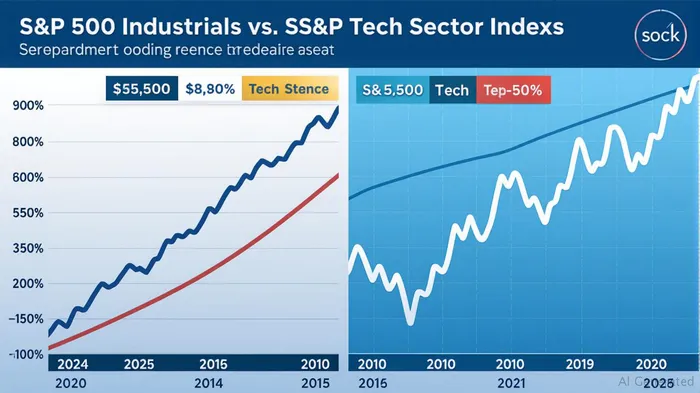
Contrarian Investing in Industrials: Where the Risk-Adjusted Reward Lies
The industrials sector has been battered by tariff-related headwinds. Companies like General Motors face up to $5 billion in earnings impacts from tariffs on imported vehicle components, while Best Buy has trimmed guidance due to rising input costs. Yet, this sector's struggles mask a compelling contrarian case:
- Balance Sheet Strength: Despite sector-wide challenges, firms with strong cash reserves and low debt are weathering the storm. For example, Caterpillar (CAT) maintains an investment-grade rating and a conservative leverage ratio of 1.5x, enabling it to invest in automation and global supply diversification.
- Inelastic Demand: Critical infrastructure projects—such as renewable energy grids and defense spending—remain tariff-resistant. Companies like United Technologies (now Raytheon Technologies, RTX) benefit from long-term government contracts insulated from trade volatility.
- Supply Chain Resilience: Firms that have already diversified production (e.g., moving manufacturing to Mexico or Vietnam) are better positioned. 3M (MMM)'s diversified product mix and regionalized supply chains have kept its margins stable despite tariffs.
Tech's Contrarian Play: AI as a Shield Against Trade Headwinds
While industrials face near-term pain, the tech sector offers a dual-layered opportunity:
- Software and AI: The Tariff-Resistant Engine: Software companies—such as Microsoft (MSFT), Adobe (ADBE), and NVIDIA (NVDA)—are less exposed to hardware tariffs. NVIDIA's $5.5 billion write-down for China-bound AI chips is a short-term hit, but its long-term bet on U.S. semiconductor manufacturing (e.g., its $4 billion Arizona facility) positions it to dominate the $50 billion AI market in China post-tariff resolution.
- Hardware's Contrarian Edge: Even hardware manufacturers with global footprints can thrive. Apple (AAPL)'s shift to Indian and Vietnamese iPhone production has reduced its China exposure, while its services revenue (50% of total) is tariff-proof.
Expert Sentiment: A Vote of Confidence in Resilient Firms
Analysts highlight that tariff-affected sectors are oversold relative to fundamentals:
- Morningstar's Q2 report notes that unprofitable tech stocks surged 15% in Q2, but high-margin firms like Microsoft and Adobe—which underpinned Facet's outperformance—remain undervalued.
- Moody's data shows industrials have the highest non-investment-grade issuers (330 companies), yet firms like CaterpillarCAT-- and 3MMMM-- remain outliers with investment-grade credit profiles.
- Bloomberg Intelligence argues that tariffs have accelerated supply chain innovation, with firms like NVIDIANVDA-- and BoeingBA-- (BA) investing in U.S. manufacturing hubs.
Investment Strategy: Targeting Resilience and Inelastic Demand
For contrarian investors, the path forward is clear:
- Prioritize Balance Sheet Strength: Focus on industrials with low leverage and strong cash flows (e.g., CAT, MMM).
- Bet on Tech's AI Future: NVIDIA and MicrosoftMSFT-- are positioned to capture secular growth in AI, even amid near-term volatility.
- Avoid Tariff-Heavy Sectors: Consumer discretionary and auto manufacturers remain vulnerable to demand slowdowns and margin pressures.
Conclusion: Volatility as a Friend of the Contrarian
The current tariff landscape is a textbook example of fear-driven mispricing. While headlines amplify the risks of trade wars, companies with diversified supply chains, strong balance sheets, and inelastic demand drivers are undervalued. For investors willing to look past the noise, sectors like industrials and tech offer compelling entry points. The key is to focus on fundamentals—not fear—and to recognize that even in uncertainty, resilience breeds opportunity.

Stay ahead of the market.
Get curated U.S. market news, insights and key dates delivered to your inbox.
AInvest
PRO
AInvest
PRO



Comments
No comments yet