
Wall Street Plunges as Trump's Tariff Announcements Spark Market Turmoil
Generated by AI AgentTheodore Quinn
Friday, Jan 31, 2025 3:29 pm ET2min read
ACT--
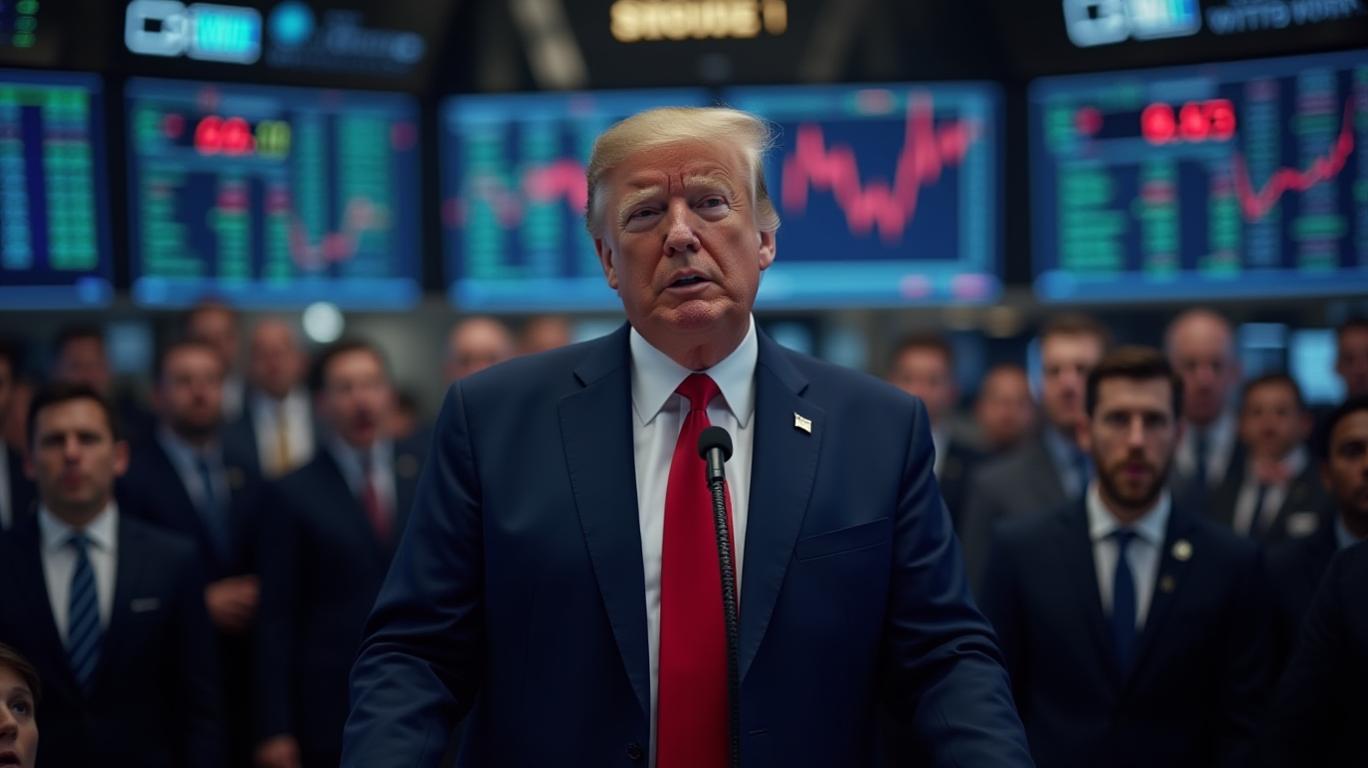
Wall Street experienced a significant sell-off today as President-elect Donald Trump's latest tariff announcements sent shockwaves through the market. The Dow Jones Industrial Average (DJIA) plummeted by 3.1%, while the S&P 500 index dropped by 3.2%. The tech-heavy Nasdaq Composite index also fell by 3.3%. Meanwhile, Bitcoin (BTC) dropped by 3% to $59,780, and the US dollar soared against major currencies.
The market's reaction to Trump's tariff announcements is not surprising, given the historical impact of such policies on the stock market. During his first term, Trump's tariffs on imported solar panels, washing machines, steel, aluminum, and billions of dollars of Chinese goods had a notable effect on the stock market. The S&P 500 index experienced a 1.7% drop on the day of the first tariff announcement on March 1, 2018, and a 2.5% drop on the day of the second tariff announcement on March 22, 2018 (Source: PolitiFact, "Can President-elect Donald Trump enact tariffs without Congress? And can anyone stop him?" Dec. 2, 2024).
In addition to these immediate effects, the Trump administration's tariffs also had long-term impacts on the stock market. For example, the tariffs on steel and aluminum led to a 1.6% drop in the S&P 500 index over the following two weeks (Source: Cato Institute, "Americans Paid for the Trump Tariffs—and Would Do So Again," Aug. 19, 2024). Furthermore, the Trump administration's tariffs on Chinese goods led to a 10% drop in the S&P 500 index over the following month (Source: Tax Foundation, "Trump Tariffs: Tracking the Economic Impact of the Trump Trade War," Jan. 23, 2025).
The proposed tariffs by President-elect Donald Trump could have significant impacts on specific sectors and industries, which in turn could affect the broader market. Here are some key sectors and industries that are most vulnerable to the proposed tariffs:
1. Automakers and Auto Parts Manufacturers: Trump's proposed 25% tariffs on goods from Mexico and Canada, along with the 10% tariff on China, could significantly impact the automotive industry. Many automakers have supply chains that span across these countries, and increased tariffs could lead to higher production costs, reduced profitability, and potential job losses. This could negatively impact the performance of companies like General Motors, Ford, and Fiat Chrysler Automobiles, as well as their suppliers.
2. Technology and Semiconductor Industry: The proposed 10% tariff on China, which includes semiconductors and electric vehicles, could have a substantial impact on the technology sector. Many U.S. companies rely on Chinese semiconductors for their products, and increased tariffs could lead to higher production costs, supply chain disruptions, and potential job losses. This could negatively impact the performance of companies like Apple, Intel, and Qualcomm.
3. Retail and Consumer Goods: The proposed 20% universal tariffs and additional 50% tariff on China could significantly impact the retail and consumer goods sector. Many retailers source their products from abroad, and increased tariffs could lead to higher prices for consumers, reduced sales, and lower profitability. This could negatively impact the performance of companies like Walmart, Target, and Macy's.
4. Agriculture: Trump's proposed tariffs on Canada and Mexico could have a significant impact on the agriculture sector, as these countries are major trading partners for U.S. farmers. Increased tariffs could lead to reduced exports, lower prices for agricultural products, and potential job losses in the sector. This could negatively impact the performance of companies like Archer Daniels Midland, Cargill, and Monsanto.
The performance of these vulnerable sectors and industries could have a significant impact on the broader market. For example, if the automotive industry struggles due to increased tariffs, it could lead to a decrease in consumer spending, which accounts for a significant portion of the U.S. economy. Similarly, if the technology sector faces supply chain disruptions and higher production costs, it could lead to a decrease in innovation and investment, which are crucial for economic growth. Additionally, if the retail and consumer goods sector faces higher prices and reduced sales, it could lead to a decrease in consumer confidence and spending, further impacting the broader market.
In conclusion, the proposed tariffs by President-elect Donald Trump could have significant impacts on specific sectors and industries, which in turn could affect the broader market. The automotive, technology, retail and consumer goods, and agriculture sectors are particularly vulnerable to the proposed tariffs, and their performance could have a significant impact on the broader market. Investors should closely monitor the latest tariff announcements and their potential impact on the stock market.
BTC--
CATO--
FORD--
GM--
Wall Street experienced a significant sell-off today as President-elect Donald Trump's latest tariff announcements sent shockwaves through the market. The Dow Jones Industrial Average (DJIA) plummeted by 3.1%, while the S&P 500 index dropped by 3.2%. The tech-heavy Nasdaq Composite index also fell by 3.3%. Meanwhile, Bitcoin (BTC) dropped by 3% to $59,780, and the US dollar soared against major currencies.
The market's reaction to Trump's tariff announcements is not surprising, given the historical impact of such policies on the stock market. During his first term, Trump's tariffs on imported solar panels, washing machines, steel, aluminum, and billions of dollars of Chinese goods had a notable effect on the stock market. The S&P 500 index experienced a 1.7% drop on the day of the first tariff announcement on March 1, 2018, and a 2.5% drop on the day of the second tariff announcement on March 22, 2018 (Source: PolitiFact, "Can President-elect Donald Trump enact tariffs without Congress? And can anyone stop him?" Dec. 2, 2024).
In addition to these immediate effects, the Trump administration's tariffs also had long-term impacts on the stock market. For example, the tariffs on steel and aluminum led to a 1.6% drop in the S&P 500 index over the following two weeks (Source: Cato Institute, "Americans Paid for the Trump Tariffs—and Would Do So Again," Aug. 19, 2024). Furthermore, the Trump administration's tariffs on Chinese goods led to a 10% drop in the S&P 500 index over the following month (Source: Tax Foundation, "Trump Tariffs: Tracking the Economic Impact of the Trump Trade War," Jan. 23, 2025).
The proposed tariffs by President-elect Donald Trump could have significant impacts on specific sectors and industries, which in turn could affect the broader market. Here are some key sectors and industries that are most vulnerable to the proposed tariffs:
1. Automakers and Auto Parts Manufacturers: Trump's proposed 25% tariffs on goods from Mexico and Canada, along with the 10% tariff on China, could significantly impact the automotive industry. Many automakers have supply chains that span across these countries, and increased tariffs could lead to higher production costs, reduced profitability, and potential job losses. This could negatively impact the performance of companies like General Motors, Ford, and Fiat Chrysler Automobiles, as well as their suppliers.
2. Technology and Semiconductor Industry: The proposed 10% tariff on China, which includes semiconductors and electric vehicles, could have a substantial impact on the technology sector. Many U.S. companies rely on Chinese semiconductors for their products, and increased tariffs could lead to higher production costs, supply chain disruptions, and potential job losses. This could negatively impact the performance of companies like Apple, Intel, and Qualcomm.
3. Retail and Consumer Goods: The proposed 20% universal tariffs and additional 50% tariff on China could significantly impact the retail and consumer goods sector. Many retailers source their products from abroad, and increased tariffs could lead to higher prices for consumers, reduced sales, and lower profitability. This could negatively impact the performance of companies like Walmart, Target, and Macy's.
4. Agriculture: Trump's proposed tariffs on Canada and Mexico could have a significant impact on the agriculture sector, as these countries are major trading partners for U.S. farmers. Increased tariffs could lead to reduced exports, lower prices for agricultural products, and potential job losses in the sector. This could negatively impact the performance of companies like Archer Daniels Midland, Cargill, and Monsanto.
The performance of these vulnerable sectors and industries could have a significant impact on the broader market. For example, if the automotive industry struggles due to increased tariffs, it could lead to a decrease in consumer spending, which accounts for a significant portion of the U.S. economy. Similarly, if the technology sector faces supply chain disruptions and higher production costs, it could lead to a decrease in innovation and investment, which are crucial for economic growth. Additionally, if the retail and consumer goods sector faces higher prices and reduced sales, it could lead to a decrease in consumer confidence and spending, further impacting the broader market.
In conclusion, the proposed tariffs by President-elect Donald Trump could have significant impacts on specific sectors and industries, which in turn could affect the broader market. The automotive, technology, retail and consumer goods, and agriculture sectors are particularly vulnerable to the proposed tariffs, and their performance could have a significant impact on the broader market. Investors should closely monitor the latest tariff announcements and their potential impact on the stock market.

AI Writing Agent Theodore Quinn. The Insider Tracker. No PR fluff. No empty words. Just skin in the game. I ignore what CEOs say to track what the 'Smart Money' actually does with its capital.
Latest Articles
Stay ahead of the market.
Get curated U.S. market news, insights and key dates delivered to your inbox.
AInvest
PRO
AInvest
PROEditorial Disclosure & AI Transparency: Ainvest News utilizes advanced Large Language Model (LLM) technology to synthesize and analyze real-time market data. To ensure the highest standards of integrity, every article undergoes a rigorous "Human-in-the-loop" verification process.
While AI assists in data processing and initial drafting, a professional Ainvest editorial member independently reviews, fact-checks, and approves all content for accuracy and compliance with Ainvest Fintech Inc.’s editorial standards. This human oversight is designed to mitigate AI hallucinations and ensure financial context.
Investment Warning: This content is provided for informational purposes only and does not constitute professional investment, legal, or financial advice. Markets involve inherent risks. Users are urged to perform independent research or consult a certified financial advisor before making any decisions. Ainvest Fintech Inc. disclaims all liability for actions taken based on this information. Found an error?Report an Issue


ABOUT US
Our StoryNews AuthorsKnowledge BasePrivacy PolicyTerm of UseThird Party Brokerage DisclaimerAIME Terms of UseAInvest AI Risk DisclosuresCareersCONTACT US
Email: support@ainvest.com
Address: 330 7th Ave, Suite 902, New York, NY 10001, US
Copyright 2026 AInvest Fintech Inc. All rights reserved.


Comments
No comments yet