
Wall Street Opens Higher as AI Boom-or-Bubble Debate Intensifies
U.S. stocks opened higher Wednesday, with all major benchmarks advancing as trading got underway. The Dow Jones Industrial Average rose 152.13 points (0.32%) to 47,264.6, while the Nasdaq Composite added 140.04 points (0.61%) to 23,156.6. The S&P 500 climbed 29.67 points (0.44%) to 6,795.55, and the Russell 2000 edged up 0.31 points (0.13%) to 245.44, signaling a cautiously upbeat start to the session.
Why young people feel hopeless — and why that’s dangerous 👇
Commodities early Wednesday morning were mostly calm. Front-month crude futures hovered near $58 a barrel, barely changed on the day. Gold edged up 0.2% to trade around $4,186 per ounce, extending a quiet week for the haven asset. BitcoinBTC-- traded near $86,900, down a touch from the prior close. The muted moves offered little direction as investors fixed their attention on the evolving narrative around AI-linked spending and profitability.
That debate was front and center in a new episode of Citi Research's Citi Markets Edition podcast where top strategists parsed whether the market’s embrace of AI represents a “boom” or a “bubble.” Dirk Willer, Citi’s global head of macro strategy, reiterated the price-based framework that has recently flashed a bubble signal. “If something is up by more than two standard deviations against the long-term trend in real terms, we call it a bubble,” he said, noting that such episodes often continue rising before giving back gains. Willer urged investors to balance participation with hedges.
Scott Chronert, Citi’s U.S. head of equity strategy, pushed back. “We’ve been characterizing this more as a boom than a bubble,” he said, pointing to compressed PEG ratios and earnings growth that has kept pace with expanding valuations. Chronert called the current environment a “once-in-a-generation setup”fueled by massive capex and durable productivity trends.
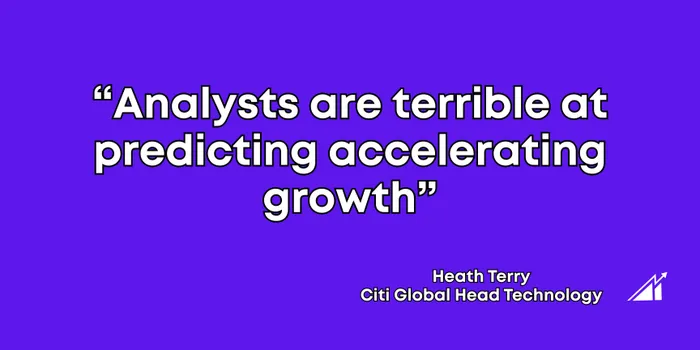
Heath Terry, Citi’s Global Head Technology and Communications research, argued that analysts are underestimating the scale of AI adoption. “Analysts are terrible at predicting accelerating growth,” he said, noting that 2024 AI capex was initially forecast at $186 billion but is finishing near $400 billion. He acknowledged growing reliance on smaller, debt-financed players but stressed that hyperscalers still generate enough operating cash flow to support investment. “This is still very much being driven by four companies with very strong balance sheets and very strong cash-flow profiles,” he said.
Across the Atlantic, strategists at J.P. Morgan said European equities may finally be positioned for a rebound after months of underperformance. “We believe Eurozone risk-reward is improving… and expect the region to outperform its peers through the end of the year and beyond,” wrote Mislav Matejka, the bank’s head of European and international equity strategy. Rising liquidity, an accommodative ECB, delayed but forthcoming German fiscal support, and a firmer outlook in China all factor into the constructive view. Even the long-lagging “Granolas,” a group of 11 megacaps including GSK, Roche, and ASML, may be poised for recovery as earnings and balance-sheet strength outshine their price performance.
Meanwhile, Oracle became a point of caution in the AI narrative. CFRA Research downgraded the stock to Hold from Buy, slashing its price target to $230 from $350. Analyst Angelo Zino warned that surging debt—now above $100 billion—combined with negative free cash-flow expectations and heavy exposure to OpenAI heighten risk. “We believe ORCL faces a precarious situation where aggressive customer acquisition raises credit downgrade concerns… multiples remain at risk of further compression,” he wrote.
For now, investors will continue parsing whether AI remains a rising tide or an overstretched one. The answer may hinge less on short-term index swings and more on how quickly the next leg of capital spending delivers tangible returns across tech and traditional sectors alike.
Why labor and inflation data are deeply flawed 👇

Adam Shapiro is a three-time Emmy Award–winning content creator, former network news correspondent, and founder of the multimedia production company TALKENOMICS. At AInvest, he created and launched Capital & Power, a video podcast series designed to drive engagement and establish thought leadership, while also producing original live streams, financial articles, and investor-focused video content. Previously, as a correspondent at FOX Business, Shapiro established the network’s Washington, D.C. bureau, reported from the White House, Capitol Hill, and the Federal Reserve, and secured exclusive bipartisan interviews with influential leaders. His reporting helped solidify FOX Business as the most-watched business channel on television. At the same time, his original Talkenomics series drew tens of thousands of viewers per episode through insightful conversations with policymakers, economists, and thought leaders. At Yahoo Finance, he played a critical leadership role in expanding digital programming to eight hours of live, bell-to-bell financial news coverage, dramatically increasing traffic from 68M to 104M unique monthly visitors and growing ad revenue from zero to over $50 million annually. Yahoo Finance continues to benefit from the credibility of Shapiro’s exclusive interviews with former President Donald Trump and numerous Fortune 500 CEOs.
Latest Articles
Stay ahead of the market.
Get curated U.S. market news, insights and key dates delivered to your inbox.




Comments
No comments yet