
Wall Street Fears There Are No More 'Rate Cuts', But Is The Fed Preparing To Restart Rate Hikes?
As economic data remain resilient, part of institutional investors have started to discuss how the Federal Reserve will manage a U.S. economy that may not land, and some of them even begin discussing whether the Fed needs to restart rate hikes.
For example, Citigroup stated that investors should have more hedging measures against the risk that the Fed may only undergo a very short easing cycle, and then soon restart rate hikes.
Ironically, just a few weeks ago, the expectation that the Fed would cut rates by as much as 150 basis points starting in March was so hot, but now, some investment institutions even started pricing the radical expectation that the Fed would restart rate hikes.
A recent media survey data shows that out of the 104 economists covered by the media, 64 believe that the Fed will cut rates by 100 basis points or less in 2024, and the rest almost think the rate cut will be 75 basis points or less.
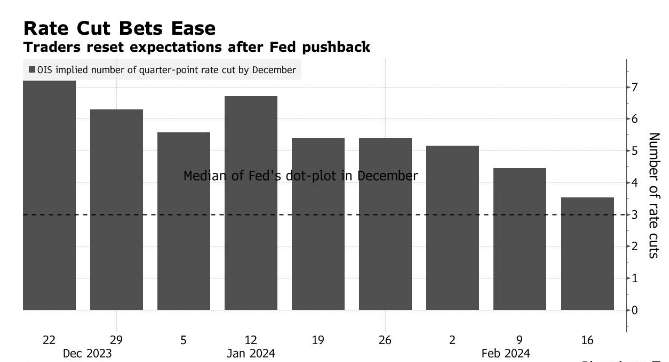
As recent CPI and PPI numbers exceeded expectations, recent swap trading data shows that not only have interest rate futures traders completely ruled out the possibility of the Fed cutting rates in March, but the likelihood of a May rate cut is also not high, and confidence in the first rate cut in June is also waning.
As a result, the latest hot topic on Wall Street regarding rates is that maybe the Fed's next move is a rate hike rather than a cut.
Former U.S. Treasury Secretary Lawrence Summers had stated some thoughts that some large Wall Street banks have been pondering recently last Friday: there is still a possibility that the Fed's next policy move is a rate hike, with probabilities possibly reaching 15%. Wall Street investment firm Jupiter Asset Management suggested a 20% possibility.
Some Fed watchers still believe that the situation at the end of the 90s might replay: only a brief period of rate cuts, and preparation for subsequent Fed rate hikes.
There are so many possible, plausible outcomes, said Earl Davis, head of fixed income and money markets at BMO Global Asset Management.
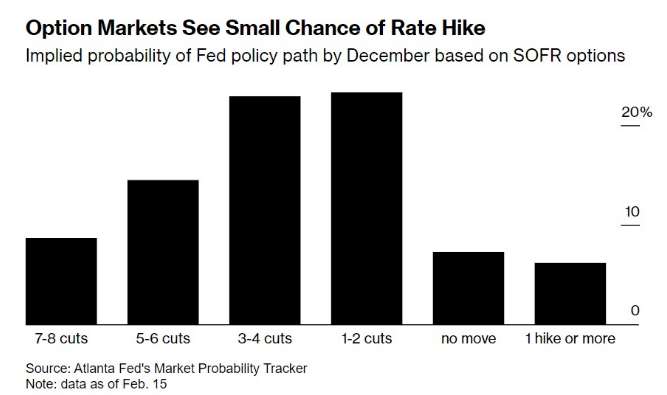
Notably, the options market considers the possibility of the Fed restarting rate hikes very small. SOFR options contract-based data on the implied probabilities of the Fed's policy path to December this year shows that the probability of the Fed hiking once or more is less than 6%, while the highest probabilities are for 1-2 rate cuts and 2-3 rate cuts.
On the other hand, for Fed policymakers, no one has publicly stated in recent weeks that they would further rate hikes. Meanwhile, the Fed has also not, as in the past, provided forward guidance on its medium-term monetary policy framework.
All of these are leaving investors directionless.
The last yards of this inflation fight is going to be bumpy, said Lindsay Rosner, head of multi-sector fixed income at Goldman Sachs Asset Management. It does feel a little bit like a ping-pong match with every single data point.
Rosner said she agrees with Summers' assessment of Fed rate hike risk but that it'd make more sense for the Fed to hold at these levels of interest rates for longer and that the Fed needs to make sure it can thoroughly curb inflation.
It is worth noting that some people who expect rate cuts are also advocating betting on this radical expectation.
Davis of BMO has been shorting two-year U.S. Treasury bonds since last December. Kit Juckes, the chief foreign exchange strategist at Societe Generale, told clients in a report last week that if the US economy re-accelerates, the Fed will eventually have to tighten again and the dollar will rally, possibly returning to its record highs in 2022.
In fact, data shows that after last week's release of CPI and PPI data that beat expectations, traders began to digest the possibility of the Federal Reserve restarting rate hikes in 2024.
Strategists at Citigroup Inc. said investors should have more hedging measures against the risk that the Fed may undergo a very brief easing cycle and then soon restart rate hikes. The bank's team of economists expects the Fed to make its first rate cut in June, but they think the Fed could replay the situation at the end of the 90s in the next few years -- restarting rate hikes after rate cuts due to a hot economy.
It was just a month ago when there was no hedging at all for the possibility of higher rates, and now you have at least some investors who seem to be doing so, said Ira Jersey, chief U.S. rates strategist at Bloomberg Intelligence.
Tiffany Wilding, an economist at PIMCO, a giant asset management firm, said that in addition to unstable domestic economic data, there are some international factors. These include conflict in the Red Sea and drought conditions causing a slowdown in the Panama Canal, and disruption to shipping leading to a rise in global freight costs.
All of these could lead to a stop-start monetary policy, economist Wilding said. There is a risk and it's very difficult to forecast-There's going to be extreme volatility both ways.

Expert analysis on U.S. markets and macro trends, delivering clear perspectives behind major market moves.
Latest Articles
Stay ahead of the market.
Get curated U.S. market news, insights and key dates delivered to your inbox.


AInvest
PRO
AInvest
PRO



Comments
No comments yet