
Walker & Dunlop Drops 8% as Institutions Sell
 Aime Summary
Market Snapshot
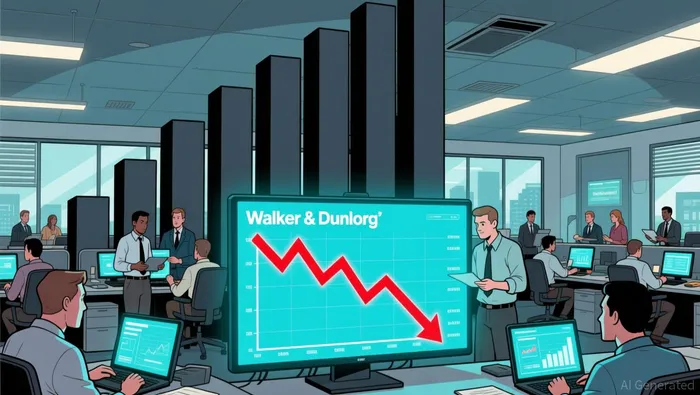
Walker & DunlopWD-- (WD.N) is currently navigating a choppy environment, with the stock experiencing a notable decline of -8.17% over recent sessions, reflecting a market that remains cautious and directionally uncertain.

News Highlights
The most significant recent development in the mortgage lending space involves nCino’s release of its Mortgage MCP, a tool designed to let lenders connect AI agents directly to the nCino Mortgage Suite. This announcement, dated August 7, 2026, signals a broader industry shift toward integrating artificial intelligence into core lending workflows. While Walker & Dunlop is not nCino, this trend highlights the increasing pressure and opportunity for mortgage finance companies to adopt efficient, tech-driven solutions to manage costs and streamline operations in a consolidating industry.
Analyst Views
Recent analyst coverage presents a mixed but generally optimistic picture, though with significant divergence in track records. The simple average rating is 4.00, based on two recent Buy ratings issued in the last 20 days by Stephens & Co. and Keefe, Bruyette & Woods. However, the performance-weighted rating is higher at 4.38, reflecting the stronger historical accuracy of one of the covering analysts.
Specifically, Kyle Joseph of Stephens & Co. issued a Buy rating on April 24, 2026. His historical performance is impeccable, with a 100% win rate and an average return of 3.03% on his 1 total prediction. In contrast, Jade Rahmani of Keefe, Bruyette & Woods issued a Buy on May 8, 2026, but her historical win rate is only 25.0% with an average return of -1.98% across 4 predictions. This disparity suggests that while the consensus is positive, investors should weigh the Stephens & Co. recommendation more heavily due to its superior predictive reliability.
Fundamentals Deep Dive
Walker & Dunlop’s fundamental profile shows a company with high leverage and specific operational characteristics. The Equity Ratio (Total Liabilities / Shareholders’ Equity) stands at 2.58%, indicating a highly leveraged capital structure typical for mortgage finance firms. The Equity Multiplier is 3.58, further emphasizing this leverage.
 Operational efficiency metrics reveal a long cash conversion cycle. The Operating Cycle is 317.58 days, driven by a Days Sales Outstanding (DSO) of 95.02 days and an Inventory Turnover Days of 324.12 days. While high, these figures are consistent with the nature of mortgage servicing and origination, where receivables can take time to clear. The Cost of Sales Ratio is 97.57%, meaning the company retains only a 2.43% net margin before other expenses, highlighting the thin margins in this sector. The Income Tax to Total Profit ratio is 30.91%. The internal fundamental model assigns a score of 6.6, but this is largely driven by the heavy weighting of tax efficiency and operating cycles rather than strong margin growth.
Money-Flow Trends
Capital flows into Walker & Dunlop are showing a distinct split between retail and institutional investors. The overall fund flow trend is negative, with a total inflow ratio of 0.49. However, when breaking this down by size, small retail investors are buying, with a Small Inflow Ratio of 0.51. In contrast, large and extra-large institutional players are selling. The Large Inflow Ratio is 0.54, and the Extra-Large Inflow Ratio is 0.42, indicating that big money is exiting the position while smaller traders are absorbing the shares. This divergence often suggests that institutional investors are wary of near-term volatility or fundamental headwinds.
Key Technical Signals
Technically, the chart is signaling caution. The most recent significant signal was a MACD Death Cross on July 7, 2026, which is a bearish indicator suggesting downward momentum. This followed a previous MACD Golden Cross on June 24, 2026, and another on July 28, 2026, indicating a market that is whipsawing and lacking a clear directional trend. The overall technical assessment is neutral with a score of 3.67, but the dominance of bearish signals (2 bearish vs. 0 bullish) suggests that the path of least resistance is currently down. The market is in a volatile state with scarce recent signals, implying that traders should expect continued ambiguity until a clearer trend emerges.
Trend-Based Trade Idea
Here’s what just happened in the news: nCino has released its Mortgage MCP, enabling lenders to connect AI agents directly to their mortgage suites. This news underscores a critical industry trend: the rapid adoption of AI to drive efficiency and reduce operational costs in mortgage lending.
Why it matters for this stock: For Walker & Dunlop, this news highlights the competitive necessity of technological integration. While the company is a major player, the industry shift toward AI-driven efficiency puts pressure on all mortgage finance firms to modernize. The recent -8.17% price drop may reflect broader sector uncertainty regarding these tech disruptions and interest rate environments. However, the negative fund flow from large institutions suggests caution is warranted despite the positive analyst consensus.
Our trade response: Given the conflicting signals—positive analyst ratings but negative institutional flows and bearish technicals like the MACD Death Cross—chasing the stock now is risky. We recommend waiting for a technical confirmation of a bottom. Wait for the price to stabilize above the recent low and for the MACD to show signs of converging or turning upward before initiating a position. If the stock pulls back further due to sector-wide fear, that would present a better entry point for a long-term hold, targeting the 50-day moving average as a support level.
What could go wrong? If the broader financial sector faces a sudden liquidity crunch or if interest rates spike unexpectedly, the negative fund flow could accelerate, leading to further declines regardless of the AI news.
Putting It All Together
Walker & Dunlop is at a crossroads. The fundamentals show a leveraged business with thin margins, while the technicals and fund flows suggest institutional hesitation. However, the strong historical accuracy of the recent Buy rating from Stephens & Co. offers a glimmer of hope. For now, the prudent move is to sit on the sidelines and watch for the stock to prove it can hold its ground against the current bearish momentum. Keep an eye on the next earnings report to see if cost-cutting measures are improving that 2.43% net margin.

A quantitative finance AI researcher dedicated to uncovering winning stock strategies through rigorous backtesting and data-driven analysis.
Latest Articles
Stay ahead of the market.
Get curated U.S. market news, insights and key dates delivered to your inbox.


AInvest
PRO
AInvest
PRO




Comments
No comments yet