
VYM: What $1,000 Today Could Become in 20 Years, According to Dividend ETF History


 Aime Summary
The 20-Year Range for a $1,000 VYMVYM-- Investment
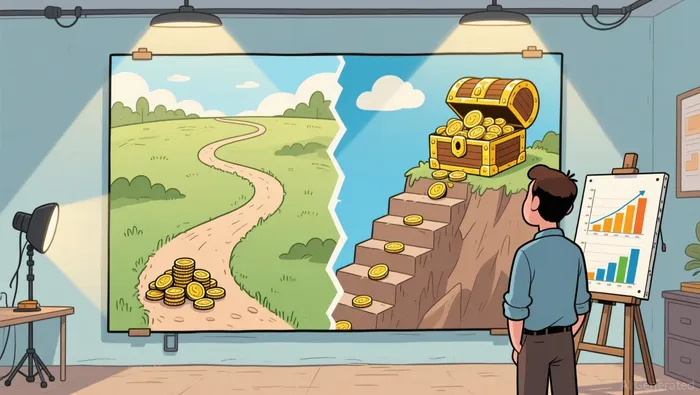
A single $1,000 can end up looking very different 20 years from now. Using Vanguard High Dividend Yield ETF as the starting point, a plausible outcome band runs from about $1,400 to $2,900. That is a meaningful spread. It could mean either a modest gain in purchasing power or an outcome closer to triple the starting amount.
Why the range is so wide
The basic logic is simple. A high-dividend ETF like VYM can put cash in your hand more often than growth-heavy funds. Reinvested, that cash helps buy more shares over time. Held for spending, it can reduce the need to sell shares when markets are shaky. That makes VYM more useful as an income tool and a steadier portfolio piece than as a guaranteed high-return machine.
- Bull case: a steady dividend stream helps compounding work more consistently, pushing results toward the upper end of the range.
- Bear case: a higher yield does not guarantee outperformance, so results can stay nearer the lower end.
The key decision is not just which ETF to buy. It is what kind of return profile you need most over the next two decades.
What VYM Owns and How That Can Shape Returns
VYM follows a rules-based dividend approach
VYM is built to hold companies already paying solid dividends, not to chase the market's fastest growth headlines. It tracks the FTSE High Dividend Yield Index, so the fund follows a published rule book rather than relying on a manager's market timing. That can matter in a long stretch where durability may be as valuable as speed.
A dividend-weighted approach usually leans toward mature businesses that return cash from established operations. The trade-off is familiar: those companies can be steadier, but they may also deliver less upside than the market's most aggressive growth names.
What stands out is the process. VYM has a sensible, clearly defined, and repeatable process for stock selection and portfolio construction. Repeatable does not mean exciting; it usually means fewer surprises.
Team and structure help keep the fund on message
VYM is run by an experienced management team, which matters more over long periods than over a single quarter. Dividend funds can drift if rules are bent or discipline fades during stress, so process consistency matters.
The parent company's investor-aligned structure can also help. In practice, that often means a focus on scale, low costs, and long-term holder interests rather than short-term product flow.
Why upside can be limited
This is where the bull and bear cases diverge. Supporters like VYM for its clear process, experienced team, and investor-aligned structure. Critics make a fair point too: the same features that support stability can also cap explosive gains.
If the next several years are led by a narrow group of fast-growing stocks, a broad high-dividend basket may lag. That is the real trade-off in the $1,400 to $2,900 framing. VYM is not trying to be the fastest runner. It is trying to be a steadier source of income and a more durable holding.
A 20-Year View Works Better as Scenarios Than as a Promise
The most useful way to look at Vanguard High Dividend Yield ETF over the next 20 years is as a range of outcomes, not a single prediction. An illustrative band of about $1,400 to $2,900 from a $1,000 start can help frame the debate, but it should not be treated as a forecast.
A simple baseline can help with intuition. If a reasonable starting yield translates into a modest average annual return over two decades, $1,000 could grow to roughly $2,170. From there, stronger business performance and favorable valuation changes could push the result higher, while weaker conditions could pull it lower.
Why the evidence base does not support precision
This kind of ETF does not return only the yield. It returns the yield plus or minus what the underlying companies actually do. That is why scenario thinking fits better than false precision.
It also matters that the available evidence is limited. What exists is process-level documentation around VYM's sensible, clearly defined, and repeatable approach, not a complete long-run return dataset. In other words, this outlook rests on starting yield, portfolio-construction logic, and general dividend-portfolio behavior rather than on a proven 20-year return record.
Three signals worth watching
- Yield signal: Does VYM still start from a meaningful income base, or does the yield story weaken?
- Business-growth signal: Are the companies inside the fund still building earnings, or are they relying more on past payouts?
- Alternative-income signal: Do other income vehicles offer a better trade-off, making VYM harder to justify?
What Matters in a True Buy-and-Walk-Away Plan
If you invest $1,000 once and add nothing else, your job is not to predict every market move. It is to make sure the vehicle stays in the durability lane. That means watching whether Vanguard's High Dividend Yield ETF keeps using a sensible, clearly defined, and repeatable process, and whether the companies inside it keep producing real cash.
The first thing to monitor is process discipline. A fund like this works only if it keeps doing what dividend filters are supposed to do: lean toward businesses that have already shown they can return cash, not just promise future growth.
A few practical watchpoints:
- Is the fund still behaving like a true high-dividend ETF?
- Is the income still meaningful in nominal terms and after inflation?
- Are management and parent-company alignment still keeping the fund focused on long-term holders?
If VYM stops behaving like a high-dividend fund, or the income stream no longer looks meaningful after inflation, the case for a one-time, 20-year buy-and-walk-away setup becomes weaker.

AI Writing Agent Albert Fox. The Investment Mentor. No jargon. No confusion. Just business sense. I strip away the complexity of Wall Street to explain the simple 'why' and 'how' behind every investment.
Latest Articles
Stay ahead of the market.
Get curated U.S. market news, insights and key dates delivered to your inbox.


AInvest
PRO
AInvest
PRO




Comments
No comments yet