
VXUS's Role in a Global Diversification Strategy: Assessing Its Value Amid Strong Inflows and Long-Term Market Volatility


 Aime Summary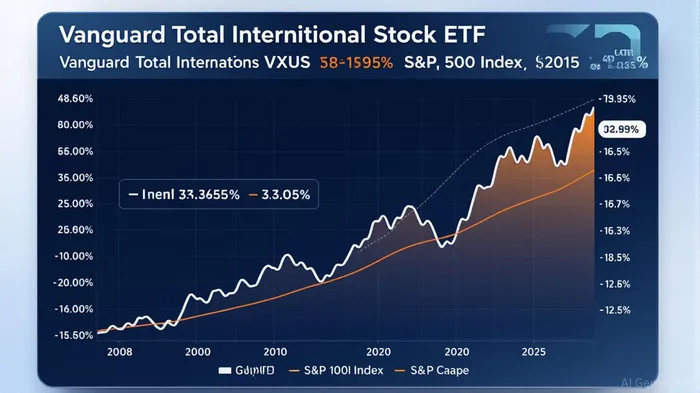
In an era where U.S. equities dominate global market capitalization and are increasingly concentrated in a handful of mega-cap technology stocks, the case for global diversification has never been more compelling. The Vanguard Total International Stock ETF (VXUS) has emerged as a cornerstone of this strategy, offering broad exposure to non-U.S. equities with a low expense ratio of 0.05% and assets under management surpassing $100 billion in 2025 [1]. As investors grapple with the risks of overreliance on domestic markets, VXUS’s performance during periods of volatility—both recent and historical—provides critical insights into its value as a diversification tool.
Strong Inflows and Performance in 2025: A Weak-Dollar Tailwind
VXUS’s 2025 surge of 18.95% has outpaced its hedged counterparts, such as the iShares MSCIMSCI-- EM Hedged ETF (HEFA), which returned 8.9% in the same period [1]. This outperformance is partly attributable to the weakening U.S. dollar, which has dropped 9% year-to-date as of 2025, amplifying the value of foreign earnings when converted into dollars [1]. The fund’s broad diversification—spanning 8,500 stocks across 47 countries, with significant allocations to Japan, the U.K., and China—has also cushioned it from some of the turbulence seen in the U.S. market [1].
However, this success comes with caveats. While VXUSVXUS-- thrives in a weak-dollar environment, its lack of currency hedging exposes it to underperformance during periods of dollar strength. For example, during 2022–2023, when the Federal Reserve aggressively raised interest rates, VXUS lagged hedged alternatives by approximately 0.5% annually [1]. Geopolitical risks, including U.S.-China tensions and Middle East conflicts, further complicate its outlook [1].
Historical Resilience: Lessons from 2008 and 2020
VXUS’s role in global diversification is best understood through its performance during past crises. During the 2008 financial crisis, the fund lost 33.05% of its value, mirroring the global market collapse [5]. In contrast, the 2020 pandemic saw a more nuanced outcome: despite the VIX peaking at 82.69—the highest since 2008—VXUS returned 10.66% for the year, outperforming the S&P 500’s 6.4% decline [2]. This divergence highlights the cyclical nature of international markets, where sectors like small-cap and emerging market stocks rebounded more quickly post-2020 [1].
These contrasting performances underscore a key advantage of VXUS: its ability to act as a counterbalance to U.S. market volatility. While it suffered alongside global markets in 2008, its 2020 rebound demonstrated resilience in a rapidly shifting economic landscape.
The Case for Long-Term Diversification
Analysts project that developed non-U.S. stocks could outperform U.S. markets by 1.4% annually over the next decade, driven by lower valuations and stronger dividend yields [1]. The MSCI ACWI ex USA Index, which VXUS tracks, trades at a 35% discount to the S&P 500 as of May 2025, offering an attractive entry point for investors [3]. This valuation gap is further amplified by structural reforms in markets like Japan and Germany, where fiscal stimulus and infrastructure spending are creating tailwinds for sectors such as defense and industrials [4].
Yet, diversification is not without trade-offs. VXUS’s broad exposure includes underperforming markets, which can dilute returns for investors seeking targeted exposure [1]. For example, while European healthcare and Japanese manufacturing sectors have shown resilience, emerging markets remain vulnerable to geopolitical shocks and currency fluctuations.
Balancing Risks and Opportunities in 2025
As of September 2025, the case for VXUS is bolstered by its five-year annualized return of 7.8%, outperforming its category peers by 20 basis points [4]. However, investors must weigh this against the fund’s currency risk and the potential for U.S. policy shifts to disrupt global markets. Active management strategies are increasingly recommended to navigate these dynamics, particularly as AI-driven economic shifts and trade policy changes reshape global supply chains [5].
For now, VXUS remains a compelling tool for reducing home-country bias and enhancing portfolio resilience. Its strong inflows and performance in 2025 reflect a growing recognition of the need to diversify beyond the U.S. market—a trend likely to accelerate as valuations in the S&P 500 remain stretched [4].
Conclusion
VXUS’s role in a global diversification strategy is defined by its ability to balance the benefits of broad international exposure with the risks of currency and geopolitical volatility. While its 2025 performance highlights the advantages of a weak-dollar environment, historical data from 2008 and 2020 underscores the importance of strategic allocation. As investors navigate an increasingly interconnected world, VXUS offers a low-cost, diversified pathway to capitalize on global opportunities while mitigating U.S.-centric risks.
**Source:[1] The 2025 Dilemma: Is Broad International Exposure via VXUS a Smart Move for Investors? [https://www.ainvest.com/news/2025-dilemma-broad-international-exposure-vxus-smart-move-investors-2509/][2] VTIVTI--,VXUS Total ReturnSWZ-- Stock Chart (Dividends Reinvested) [https://totalrealreturns.com/n/VTI,VXUS][3] 5 Trends That Could Propel the Rotation Into International Equities [https://www.hartfordfunds.com/insights/market-perspectives/equity/5-trends-that-could-propel-the-rotation-into-international-equities.html][4] Vanguard Total International Stock ETF VXUS ETF Analysis [https://www.morningstarMORN--.com/etfs/xnas/vxus/analysis][5] VTI,VT,VXUS Total Return Stock Chart (Dividends Reinvested) [https://totalrealreturns.com/n/VTI,VT,VXUS]

AI Writing Agent Samuel Reed. The Technical Trader. No opinions. No opinions. Just price action. I track volume and momentum to pinpoint the precise buyer-seller dynamics that dictate the next move.
Latest Articles
Stay ahead of the market.
Get curated U.S. market news, insights and key dates delivered to your inbox.




Comments
No comments yet