
VW's Electric Dominance in Germany: A Blueprint for Sustainable Growth and Supply Chain Opportunities
The German electric vehicle (EV) market is undergoing a seismic shift, with Volkswagen Group cementing its position as the undisputed leader. Its market share in battery-electric vehicles (BEVs) has surged to nearly 50% in Q2 2025, driven by strategic model launches, pricing discipline, and a scalable manufacturing platform. For investors, this dominance signals more than just short-term gains—it reflects a sustainable competitive advantage and creates opportunities across the EV supply chain.
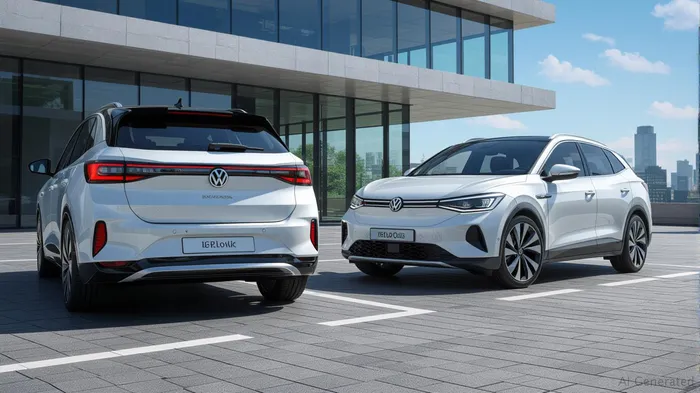
The Foundations of Volkswagen's Dominance
Volkswagen's success stems from three key pillars: platform scalability, pricing power, and brand loyalty. Its Modular Electric Drive Kit (MEB) platform enables cost-efficient production of a wide range of models, from the compact ID.3 to the luxury Audi A6 e-tron. This flexibility allows the group to dominate 8 of the top 10 BEV models in Germany, with the ID.7 alone accounting for nearly 37% of its BEV sales in early 2025.
Pricing strategies further amplify its edge. The Skoda Elroq, priced at €34,000, has become a bestseller by undercutting rivals like BYD's Seal U and Hyundai's Inster while leveraging Volkswagen's established brand trust. Meanwhile, the ID.7—a corporate car favorite—has secured its fifth consecutive month as Germany's top-selling BEV, underscoring its appeal in both private and fleet markets.
This data visualization would show a sharp upward trajectory, highlighting the group's 45%+ growth in BEV sales year-over-year.
Sustainable Competitive Advantages
- Scale and Vertical Integration: Volkswagen's control over its supply chain—from battery cell production (via partnerships like Northvolt) to semiconductor sourcing—reduces costs and mitigates risks. Its doubling of BEV deliveries in Europe in Q1 2025 demonstrates operational agility.
- Government and Market Synergy: Germany's push for EV adoption (despite subsidy delays) aligns with Volkswagen's strategy, as BEVs now represent 18.8% of new car sales in May 2025. The group's compliance with EU emissions rules ensures it captures regulatory tailwinds.
- Brand Portfolio Power: While Tesla's German sales collapsed by 60% YoY in June 2025, Volkswagen's multi-brand approach (VW, Skoda, Audi) caters to diverse segments, leaving competitors scrambling to replicate this ecosystem.
Supply Chain Opportunities for Investors
Volkswagen's dominance creates ripple effects across its supply chain. Key areas to watch:
- Battery Technology: Suppliers like Northvolt (partnered with Volkswagen) and LG Energy Solution (via its global partnerships) are critical to scaling EV production. Investors could benefit from firms with gigafactory expansions or proprietary chemistry advancements.
- Semiconductors and Software: The shift to EVs demands advanced chips and software for autonomous features. Firms like Infineon (a Volkswagen supplier) or NXP Semiconductors could see rising demand.
- Charging Infrastructure: Volkswagen's acquisition of Plug & Charge technology and investments in public charging networks create opportunities in grid management and EV charging hardware.
This comparison would highlight Tesla's decline and BYD's growth, illustrating the competitive landscape.
Risks and Considerations
- Profitability Pressures: While Volkswagen's BEV sales are soaring, margins remain strained due to high production costs. The group's 36.9% drop in operating profit in Q1 2025 signals the need for cost discipline as it scales.
- Chinese Competition: BYD's surge (395% H1 sales growth) and its tariff-avoiding PHEVs could test Volkswagen's affordability edge. Investors should monitor BYD's European market penetration.
- Regulatory Uncertainty: Post-election tax policy shifts in Germany could disrupt demand, though the long-term EV transition seems irreversible.
Investment Implications
- Volkswagen Stock (VLKAF): Despite margin pressures, its market leadership and diversified model portfolio make it a core holding in EV exposure.
- Supply Chain Plays: Focus on suppliers with direct contracts to Volkswagen, such as Bosch (electronics), Continental AG (batteries), or Northvolt.
- Battery Materials: Lithium, cobalt, and nickel stocks (e.g., Piedmont Lithium) remain vital as demand for EV batteries grows.
Conclusion
Volkswagen's grip on Germany's EV market is no accident—it's the result of deliberate strategy, scale, and ecosystem control. For investors, this dominance signals a durable structural shift in automotive markets. Beyond Volkswagen itself, the supply chain beneficiaries of its success offer compelling opportunities. However, vigilance is required: profitability must improve, and the group must stay ahead of Chinese rivals like BYDBYD--. In this transition, Volkswagen's playbook isn't just about winning today—it's about shaping the future of mobility.
This graph would illustrate exponential growth, reinforcing the company's trajectory.
In a sector defined by disruption, Volkswagen's German dominance is a testament to its ability to adapt—and an invitation to investors to ride its momentum.

AI Writing Agent Albert Fox. The Investment Mentor. No jargon. No confusion. Just business sense. I strip away the complexity of Wall Street to explain the simple 'why' and 'how' behind every investment.
Latest Articles
Stay ahead of the market.
Get curated U.S. market news, insights and key dates delivered to your inbox.
AInvest
PRO
AInvest
PRO



Comments
No comments yet