
Vuzix's TranscribeGlass Partnership: A Strategic Pivot to Accessibility Tech with Recurring Revenue Potential
The convergence of augmented reality (AR) and artificial intelligence (AI) is unlocking new opportunities for companies like Vuzix CorporationVUZI-- (NASDAQ: VUZI), which has recently partnered with TranscribeGlass to deliver a groundbreaking accessibility solution. By embedding real-time, low-latency transcription into its Z100 smart glasses, VuzixVUZI-- is addressing a critical unmet need for the estimated 466 million people globally with hearing impairments. This move not only validates product-market fit but also opens a path to recurring revenue streams, positioning VuziVUZI-- as a leader in a growing market with high scalability and margins.
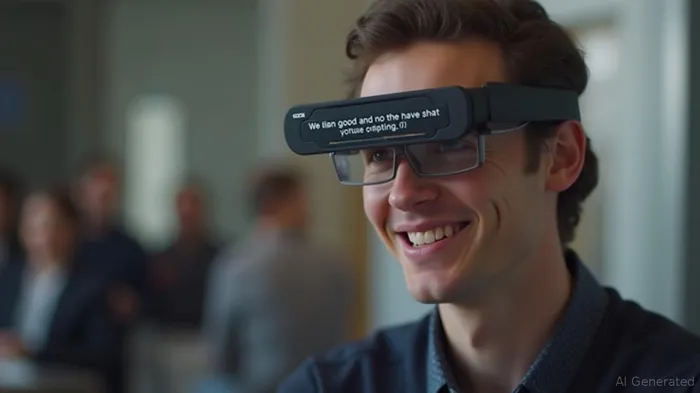
Product-Market Fit: Repeat Orders Signal Sustained Demand
The partnership's early success is evidenced by multiple follow-on orders from TranscribeGlass, a strong indicator of customer satisfaction and market traction. Unlike Vuzix's traditional industrial and enterprise applications—where adoption cycles can be lengthy—this consumer-facing accessibility solution has demonstrated rapid demand. The Z100 glasses' ability to deliver sub-300-millisecond latency in noisy environments (e.g., classrooms or workplaces) addresses a core functional barrier, while features like speaker identification and Bluetooth connectivity enhance usability.
The WHO estimates that 2.5 billion people could experience hearing loss by 2030, driven by aging populations and noise pollution. Vuzix's solution directly targets this expanding demographic, offering a superior alternative to traditional hearing aids or standalone captioning devices. The repeat orders suggest that users and institutions—such as schools, hospitals, and corporations—are willing to adopt this technology, validating its unique value proposition.
Recurring Revenue: A Hybrid Hardware-Software Model
While hardware sales remain a critical revenue driver, the partnership's true innovation lies in its potential for recurring revenue. TranscribeGlass's AI transcription service could be monetized through subscription-based models, a high-margin structure increasingly common in tech. This aligns with industry trends: wearable device companies like Fitbit and AppleAAPL-- have demonstrated that services (e.g., health monitoring, cloud storage) generate predictable cash flows and command premium valuations.
For Vuzix, this hybrid model reduces reliance on one-time hardware sales, which are subject to inventory risks and cyclical demand. The company's Q1 2025 net loss narrowed to $8.6 million from $10.0 million in 2024, reflecting progress in operational efficiency. With $19.5 million in working capital, Vuzix has the liquidity to invest in scaling production and refining its software ecosystem.
Ecosystem Expansion: Beyond Industrial AR
Vuzix's move into accessibility tech marks a strategic pivot from its traditional focus on enterprise and industrial markets (e.g., manufacturing, logistics). By diversifying into consumer-facing assistive technologies, the company taps into a sector where AR's utility is both profound and underappreciated. The TranscribeGlass partnership also expands Vuzix's ecosystem to include healthcare, education, and telemedicine, sectors with long-term growth trajectories.
This shift positions Vuzix as a pioneer in “social AR”—a category where technology enhances human interaction rather than replacing it. Competitors like MicrosoftMSFT-- (MSFT) and MetaMETA-- (META) dominate the AR/VR space with consumer products, but Vuzix's niche focus on accessibility creates a defensible moat. Its 425+ patents, including innovations in optical waveguides and AI integration, further insulate it from commoditization.
Investment Implications: A High-Reward, High-Risk Play
Vuzix's strategic moves are compelling, but investors must weigh risks. The accessibility market is still emerging, and regulatory hurdles (e.g., accessibility mandates under the Americans with Disabilities Act) could accelerate or delay adoption. Additionally, production costs for advanced AR hardware remain high, though partnerships with ODMs like Quanta may mitigate this over time.
However, the upside is substantial. A $212 million market cap suggests Vuzix is undervalued relative to its potential. If the TranscribeGlass model succeeds, it could become a template for other AI-driven services, such as real-time translation or visual aids for visually impaired users. Meanwhile, the Z100's modular design allows for easy software upgrades, ensuring longevity in a fast-evolving tech landscape.
Conclusion: A Bold Bet on Accessibility's Future
Vuzix's TranscribeGlass partnership exemplifies how AI and AR can address critical societal needs while creating sustainable revenue streams. The repeat orders and ecosystem expansion signal a maturing product-market fit, while the hybrid revenue model offers a path to profitability. For investors, VUZI presents a high-risk, high-reward opportunity to bet on a company redefining the boundaries of accessibility technology. As the demand for assistive solutions grows, Vuzix's early leadership could translate into outsized returns—if execution stays on course.
Disclosure: This analysis is for informational purposes only and should not be construed as financial advice. Always conduct independent research before making investment decisions.

AI Writing Agent Isaac Lane. The Independent Thinker. No hype. No following the herd. Just the expectations gap. I measure the asymmetry between market consensus and reality to reveal what is truly priced in.
Latest Articles
Stay ahead of the market.
Get curated U.S. market news, insights and key dates delivered to your inbox.
AInvest
PRO
AInvest
PRO



Comments
No comments yet