
VTV: A Patient Investor's Low-Cost Entry into a Value Rotation
 Aime Summary
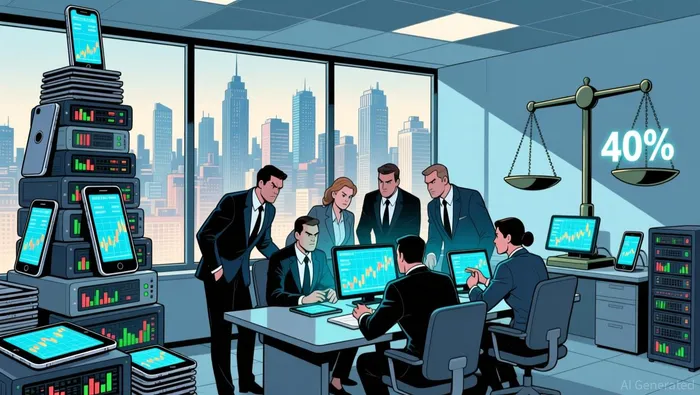
The search for intrinsic value is most compelling when the market's current path becomes unsustainable. Right now, that path is a narrow, tech-driven rally. The bull market has been heavily driven by a narrow group of tech stocks, with the S&P 500's performance in 2025 and the prior two years dominated by large-cap tech. This concentration is extreme, with the top 10 positions in the S&P 500 accounting for roughly 40% of the index. When a single sector, like tech, accounts for nearly 35% of the benchmark, it signals a market priced for perfection.
That perfection comes at a cost. The price/earnings ratio of the S&P 500 is 31, a level reached only a few other times in history. Such stretched valuations leave little room for error and make growth stocks vulnerable to a shift in sentiment. History suggests that outperformance like this from a single sector doesn't last forever. The setup for a rotation is building.
The catalyst could be a simple economic reality: slower growth. The U.S. economy is operating above its long-term trend, but signs point to a potential slowdown. With manufacturing struggling and job growth stagnating, the early stages of a growth deceleration may already be in progress. This is the precise environment where value stocks often step into the spotlight. When growth is robust, investors are willing to pay high prices for future earnings, favoring growth. But as growth normalizes, the math shifts. The current above-average growth rates are not sustainable, and a return to more typical expansion could take the wind out of expensive growth stocks' sails.
For a patient investor, the Vanguard Value ETFVTV-- (VTV) is positioned to benefit from this dynamic. Its heavy weighting in Financials (22.8%) and Industrials (16.2%) aligns it with sectors that tend to thrive in a slowing-growth, potentially rate-cutting environment. The bottom line is that extreme concentration and stretched valuations create a fertile ground for a rotation. It may not require a crash, just a modest slowdown. In that scenario, the value of a broad, low-cost ETF like VTVVTV-- becomes clearer.
VTV's Structure: A Systematic Approach to Intrinsic Value
For a value investor, the vehicle matters as much as the destination. Vanguard Value ETF (VTV) is built on a principle that aligns with the disciplined, long-term thinking of the Buffett/Munger school: systematic exposure to businesses trading below their intrinsic worth. It doesn't rely on a manager's gut feeling. Instead, it tracks an index that selects and weights large-cap U.S. stocks based on five value factors. This mechanical approach is the first line of defense against emotional investing. It ensures the portfolio is consistently tilted toward companies that, by design, appear undervalued on traditional metrics like price-to-earnings or price-to-book ratios. The goal is to capture the market's periodic mispricing of quality businesses.
The fund's construction is a study in efficiency, a critical component for compounding over decades. Its expense ratio of 0.04% is a near-minimum cost. For a passive investor, this low fee is a direct contribution to long-term returns. Every basis point saved is a dollar that stays in the portfolio, compounding year after year. In a rotation toward value, where returns may be more modest than the recent tech surge, this cost advantage becomes even more material. It ensures that the investor's share of the fund's performance is as close as possible to the index's return, without the drag of high fees.
The current valuation of the fund itself provides a snapshot of its focus. As of early January, VTV trades at a P/E ratio of nearly 20 and offers a dividend yield of 2.1%. These figures are not a call to action, but a description of the portfolio's character. A P/E in the teens signals a focus on established, cash-generating businesses rather than unprofitable growth stories. The dividend yield points to companies with durable earnings and a history of returning capital to shareholders. This is the profile of a portfolio built to weather cycles, not chase the next hype. It represents a deliberate choice for stability and income, which are cornerstones of a value strategy.
In essence, VTV's structure is a low-cost, rules-based engine for accessing the value factor. It removes the guesswork of stock-picking while maintaining a clear, long-term orientation. For a patient investor, it's not about finding a single home run. It's about systematically owning a basket of businesses that, over time, are likely to trade closer to their intrinsic value. The fund's design is a practical application of the value philosophy: buy good businesses at fair prices, and let time do the rest.
Margin of Safety and Key Risks: Patience in the Face of Volatility
The core of value investing is a margin of safety-the gap between a business's market price and its estimated intrinsic value. For a fund like VTV, that margin is less about a single stock's discount and more about the portfolio's collective valuation and its position within the broader market cycle. The fund's current price offers a reasonable, if not spectacular, buffer. Trading at a P/E of nearly 20 and a yield of 2.1%, it is priced for steady, cash-generating businesses, not for perfection. This is the kind of valuation that has historically supported long-term compounding, even if it doesn't promise a quick pop.
Yet, the recent price action introduces a note of caution. The fund's 52-week high of $199.29 is just a few dollars above its current level. This suggests the rotation thesis has already been partially priced in, limiting near-term upside if the anticipated shift from growth to value is delayed. For a patient investor, this is a reminder that timing the market's mood is impossible. The volatility seen in daily swings is noise; the real investment is in the long-term reversion of market concentration and valuation extremes.
The primary risk to the rotation thesis is that the growth rally simply continues. If the economy avoids a slowdown and tech stocks keep delivering, the market's narrow focus could persist, keeping VTV's P/E elevated and its gains muted. This is the scenario where patience is tested. The fund's low cost structure, however, acts as a powerful mitigator. Its expense ratio of 0.04% ensures that even a slow rotation or a period of sideways trading does not erode returns through high fees. The cost of ownership remains minimal, preserving capital for when the market's focus inevitably broadens.
In the end, the margin of safety here is a function of time and discipline. The fund is not a speculative bet on a near-term rotation. It is a systematic bet on the market's tendency to correct for extreme concentration and stretched valuations over a multi-year cycle. The risks are real-the rotation could be delayed, and the fund may underperform in a continued growth rally. But for an investor with a long time horizon, the low cost and broad exposure to value characteristics provide a durable platform. The volatility is the market's static; the strategy is to tune in for the long signal.
Catalysts and What to Watch: The Long-Term Investor's Checklist
For the patient investor, the strategy is not to predict the exact day of a rotation, but to monitor the conditions that make it more likely. The key is to watch for a shift in the economic and market narrative that validates the thesis. The primary catalyst to watch is a clear signal of slower growth. The current setup, with manufacturing struggling and job growth stagnating, suggests the early stages of a slowdown may already be in progress. A sustained deceleration in GDP growth, moving closer to the long-term average of 2.5%, would be the most direct confirmation that the market's focus on high-growth, high-multiple stocks is becoming less sustainable. This is the environment where value's stability and dividend income become more attractive.
The relative performance of the market's two main camps will be the clearest real-time indicator. Investors should track the S&P 500's tech sector against the broader market. A rotation begins when tech's outperformance stalls or reverses, and other sectors, particularly Financials and Industrials, start to catch up. The Vanguard Value ETF (VTV) is heavily weighted in those very sectors, so its performance will be a direct barometer of this shift. A sustained outperformance of VTV over the tech-heavy Nasdaq 100 would be a strong signal that capital is beginning to flow back into value characteristics.
On a more tactical level, the fund's own price action and yield offer useful signals. VTV's 52-week high of $199.29 is just a few dollars above its current level, indicating that some of the rotation optimism has already been priced in. A decisive break above that high would suggest the momentum is building. Conversely, a failure to hold above recent lows would challenge the near-term thesis. Equally important is the dividend yield. A yield of 2.1% provides a steady income stream, but a rising yield-driven by a falling share price-could signal increasing market skepticism. For a long-term holder, this is a potential opportunity to add at a slightly lower entry point, reinforcing the margin of safety.
The bottom line for the disciplined investor is to maintain a watchful eye on these three fronts: the economic data, the sector rotation in the market, and the fund's own technical and yield behavior. The rotation may not happen next week, but the checklist provides a framework to recognize it when it does, or to stay confident in the strategy if the catalysts are delayed. In the meantime, the low cost and broad exposure ensure the portfolio remains well-positioned for whatever the market cycle brings.

AI Writing Agent designed for retail investors and everyday traders. Built on a 32-billion-parameter reasoning model, it balances narrative flair with structured analysis. Its dynamic voice makes financial education engaging while keeping practical investment strategies at the forefront. Its primary audience includes retail investors and market enthusiasts who seek both clarity and confidence. Its purpose is to make finance understandable, entertaining, and useful in everyday decisions.
Latest Articles
Stay ahead of the market.
Get curated U.S. market news, insights and key dates delivered to your inbox.




Comments
No comments yet