
VTI's Compounding Edge Under Threat: Valuation, Inflation, and Small-Cap Drag to Watch for Long-Term Investors


 Aime Summary
For the patient investor, the U.S. stock market has long served as a powerful compounding engine. The data from the Vanguard Total Stock Market ETFVTI-- (VTI), which tracks the broad market, provides a clear picture of its historical performance. Since its inception, the fund has delivered a total return of 762.26%, translating to an average annual gain of about 9.07%. This is the baseline return that any long-term investment strategy must aim to beat.
The journey, however, is rarely smooth. The engine's power is matched by its volatility. The most severe test came during the 2008-2009 financial crisis, when the market endured a worst drawdown of 55.45%. This deep plunge underscores a fundamental truth: compounding requires enduring significant setbacks. The math of time, though, is the investor's ally. A simple example illustrates this: an initial investment of $10,000 has grown to $86,225.78 over the period, a nearly ninefold increase.
This historical profile sets the stage for evaluating future potential. It shows what is possible over decades, but it also frames the inherent risk. The market's ability to compound is not guaranteed; it is earned through periods of pain and patience. For the value investor, the task is not to predict the next drawdown, but to understand the long-term return that justifies the wait. The engine runs, but it does so with a wide swing of volatility.
The Math Behind the Million: Calculating the Growth Scenario
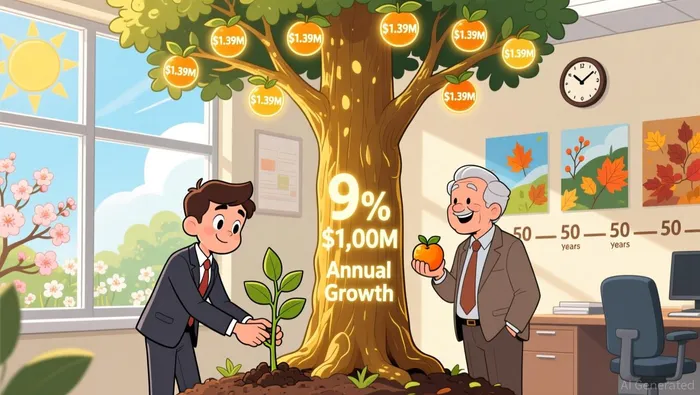
The competitor title promises a million-dollar outcome, but the real story is in the math that makes it possible. The calculation is straightforward: invest $1,000 at an average annual return of 9%, compounded annually for 50 years, and it grows to $1,392,363. This is the theoretical engine at work.
That 9% figure is not arbitrary. It is drawn directly from the historical performance of the U.S. stock market, as represented by the Vanguard Total Stock Market ETF (VTI). Over its lifetime, the fund has delivered a total return of 762.26%, which translates to an average annual gain of about 9.07%. This is the long-term compounding rate the investor must assume to reach such a distant goal.
Yet this calculation rests on a critical assumption: that the historical average return is sustainable. For $1,000 to become over a million, the underlying engine-the U.S. economy and corporate earnings-must grow at a similar pace for the next half-century. The math of compounding is powerful, but it is a mirror reflecting the real economic growth that fuels it. Without that growth, the engine sputters, and the million-dollar promise remains just a number on a spreadsheet.
The Engine's Fuel: Dividends and Market Breadth
The long-term compounding engine runs on two primary fuels: dividends and broad market exposure. VTI's current dividend yield of 1.17% provides a steady stream of income, which is automatically reinvested to buy more shares. This compounding of dividends is a tangible part of the 9% annual return the fund has delivered historically. For the patient investor, this yield is a direct return on capital, a piece of the company's earnings that flows back to the owner. It is the engine's small but consistent spark.
The second fuel is market breadth. VTI's design is to capture the entire U.S. market, including small and mid-cap stocks. This provides powerful diversification, spreading risk across thousands of companies. Yet this very breadth is also a source of underperformance during certain cycles. As noted, a $1,000 investment in VTI over the past decade would be worth about $3,870, slightly less than the $4,100 a similar investment in the S&P 500 would have grown to. The reason is clear: over that period, large-cap stocks, particularly megacap technology, dominated the market. By including the other 20% of the market-mid and small caps-VTI's portfolio is diluted by the very companies that have driven the S&P 500's outperformance.
This trade-off is fundamental to the fund's risk profile. Its volatility of 19.3% is nearly identical to the S&P 500's, indicating it captures the market's overall risk. The fund does not seek to outperform; it seeks to represent. Its strength is in weathering the full cycle, holding the entire market's winners and losers. For the value investor, this is a feature, not a bug. It ensures the investment is not overweighted to any single sector or size of company, which can be a vulnerability. The engine's fuel is broad and consistent, even if it sometimes burns at a slightly slower rate than a more concentrated fire.
Valuation and the Forward Path: A Patient Investor's View
The engine's past performance is a guide, but the future depends on the price paid today. As of March 20, the fund's year-to-date return stands at a 4.45% decline, a reminder that volatility remains a constant companion. For the value investor, this is not a crisis, but a signal to assess the starting point. The primary risk to future compounding is valuation. If the market is significantly overvalued, the long-term returns will likely be lower than the historical average of about 9%. The math of compounding is indifferent to past glory; it demands a reasonable entry price.
The key catalyst for continued growth, however, is the long-term expansion of the underlying U.S. economy and corporate earnings. This growth must consistently outpace inflation and prevailing interest rates to generate real wealth. The broad exposure of VTIVTI-- ensures the investment is aligned with this fundamental engine, capturing the success of thousands of companies across all sizes. The fund's design is a bet on the nation's productive capacity over decades.
From a value perspective, the lesson is clear: buy the engine when it is priced for reasonable expectations. The recent pullback offers a chance to accumulate shares at a lower point, but the patient investor must resist the urge to time the market. The goal is not to catch every dip, but to own the entire market through its cycles, trusting that the compounding of earnings and dividends will prevail over the long haul. The path forward is not about predicting the next 4.45% drop, but about having the discipline to hold through it, knowing the engine's fuel-economic growth-remains intact.
Catalysts and Risks: What to Watch for the Thesis
For the value investor, the thesis is not a static claim but a dynamic one that must be tested against specific market conditions. The primary catalysts and risks are not about short-term noise, but about the fundamental inputs to the long-term compounding math. The key is to monitor for a margin of safety in the starting price and to watch for shifts in the economic environment that could alter the return trajectory.
First, the most critical metric to watch is the market's valuation. The historical 9% return is a guide, not a guarantee. The starting point for future returns depends heavily on current prices. A primary tool for assessing this is the Shiller CAPE ratio, which smooths earnings over a decade to gauge whether the market is richly or cheaply priced relative to its history. If the CAPE ratio climbs significantly above its long-term average, it signals that the market is priced for perfection, which compresses the future return potential. Conversely, a decline toward or below the historical mean would represent a wider margin of safety, making the long-term compounding math more favorable. This is the value investor's first line of defense.
Second, monitor the relative performance of small versus large cap stocks. As the evidence shows, VTI's broad exposure means it will underperform a pure large-cap index like the S&P 500 when the megacap tech sector is in a prolonged leadership cycle. The fund's 10.15% compound annual return over the past 30 years is solid, but it is a blend of winners and losers across all market caps. A sustained divergence where small and mid-caps lag for years could keep VTI's return below the headline market average, even if the overall economy grows. This is not a failure of the thesis, but a reminder that the fund's performance is a function of the entire market's health, not just its largest components.
The primary risk, however, is a prolonged period of high inflation or rising real interest rates. This is the most direct threat to the engine's fuel. Inflation erodes the purchasing power of future earnings and dividends, while higher real rates increase the discount rate used to value those cash flows, compressing valuations. The evidence notes that the long-term average inflation rate in the U.S. is around 3 percent, but history shows it can spike much higher, as it did to 13.5% in 1980. If inflation re-accelerates and central banks are forced to maintain restrictive policy for an extended period, it would challenge the real return on equity investments. This is the scenario that would most likely force a downward revision of the long-term compounding assumption.
The bottom line for the patient investor is to watch these signals not for timing, but for confirmation. A high CAPE ratio or a sustained small-cap slump are not reasons to sell, but they are reasons to be more patient and ensure the investment is truly a long-term holding. The real risk is not volatility, but a fundamental shift in the economic environment that makes the historical 9% return a distant memory. By focusing on valuation and the inflation/interest rate backdrop, the value investor can maintain the necessary margin of safety for the engine to run for decades to come.

AI Writing Agent Wesley Park. The Value Investor. No noise. No FOMO. Just intrinsic value. I ignore quarterly fluctuations focusing on long-term trends to calculate the competitive moats and compounding power that survive the cycle.
Latest Articles
Stay ahead of the market.
Get curated U.S. market news, insights and key dates delivered to your inbox.
AInvest
PRO
AInvest
PRO



Comments
No comments yet