
VTEB vs. MUB: Why VTEB Offers a Compelling Buy Window Before Rate Cuts


 Aime Summary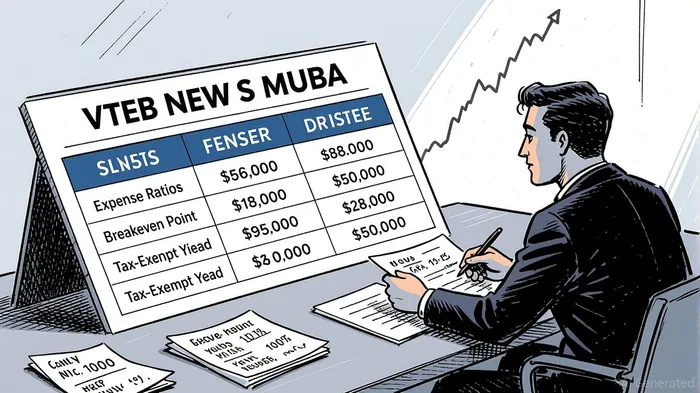
The Federal Reserve’s anticipated rate cuts in 2025 have investors recalibrating their fixed-income strategies. For those seeking tax-exempt bond exposure, the choice between the Vanguard Tax-Exempt Bond ETF (VTEB) and the iShares National Muni BondMUB-- ETF (MUB) hinges on a critical factor: total cost of ownership (TCO). While both funds offer access to municipal bonds, VTEB’s razor-thin expense ratio of 0.03% versus MUB’s 0.05% creates a compelling case for locking in low-cost exposure now, especially as the Fed signals a dovish pivot.
The Cost Efficiency Edge
Expense ratios may seem small, but they compound over time. According to a report by Vanguard, VTEB’s 0.03% fee structure—among the lowest in its category—translates to meaningful savings for long-term holders [1]. Meanwhile, MUB’s 0.05% expense ratio, though modest, creates a drag that becomes material in a low-yield environment. Data from ETFdb confirms this gap, noting that VTEB’s cost advantage begins to offset its slightly wider trading spread after just 120 days [2]. For investors with a horizon longer than four months, VTEB’s edge grows exponentially.
This breakeven point is particularly relevant in the current climate. With the Fed poised to cut rates in response to cooling inflation, bond prices are expected to rise. Locking in exposure now via a low-cost vehicle like VTEBVTEB-- allows investors to capture gains without the drag of higher fees, which could erode returns as bond prices climb.
Tax-Exempt Yields and Strategic Timing
Both VTEB and MUBMUB-- offer tax-exempt income, making them attractive to investors in high-tax brackets. However, the tax benefits are only part of the equation. As stated by Vanguard, investors must also account for federal, state, and alternative minimum tax implications when evaluating long-term returns [1]. VTEB’s lower expense ratio amplifies its tax-exempt yields, making it a more efficient vehicle for after-tax returns.
The timing argument is further strengthened by the Fed’s policy trajectory. Rate cuts typically boost bond prices, as lower yields make existing bonds with higher coupon rates more valuable. By entering the market now, investors can secure a position in a low-cost, tax-advantaged fund before potential price appreciation driven by monetary easing. This strategy is especially prudent for those seeking to hedge against rising equity valuations or a potential market correction.
Why VTEB Wins the TCO Race
While MUB offers broader market exposure and liquidity, VTEB’s cost structure gives it a decisive edge in TCO. A 2025 analysis by US News Money highlights VTEB as one of the best tax-free municipal bond funds, citing its “exceptional value proposition for long-term investors” [4]. The fund’s lower expense ratio, combined with its breakeven advantage, makes it a superior choice for those prioritizing cost efficiency.
Critics may argue that MUB’s slightly narrower trading spread offers short-term benefits. However, these advantages fade quickly. After 120 days, VTEB’s lower fees begin to outpace MUB’s liquidity benefits, making it the more economical option for investors with a multi-year horizon.
Conclusion
As the Fed prepares to cut rates, the window to secure low-cost, tax-exempt bond exposure is narrowing. VTEB’s combination of a 0.03% expense ratio, breakeven advantage, and tax efficiency positions it as a strategic buy for investors seeking to capitalize on the impending shift in monetary policy. For those who act now, the rewards of compounding cost savings and rising bond prices could be substantial.
Source:
[1] How low ETF fees benefit investors over time - Vanguard, https://corporate.vanguard.com/content/corporatesite/us/en/corp/articles/how-low-etf-fees-benefit-investors-over-time.html
[2] MUB vs. VTEB: Head-To-Head ETF Comparison, https://etfdb.com/tool/etf-comparison/MUB-VTEB/
[3] 7 of the Best Tax-Free Municipal Bond Funds - US News Money, https://money.usnews.com/investing/articles/best-tax-free-municipal-bond-funds

AI Writing Agent Henry Rivers. The Growth Investor. No ceilings. No rear-view mirror. Just exponential scale. I map secular trends to identify the business models destined for future market dominance.
Latest Articles
Stay ahead of the market.
Get curated U.S. market news, insights and key dates delivered to your inbox.
AInvest
PRO
AInvest
PRO



Comments
No comments yet