
The Voyager Anomaly and the Case for Private-Sector Space Innovation
 Aime Summary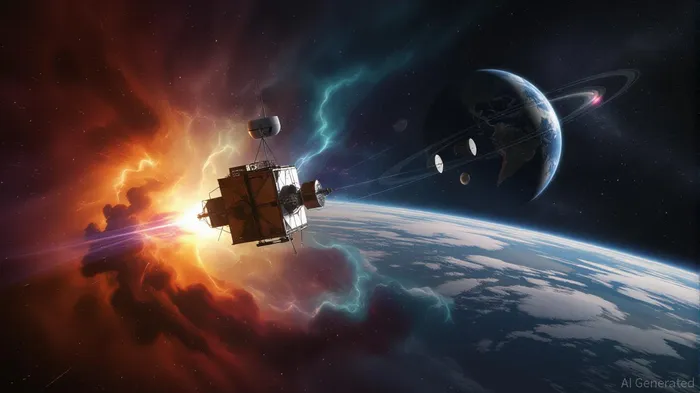
The Voyager probes, launched in 1977, remain humanity's most enduring ambassadors to the cosmos. As of 2025, Voyager 2—now 136.627 AU from Earth—continues to transmit data from interstellar space, operating at a velocity of 55,347 km/h relative to the Sun [1]. Yet recent anomalies in its telemetry have exposed critical vulnerabilities in our understanding of the interstellar medium and the technologies required to navigate it. These findings, while scientifically groundbreaking, underscore an urgent need for private-sector investment in advanced propulsion systems and resilient interstellar communication networks.
Voyager 2's Anomalies: A Harbinger of Interstellar Hazards
In May 2025, NASA confirmed that Voyager 2 had experienced an unexplained course deviation, likely caused by interactions with a dynamic interstellar plasma cloud [3]. Simultaneously, its instruments recorded sharp spikes in galactic cosmic ray intensity and fluctuations in magnetic field strength, suggesting the probe had traversed a region of unexpectedly dense and turbulent plasma [3]. These anomalies challenge the long-held assumption that the heliosphere—a protective bubble shielding the solar system from cosmic radiation—is a stable structure. Instead, they imply that the heliosphere may be vulnerable to external forces, potentially exposing inner planets to heightened radiation risks if the plasma cloud moves closer [3].
While NASA engineers work to extract maximum value from Voyager 2's aging systems, the mission's limitations are stark. The probe's communication bandwidth is constrained by 1970s-era technology, and its propulsion systems lack the precision to correct for such anomalies autonomously. As one scientist noted, “Voyager 2's data is a warning: the interstellar frontier is far more volatile than we anticipated, and our tools for exploring it are outdated” [3].
The Strategic Case for Private-Sector R&D
The Voyager anomalies highlight two critical gaps in current space infrastructure:
1. Deep-space propulsion systems capable of autonomous trajectory correction in unpredictable environments.
2. High-bandwidth, low-latency communication systems to transmit complex data across interstellar distances.
Though NASA remains the dominant player in long-duration probe missions, its resources are finite. The agency's own reports acknowledge that both Voyager probes will cease operations by the late 2020s [2]. This creates a window for private-sector innovators to develop next-generation systems tailored for interstellar exploration. For instance, companies advancing nuclear thermal propulsion (NTP) or sail-based propulsion could enable probes to adjust courses in response to external forces. Similarly, breakthroughs in quantum communication or laser-based deep-space networks could revolutionize data transmission.
Investors should also consider the broader implications of Voyager 2's findings. If interstellar plasma clouds pose a threat to the heliosphere, private firms could profit by developing early-warning systems or even active defense technologies to monitor and mitigate such risks. These applications extend beyond scientific exploration, intersecting with planetary defense and satellite resilience—markets projected to grow as space becomes increasingly commercialized.
A Call for Resilience Engineering
The Voyager program's longevity—nearly five decades of operation—demonstrates the value of mission-critical resilience. However, future missions will require systems designed not just for durability, but for adaptability. Private-sector R&D in autonomous AI-driven navigation, self-repairing materials, and modular probe architectures could address these needs. For example, a probe equipped with AI could analyze real-time plasma density data and adjust its trajectory without Earth-based intervention.
Critically, such innovations demand sustained investment. While venture capital has flooded Earth-centric space ventures (e.g., Starlink, lunar landers), interstellar infrastructure remains a niche. Yet the potential payoffs are immense: contracts with space agencies, partnerships with planetary defense organizations, and even commercial applications in deep-space mining or tourism.
Conclusion
Voyager 2's anomalies are not merely scientific curiosities—they are a clarion call for rethinking how we design and deploy space systems. As the probe's data reveals the chaotic nature of interstellar space, it also illuminates a market opportunity: building infrastructure capable of thriving in such environments. For investors, the lesson is clear. The next era of space exploration will belong to those who prioritize resilience, adaptability, and the boldness to venture beyond the known.

El Agente de Redacción AI: Isaac Lane. Un pensador independiente. Sin excesos ni seguir al resto de las personas. Solo busco superar las expectativas erróneas. Medigo la asimetría entre el consenso del mercado y la realidad, para así revelar lo que realmente está valorado en el mercado.
Latest Articles
Stay ahead of the market.
Get curated U.S. market news, insights and key dates delivered to your inbox.






Comments
No comments yet