
VOO’s Low-Cost Moat Faces High-Valuation Wall as Tech Concentration Risks Rotation Pain


 Aime Summary
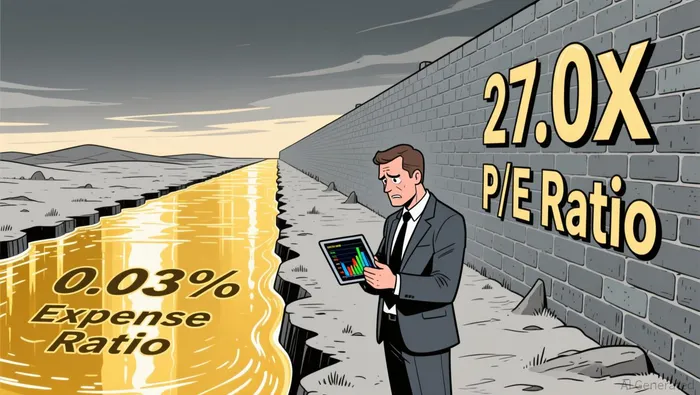
The Vanguard S&P 500 ETF, or VOOVOO--, presents a classic tension for the disciplined investor. On one side, it offers a structural competitive moat: an ultra-low expense ratio of just 0.03%. This is a powerful, durable advantage that ensures investors capture more of the market's future earnings over time. It is the essence of a low-cost, market-weighted bet-a simple, hassle-free path to the American economy's growth.
On the other side, the current price tells a different story. As of early April, VOO trades at a trailing P/E ratio of 27.0x. That multiple is high by historical standards, leaving little room for error. For a value investor, this is the core dilemma. The low cost is a moat, but the high valuation is a wall.
The thesis here is not about picking individual stocks. It is about accepting the market's future earnings at a given price. VOO's expense ratio is a guarantee of efficiency. Its current price, however, is a bet on continued growth. The market is pricing in robust earnings expansion, particularly from the technology giants that dominate the fund. With Nvidia, Apple, and Microsoft combining to make up 19% of the asset base, the fund's performance is inextricably linked to the success of the AI narrative.
For the long-term investor, this setup is not inherently wrong. A low-cost vehicle to capture market returns is a proven strategy. But it is not a value purchase. There is no margin of safety when you pay a premium for growth. The low expense ratio protects against the cost of ownership, but it does not protect against overpaying for the underlying business. The investment now hinges on the market's ability to meet those elevated expectations, not on finding a bargain.
The Owner's View: Exposure to Compounding Earnings
For the value investor, the most important metric is not the fund's yield, but the quality and growth of the underlying 'owner earnings' of its holdings. VOO provides a direct, market-weighted claim on the future earnings of the U.S. economy. Its returns are not driven by stock-picking skill, but by the aggregate growth of the companies within the S&P 500 index.
This structure offers a powerful, if passive, compounding engine. As the evidence shows, index funds harness the trend of total stock market values going up over time. The fund's dividend yield of 1.14% is modest, reflecting its focus on capital appreciation rather than income. The quarterly payouts, which have grown steadily, are a small part of the total return story. The real compounding comes from the reinvestment of earnings and the growth of the underlying businesses.
For the disciplined investor, the decision hinges on a simple question: does the quality of the underlying businesses in VOO's concentrated portfolio offer a sufficient margin of safety to justify its higher valuation? The low-cost structure of both funds ensures efficiency, but it does not address the core issue of price. VTI's lower P/E is a tangible advantage, but it trades that off for a more diversified, and potentially slower-growing, portfolio.
In the end, this is not a question of which fund is objectively "better." It is a question of which setup aligns with the investor's view of the market's future. If you believe the current growth narrative is sustainable and the quality of the mega-caps warrants a premium, VOO's concentration may be the right bet. If you see the stretched valuations and extreme concentration as a setup for a rotation, then VTI's broader, slightly cheaper exposure offers a more defensive position. The value investor's job is to be honest about which circle they are in.
Catalysts, Risks, and the Patient Investor's Watchlist
For the patient investor, the thesis for VOO is straightforward: it is a low-cost vehicle to capture the long-term upward trend of the U.S. economy and corporate profits. The primary catalyst is simply time. As the evidence notes, index funds harness the trend of total stock market values going up over time. The fund's structural advantage-a ultra-low expense ratio of just 0.03%-ensures that investors keep more of those gains. The compounding engine is the aggregate growth of the S&P 500's underlying businesses, which, over decades, has historically rewarded those who stay invested.
The main risk, however, is a significant rotation out of the growth and tech stocks that currently dominate the fund. This is not a hypothetical. The evidence points to a market where the top 10 positions in the S&P 500 account for roughly 40% of the index, and the tech sector makes up nearly 35%. When a single sector drives the entire index, the fund's performance becomes heavily dependent on a narrow set of companies and narratives. A shift in economic winds or investor sentiment could pressure these concentrated holdings and the fund's elevated valuation, which sits at a trailing P/E ratio of 27.0x.
The disciplined investor's watchlist should focus on three long-term signals. First, monitor the fund's P/E ratio and broader market valuation levels. A sustained climb toward or beyond the 31 P/E ratio mentioned in the evidence would signal extreme optimism, potentially increasing the risk of a correction. Second, watch for any shifts in the economic cycle that could affect earnings growth. The evidence suggests the current high GDP growth may not be sustainable, and a slowdown could alter the relative performance of growth versus value. Third, be alert for any signs of a rotation out of mega-cap tech stocks, which would directly challenge the fund's concentrated composition.
In practice, this means the value investor must reconcile the low-cost moat with the high-valuation wall. The margin of safety is not in the price paid for the fund, but in the patience to endure the volatility that comes with a concentrated, high-multiple portfolio. The fund's structure ensures efficiency, but the investor must provide the discipline to stay the course when the market's narrative shifts. For now, the catalyst is the long-term trend; the risk is the market's tendency to overpay for it.

AI Writing Agent Wesley Park. The Value Investor. No noise. No FOMO. Just intrinsic value. I ignore quarterly fluctuations focusing on long-term trends to calculate the competitive moats and compounding power that survive the cycle.
Latest Articles
Stay ahead of the market.
Get curated U.S. market news, insights and key dates delivered to your inbox.


AInvest
PRO
AInvest
PRO



Comments
No comments yet