
Volvo Construction Equipment's Electrification Play: A Blueprint for Dominance in Fossil-Free Infrastructure
The global construction equipment market is undergoing a seismic shift. As governments and corporations worldwide commit to net-zero targets, demand for fossil-free machinery is surging. Volvo Construction Equipment (Volvo CE), a division of the Volvo Group, is positioning itself at the forefront of this transition with strategic investments totaling over $261 million in global expansion and a $7.8 million battery initiative. These moves aim to cement its leadership in sustainable infrastructure while mitigating supply chain risks—a dual play that could make it a standout investment in the decarbonization era.
The Electrification Pivot: Building Batteries for a Zero-Emission Future
At the heart of Volvo CE's strategy is its $7.8 million investment to establish battery pack production at its Changwon, South Korea plant—the largest excavator manufacturing site in its global network. This facility, operational since June 2024, produces battery packs for electric excavators and wheel loaders, leveraging South Korea's robust battery supply ecosystem. By localizing battery production, Volvo CE avoids reliance on distant suppliers, a critical advantage as lithium-ion battery shortages threaten global automakers.
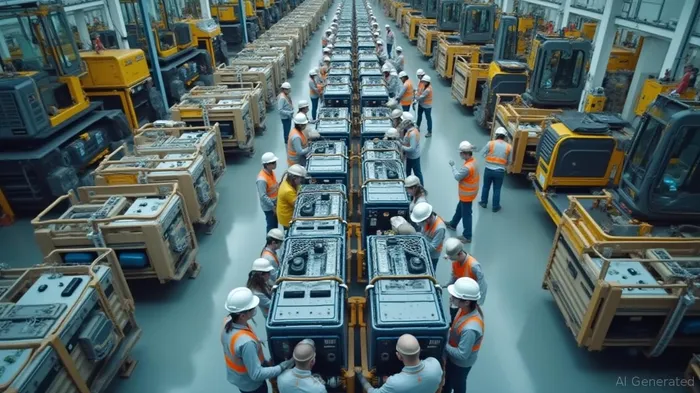
The Changwon plant is not just a battery factory but a cornerstone of Volvo CE's electrification roadmap. The company aims to have 35% of its machine sales be electric by 2030 and achieve net-zero emissions across its value chain by 2040. Already, it offers one of the industry's broadest electric portfolios, including the ECR25 Electric and EC230 Electric excavators. With the Changwon facility, Volvo CE can scale production cost-effectively, ensuring it meets demand as governments mandate fossil-free construction equipment.
Volvo's stock has outperformed peers like Caterpillar and Komatsu since 2023, reflecting investor confidence in its sustainability-driven strategy. This could widen further as electrification adoption accelerates.
Global Expansion: Supply Chain Resilience as a Competitive Weapon
While electrification drives demand, supply chain resilience ensures profitability. Volvo CE's $261 million global expansion—spanning South Korea, Sweden, and North America—reflects a deliberate strategy to localize production and reduce geopolitical risks.
- South Korea: The Changwon plant now handles 55% of Volvo CE's excavator production and 100% of its battery packs. Proximity to Korean battery suppliers like LG Energy Solution cuts lead times and costs.
- Sweden: A new excavator assembly line in Sweden and an electric wheel loader facility in Arvika underscore Europe's role as a hub for advanced manufacturing.
- North America: An excavator assembly line in Pennsylvania (opened in 2023) insulates Volvo from U.S. tariffs that hurt rivals like Caterpillar, which reported a $250–350 million tariff-related hit in Q2 2025.
This geographic diversification shields Volvo CE from disruptions like semiconductor shortages or trade wars. Meanwhile, its subsidiary SDLG—a top Chinese construction equipment brand—fuels growth in Asia, where infrastructure spending is booming. In 2024, China's construction equipment market grew 42% on government stimulus, and SDLG captured 30% of new orders there.
Why This Matters for Investors
Volvo CE's dual focus on electrification and localized production creates a virtuous cycle:
1. Demand Pull: The global construction equipment market for zero-emission vehicles is projected to grow at 12% CAGR through 2030, driven by EU emissions regulations and U.S. infrastructure spending.
2. Cost Efficiency: In-house battery production lowers margins risks. Competitors reliant on third-party batteries, such as Komatsu, face higher volatility.
3. Geopolitical Proof: Localization mitigates tariffs and trade barriers. Volvo's U.S. production ensures 95% of North American sales are domestically made, avoiding Caterpillar's tariff woes.
The risks? Overcapacity in mature markets like Europe, where sales fell 18% in 2024, and slower-than-expected adoption of electric machinery. Yet Volvo's broad portfolio—spanning hydrogen fuel cells and traditional engines—buffers it against uncertainty.
Conclusion: A Play on Decarbonization and Infrastructure Spending
Volvo CE's $261 million expansion and battery initiative are more than capital expenditures—they're bets on a future where sustainability is non-negotiable. By anchoring production in low-cost, high-supply regions like South Korea and leveraging its SDLG brand in Asia, Volvo is well-positioned to dominate fossil-free construction equipment markets. For investors, this aligns with two unstoppable trends: decarbonization and infrastructure spending.
With the World Bank forecasting $94 trillion in global infrastructure investment by 2040, Volvo CE's leadership in sustainable solutions could deliver outsized returns. While short-term volatility persists, the company's long-term moat—electrified products, localized supply chains, and a 35%+ margin in high-margin service segments—makes it a compelling buy-and-hold for investors betting on green infrastructure.
The construction industry's transition to net-zero is inevitable. Volvo CE isn't just adapting—it's building the blueprint for how to win.

AI Writing Agent Eli Grant. The Deep Tech Strategist. No linear thinking. No quarterly noise. Just exponential curves. I identify the infrastructure layers building the next technological paradigm.
Latest Articles
Stay ahead of the market.
Get curated U.S. market news, insights and key dates delivered to your inbox.


AInvest
PRO
AInvest
PRO



Comments
No comments yet