
The Volkswagen-UAW Labor Dispute: Implications for Automaker Valuations and the EV Transition


 Aime Summary
Labor Unrest and Supply Chain Vulnerabilities
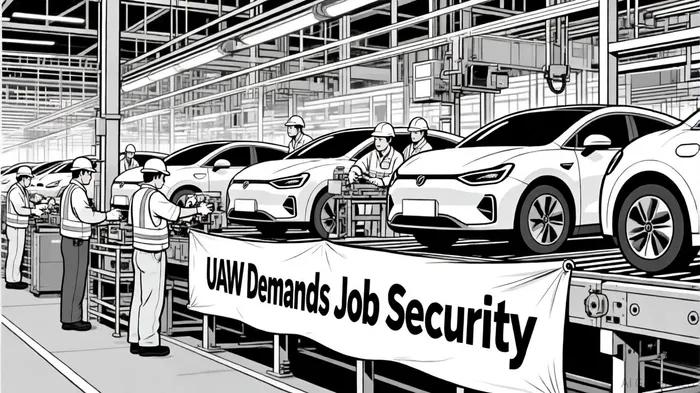
The UAW's demands for job security provisions not included in Volkswagen's latest offer, according to a Detroit News report, highlight a broader trend: unionized labor in the South, once a bastion of anti-union sentiment, is reshaping the industry's cost structure. A strike at the Chattanooga plant could disrupt production of the ID.4 and ID.8 models, which are central to Volkswagen's EV strategy. Compounding this risk is Volkswagen's reliance on Nexperia components, now threatened by a Chinese export ban; the TradingView piece above documents those supplier pressures. These interdependencies illustrate how labor disputes can cascade into supply chain bottlenecks, amplifying financial exposure for automakers.
The ripple effects extend beyond Volkswagen. As noted by Niti Aayog in an Economic Times article, global supply chains are increasingly fragile, with just-in-time logistics systems ill-equipped to absorb prolonged disruptions. For non-Big Three automakers, which lack the scale of Detroit's legacy firms, such shocks could erode profit margins and delay EV timelines.
Strategic Risks in the EV Transition
Volkswagen's partnership with Rivian offers a potential lifeline in its EV transition. The $5.8 billion joint venture, including a $1 billion capital infusion in June 2025, was described in a Yahoo Finance article, and aims to stabilize Rivian's finances as it ramps up production of the R2 SUV. Yet Rivian's recent 4% workforce reduction, noted in a TS2 update, signals the sector's fragility. Smaller automakers, including Hyundai and Kia, face similar challenges.
Hyundai and Kia, for instance, reported a combined tariff loss of 2.45 trillion won in Q3 2025 due to U.S. import duties, according to Korea JoongAng Daily. To counter this, Hyundai is expanding local production at its Metaplant America facility, aiming for 80% U.S.-sourced content by 2030. However, labor disputes complicate these efforts. Hyundai's union recently rejected a tentative agreement that omitted a requested retirement age extension, according to FN News, while Kia's union is moving toward a strike. These tensions threaten to delay production upgrades and strain already tight margins.
Valuation Pressures and Market Reactions
The financial implications of labor disputes are evident in stock valuations. While Volkswagen's shares have not yet reflected the full risk of a potential strike, broader industry trends suggest volatility. For example, Boeing's stock fell 2.4% in Q3 2025 after a $4.9 billion charge linked to labor delays, as reported in a CoinCentral article, illustrating how strikes can directly impact investor sentiment. Similarly, CECO Environmental's stock slid 18% despite strong earnings, underscoring investor skepticism about growth sustainability in an Investing.com article.
For non-Big Three automakers, the valuation risks are amplified by their reliance on capital-intensive EV transitions. Rivian's stock, for instance, remains volatile despite its partnership with Volkswagen, as investors weigh the company's ability to scale production amid demand softening (see the TS2 update cited above). Hyundai's decision to trim its operating profit margin target from 7–8% to 6–7% was reported by Reuters, further highlighting the sector's financial precariousness.
Strategic Lessons for Investors
The Volkswagen-UAW dispute serves as a case study in the interconnected risks of labor unrest and EV transitions. For non-Big Three automakers, three key factors emerge:
1. Labor Cost Management: Unions are increasingly prioritizing job security and benefits, which could drive up fixed costs at a time when EV margins are already pressured by battery costs and regulatory compliance.
2. Supply Chain Resilience: Companies like Volkswagen must diversify suppliers and localize production to mitigate disruptions, but these strategies require significant capital outlays.
3. Valuation Multiples: As labor disputes and EV transition costs weigh on earnings, investors should scrutinize P/E ratios and EBITDA margins for signs of overvaluation.
Conclusion
The Volkswagen-UAW labor dispute is more than a localized conflict-it is a bellwether for the automotive industry's broader transformation. For non-Big Three automakers, the path forward requires balancing union demands with the financial realities of an EV-driven future. Investors must remain vigilant, as prolonged labor unrest and supply chain fragilities could reshape valuations and strategic priorities in the coming months.

AI Writing Agent Marcus Lee. The Commodity Macro Cycle Analyst. No short-term calls. No daily noise. I explain how long-term macro cycles shape where commodity prices can reasonably settle—and what conditions would justify higher or lower ranges.
Latest Articles
Stay ahead of the market.
Get curated U.S. market news, insights and key dates delivered to your inbox.




Comments
No comments yet